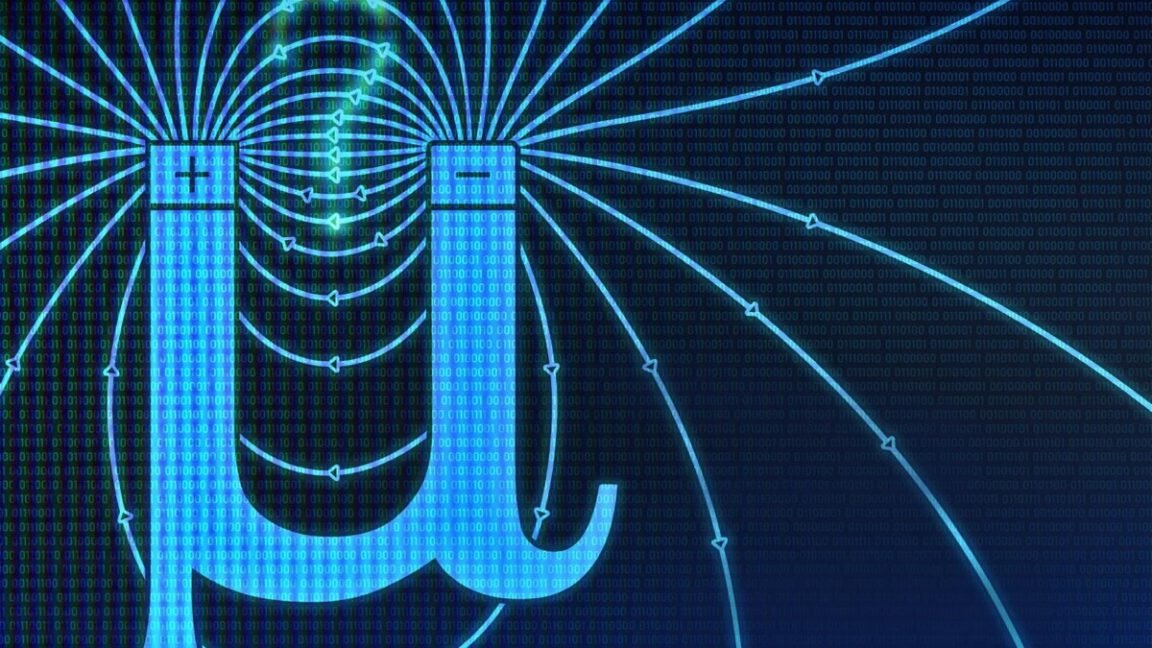
Physicists have spent the last 20 years pondering an apparent discrepancy between experimental results and theoretical predictions for the magnetic properties of the muon, the electron’s heavier cousin—a mismatch that hinted at a possible fifth force. But according to a new paper published in the journal Nature, the discrepancy is due to a calculation fluke, not exciting new physics, so the Standard Model of particle physics is still holding strong.
“There were many calculations in the last 60 years or so, and as they got more and more precise, they all pointed toward a discrepancy and a new interaction that would upend known laws of physics,” said co-author Zoltan Fodor, a physicist at Penn State University. “We applied a new method to calculate this discrepancy quantity, and we showed that it’s not there. This new interaction we hoped for simply is not there. The old interactions can explain the value completely.”
As previously reported, the muon (a member of the lepton classification) is the heavier second-generation cousin of the electron—the tau is the third-generation cousin—and that makes muons particularly sensitive to virtual particles popping into and out of existence in the quantum vacuum, since they can briefly interact with those virtual particles. Muons are special to physicists because they are light enough to be plentiful yet heavy enough to be used experimentally to probe the accuracy of the Standard Model of particle physics.
The muon has an internal magnet and an angular momentum (spin); “g” (the “proportionality constant”) refers to the ratio between the internal magnet’s strength and the rate of gyration. The muon’s magnet would typically rotate to align along the axis of the magnetic field, much like a compass does in Earth’s magnetic field. But because of the muon’s angular momentum, this doesn’t happen; instead, the field exerts a torque on the muon’s spinning magnetic moment, causing it to precess around the axis of the field. Because the muon can interact with virtual particles, the value for g differs from the classical value of 2 by about 0.1 percent—so it’s technically known as the anomalous magnetic moment of the muon.
Intriguing hints
The Muon g-2 experiment (pronounced “gee minus two”) is designed to look for tantalizing hints of physics beyond the Standard Model of particle physics. It does this by making precise measurements of the wobble that occurs when a muon is placed in a magnetic field, in response to virtual particles popping in and out of existence. If the value of the wobble disagrees with the exacting prediction of the Standard Model, that’s a strong hint that some new physics might be involved. The final result, announced in 2006, found an intriguing discrepancy with the predicted value of the Standard Model: The muon’s measured magnet moment came in at a smaller value.
Even more intriguing, that result was deemed a 3.7-sigma effect. (A signal’s strength is determined by the number of standard statistical deviations, or sigmas, from the expected background in the data, producing a telltale “bump.” This metric is often compared to a coin landing on heads several times in a row. A three-sigma result is a strong hint. The gold standard for claiming discovery is a five-sigma result, comparable to tossing 21 heads in a row, for example.)
That said, three-sigma results, while tantalizing, pop up all the time in particle physics, and more often than not, they disappear once more data is added to the mix. So Fermilab revived the Muon g-2 experiment in hopes of either confirming or refuting the discrepancy. The Fermilab physicists completed their initial analysis of data from the updated Muon g-2 experiment, showing “excellent agreement” with the discrepancy Brookhaven recorded. Taken together, they boosted the statistical significance to 4.2 sigma—teetering just on the verge of the threshold required for discovery. The experiments recently received a Breakthrough Prize in Fundamental Physics.
A new approach
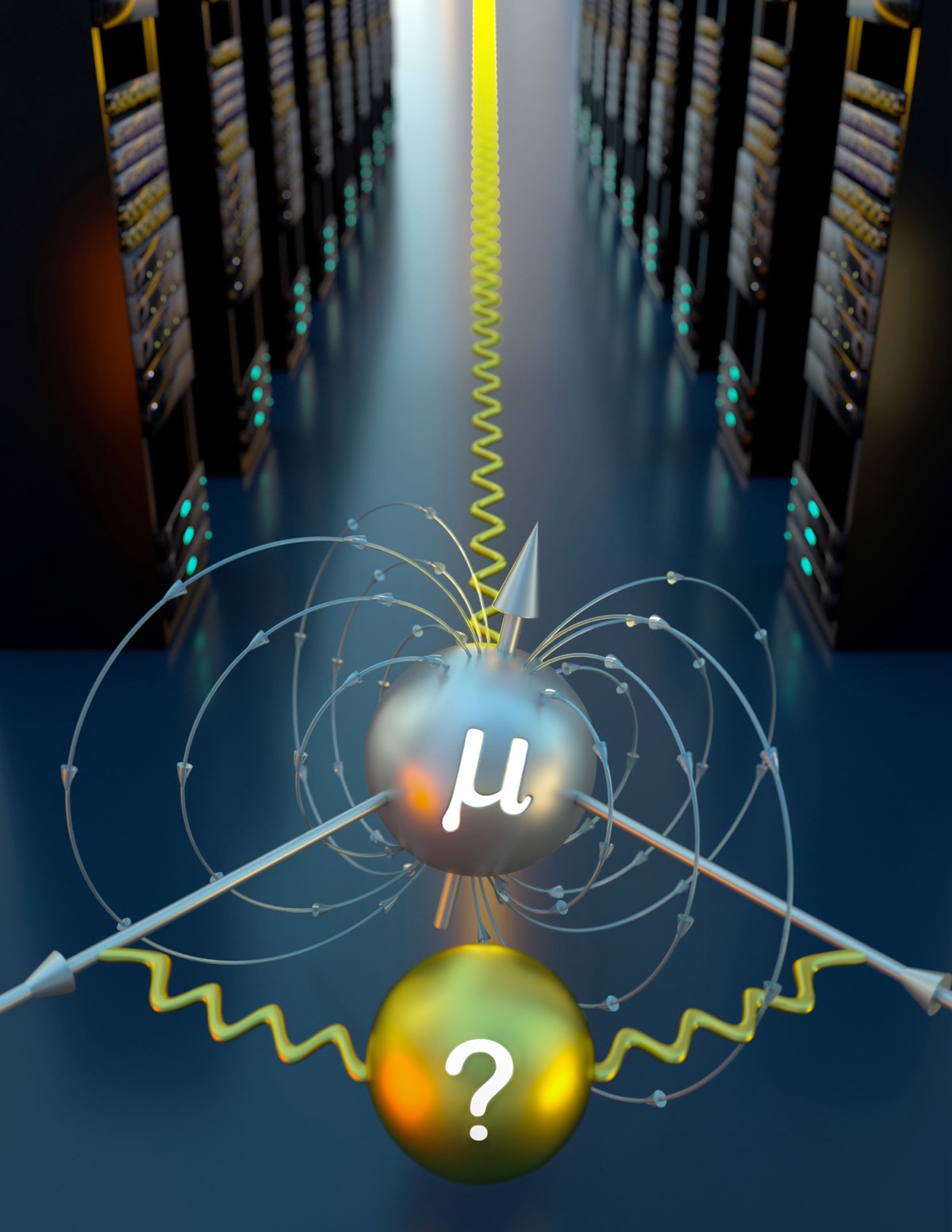
This latest measurement focuses on strong force effects, specifically the “hadronic vacuum polarization,” which arises as quarks and gluons interact within the framework of quantum chromodynamics (QCD) theory. The authors adopted a hybrid approach, combining powerful large-scale computer simulations with experimental data.
“The old methodology involved collecting thousands of experimental results and reinterpreting them to get the single number, the magnetic moment of the muon,” Fodor said. “Our approach was completely different. We divided space-time into very small cells, a lattice, then we solved the equations of the Standard Model on that. There was an awful lot of theory, mathematics, programming, computational knowledge and computer architecture behind this calculation.”
It took 10 years to make those complicated calculations, but when they were done. Fodor et al. found their results agreed with the Standard Model to within half a standard deviation and down to 11 decimal places. It’s the most precise calculation yet achieved, accurate to parts per billion. While the results do not completely rule out possible new physics like a fifth force, they do further constrain the areas where new physics might be lurking.
“People ask me how it feels to make this discovery and, to be honest, I feel somewhat sad,” said Fodor. “When we started to calculate this quantity, we thought we were going to have a good and trustworthy calculation for a new fifth force. Instead, we found there is no fifth force. We did find a very precise proof of not just the Standard Model but also of quantum field theory, which is the foundation on which the Standard Model was built.”
Nature, 2026. DOI: 10.1038/s41586-026-10449-z (About DOIs).