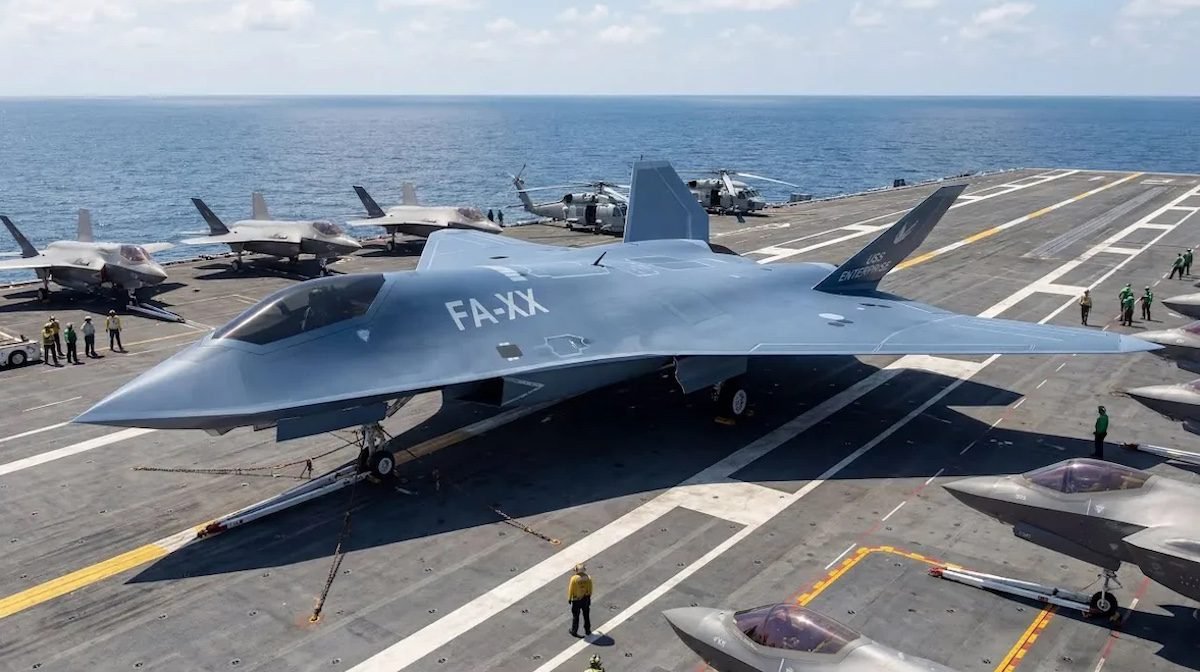
The US Navy’s F/A-XX fighter bid underscores a deeper contest with China not just over next-generation carrier aircraft, but over which side can sustain carrier aviation as a credible instrument of power, deterrence and influence in the Indo-Pacific.
The Navy will select a builder for its next-generation F/A-XX carrier-based fighter in August, Chief of Naval Operations Admiral Daryl Caudle said at the Navy League’s Sea-Air-Space Symposium in National Harbor, Maryland, following consultations with the US Department of Defense (DoD) and Deputy Secretary of Defense Steve Feinberg, USNI News reported.
Boeing and Northrop Grumman are competing for the program, intended to replace the F/A-18 Super Hornet in the 2030s, though one contractor may be unable to meet timelines.
The aircraft is part of a broader effort to improve adversary air defenses and the spread of low-cost yet capable weapons by enhancing carrier survivability through greater range, stealth, and integration with unmanned systems and collaborative combat aircraft.
The F/A-XX is being developed to preserve the relevance of US aircraft carriers in a Pacific battlespace increasingly shaped by China’s scale, proximity and anti-access/area-denial (A2/AD) capabilities, combining extended range, stealth and AI-enabled integration with unmanned systems to allow carrier air wings to strike from greater distances while maintaining survivability and sustained airpower.
However, it remains unclear how the US Navy’s F/A-XX will compare with China’s emerging carrier aviation ecosystem in terms of tactical capability, operational effectiveness, and doctrinal utility in a future Indo-Pacific conflict.
At the tactical level, the problem is how the F/A-XX will compare with China’s emerging carrier-based aircraft and air-wing enablers in terms of survivability, sensor integration, sortie generation, and combat effectiveness in contested engagements.
Aita Moriki mentions in an October 2025 National Institute for Defense Studies (NIDS) report that China’s emerging carrier ecosystem has advanced significantly with Fujian’s successful electromagnetic launch system (EMALS) launches and arrested landings of the new J-35 stealth fighter, J-15T fighter and KJ-600 airborne early warning and control (AEW&C) aircraft, marking a major step forward in the People’s Liberation Army Navy’s (PLAN) carrier aviation.
Moriki argues that this ecosystem could enhance blue-water combat potential through a J-35/J-15T “high-low mix” and, crucially, the KJ-600, widely described as providing the carrier group’s “flying eyes” and “brain.”
However, he stresses that this is not yet fully operational: EMALS reliability, adjustments to launch and arresting systems, and the collection of extensive validation data, along with pilot training, remain major technical and human-resource hurdles before true combat deployment.
In a January 2026 report for the Lexington Institute, Rebecca Grant discusses the F/A-XX as part of the future carrier air wing alongside platforms such as the F-35 and MQ-25. Grant states that the F/A-XX will enhance survivability and combat effectiveness through greater stealth, payload and extended range, enabling operations in contested environments and maintaining naval air dominance.
She notes that the future air wing combines the sensing capability of the F-35, the range extension of the MQ-25 and the capabilities of the F/A-XX, while carrier air wings can generate sustained strike output through high sortie rates, with future systems extending range and lethality.
Taken together, the comparison suggests a gap between China’s emerging carrier capabilities and the US focus on integrating survivability and reach within a more mature air wing architecture.
Beyond platform performance, the contest is whether each side can maintain its combat system under pressure. The decisive operational advantage will go to the side that can sustain a resilient “kill web”— keeping connectivity and logistics despite network and infrastructure attacks.
According to Ying Yu Lin and Tzu-Hao Liao in a July 2025 Jamestown Foundation report, China is improving fleet coordination through dual-carrier operations, requiring extensive coordination among escort vessels, logistical support ships, submarines and carrier aviation. They note dual-carrier operations also allow aircraft to land on another carrier in emergencies, while the Shandong demonstrates higher sortie rates.
However, Lin and Liao highlight key limitations, including a lack of clear cross-service joint operations beyond the PLAN, uneven carrier capabilities and continued reliance on coordinated escort and support formations, indicating that China’s ability to project power beyond the first island chain remains developing.
From the US perspective, Bryan Clark, in a January 2023 article for the Institute for International Affairs (IAI), argues that US naval advantage in a contested environment will depend on distributed, mobile forces enabled by evolving command-and-control (C2) approaches rather than on concentrated platforms alone.
Clark says that the US Navy’s Distributed Maritime Operations (DMO) concept, Joint All-Domain Command and Control (JADC2) and Project Overmatch are intended to connect the best shooter, sensor and commander for a given task, while command and control processes must adapt to communications availability as adversaries like China could disrupt long-range communications.
He also highlights unmanned systems and common control architectures as part of a more heterogeneous fleet, while MQ-25 refueling is discussed separately as extending carrier air wing range.
The US model ensures continuous combat power despite disruptions, while China’s relies on a resilient, coordinated C2 structure with reliable logistics. This divergence shows China focuses on integrated forces, whereas the US emphasizes operational continuity under stress.
At the strategic level, the issue is no longer how these forces fight, but what they achieve over time. The challenge is how the evolution of US carrier aviation will compare with China’s emerging carrier ecosystem in sustaining credible power projection, reinforcing deterrence, and shaping the long-term balance of maritime influence in the Indo-Pacific.
Connor Hall argues in a March 2025 article for the SAIS Review of International Affairs that China’s carrier program is not primarily focused on directly countering US carrier forces in a near-term conflict, but rather on enhancing regional power projection, intimidation and symbolic demonstrations of national power, particularly against weaker Indo-Pacific actors.
While Hall says carriers support China’s long-term ambition for a “world-class” military and expanded maritime influence, their role in a direct conflict with the US is likely limited due to vulnerabilities, sustainment challenges, overseas basing constraints and exposure to US naval capabilities.
For the US, Sam Tangredi notes in a 2025 US Naval War College Review article that US naval aviation dominance emerged from a process of simultaneous experimentation with multiple competing technological paths rather than a single predetermined solution.
He emphasizes that aircraft carriers became dominant only after alternative approaches were tested, compared in operational conditions and, if found wanting, discarded, highlighting the role of competition and real-world experimentation in determining effective means of projecting maritime airpower.
Together, these perspectives suggest that while China’s carriers are enhancing regional leverage, the US advantage lies in its ability to continually adapt carrier aviation to shifting strategic conditions. China’s carriers may expand influence, but the US is competing on whether carrier power itself can remain decisive.