After the successful conclusion of the Artemis II mission earlier this month, focus turned to what comes next in NASA’s roadmap to return humans to the Moon.
The biggest question concerned the readiness of lunar landers, the complex and essential machines needed to take astronauts down to the lunar surface and back up to orbit. And as Ars reported at the time, both SpaceX and Blue Origin have a significant amount of developmental and testing work left to do before even a prototype lander is ready.
But a secondary question has been the development of spacesuits, which are necessary for astronauts to exit their landers and explore the lunar surface. Less is publicly known about their development.
However, the release of a report by NASA’s Inspector General on Monday sheds some light on this progress. And for those interested in NASA’s aggressive 2028 timeline to land humans on the Moon, it’s worth noting what the report did and did not say.
The report
Broadly speaking, the new report examines the process by which NASA has gone about acquiring lunar spacesuits. For those not paying attention to spacesuit procurement—which is basically everyone with a life or without a financial interest in the matter—it has been a long and tortured process. NASA has been working internally for decades to develop a next-generation spacesuit.
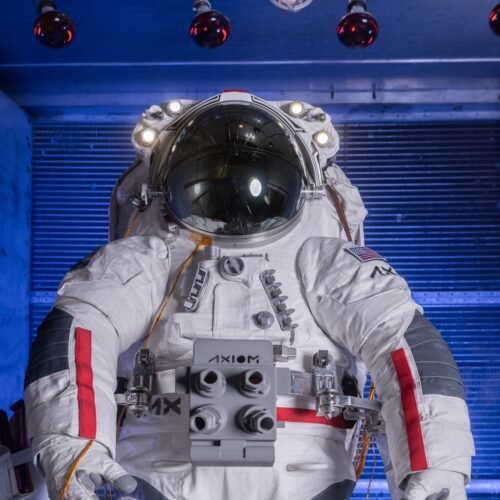
It has been a messy, bloated process, so the space agency decided to try something different in 2022. Following a more commercial procurement process, NASA awarded two Exploration Extravehicular Activity Services (xEVAS) contracts—firm-fixed-price, service-based contracts worth up to $3.1 billion—to teams led by Axiom Space and Collins Aerospace. Axiom was a new space company with no experience in spacesuits, and Collins was a more traditional provider with a lot of experience.
However, two years later, Collins dropped out of the competition. The company had apparently not managed the contract particularly well and determined it could not continue working on spacesuits profitably.
“Collins’ descope from xEVAS negated the competition and redundancy sought by the Agency, leaving NASA with only one xEVAS spacesuit provider,” the inspector general’s report finds. “If Axiom cannot satisfy its contractual requirements in a timely or cost-effective manner, then NASA could be forced to continue using the problematic EMUs throughout the life of the ISS and significantly adjust its lunar plans.”
The report also provides some basic comparisons to other spaceflight programs and finds that, based on historical averages, the Axiom spacesuit may not be ready for an Artemis demonstration before 2031—five years from now.
So, are lunar astronauts out of luck?
This all sounds pretty dire, so we did a little digging. In reality, the situation does not appear as grim as what’s outlined in the new report. Yes, it does seem like NASA made some mistakes in procuring the spacesuits “as a service,” especially when there are likely to be no non-NASA customers for these suits for a long time.
However, the space agency has evidently found a good partner in Axiom Space, a Houston-based company also working to develop a commercial space station. Axiom has no guarantees that it will ultimately make money from this project, but it has nevertheless poured resources into the program and hired appropriately to meet its needs. Unlike the traditional space company Collins, Axiom and its investors have been willing to make a long-term bet that its suits will one day be in great demand. If NASA does succeed in building a Moon Base, this bet could pay off big time.
Despite the 2031 date bandied about in the spacesuit report, it appears this is too pessimistic. After the report’s release on Monday, NASA Administrator Jared Isaacman replied, “I am confident that when NASA is ready to land on the Moon in 2028, our astronauts will be wearing Axiom suits.”
This is consistent with what two sources have told Ars: that internally the spacesuit program is making good progress and that both Axiom and NASA are putting in the time and resources to push it toward success. Axiom Space chief executive Jonathan Cirtain said Tuesday that Axiom’s suit has logged more than 950 hours of crewed pressurized testing and should complete critical design review this year. Problems can always occur during hardware development programs, of course, but things appear to be on track.
NASA presently plans to fly Artemis III in 2027, during which Orion will dock with one or both lunar lander prototypes in Earth orbit. That mission is likely to carry an Axiom suit for demonstration in microgravity. This would be a precursor mission to a lunar landing in 2028.
At this point, the new report notwithstanding, the Artemis schedule is unlikely to be delayed by spacesuit readiness.