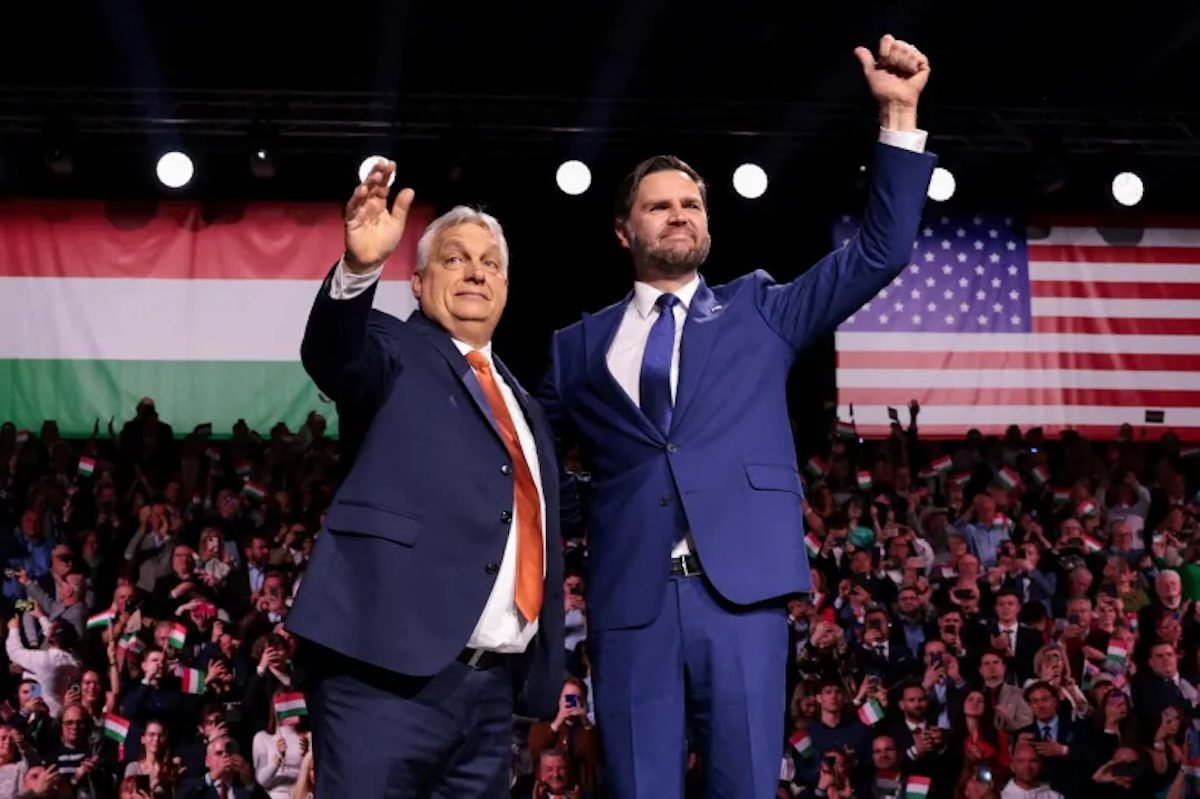
If you want to understand why the general election in Hungary April 12 will be geopolitically significant, and how today’s geopolitics are different from any previous time in the 80 years since World War II, you have only to learn which two governments have been openly supporting the incumbent Hungarian prime minister, Viktor Orban.
Shockingly, they are the governments of America and Russia. Vladimir Putin and Donald Trump are closely aligned in endorsing a man who has now led Hungary for 16 years and who has built what he proudly calls “an illiberal democracy.”
We shall learn at around midnight, Hungarian time, on April 12 which part of Orban’s formula has proved more powerful, the “illiberal” part or the “democracy” part, and thus whether the big lead in opinion polls consistently held by his opponent, Peter Magyar, has been translated successfully into a parliamentary majority.
Hungary is a small country of just 10 million people and has a small economy that has stagnated under Orban’s rule. But, as Putin’s and Trump’s interest implies, the result will carry a disproportionate importance for Ukraine and the European Union, a country and a supranational organisation that both Putin and Trump despise.
The result will matter for Ukraine because since Russia’s full invasion attempt began in 2022 Orban’s Hungary has acted as Putin’s not-so-secret agent inside the EU to disrupt and where possible block EU aid for Ukraine. His latest act just a few weeks before the election was to block the EU’s special loan to Ukraine of 90 billion euros that had been agreed as long ago as last December.
Fortunately, despite not yet having received that funding, Ukraine is currently gaining something of an upper hand in the war with Russia. Its domestically produced drones and missiles are now allowing it to match or even exceed the daily volume of Russian attacks. And it has regained some territory from Russian forces while inflicting increasing numbers of casualties on its opponent.
But to keep that momentum going will require funding and supplies from EU countries and the United Kingdom, through both the blocked loan and other support. Ukraine knows that it can no longer expect any support from Trump: perhaps its best hope is that Trump and US Vice President JD Vance will be so distracted by their negotiations with Iran that they will not find time to lash out at Ukraine.
One of the great mysteries of today’s geopolitics is the fact that Trump and Vance seem to pay no attention to the fact that Russian support is one of the reasons why the Iranian regime has remained resilient against six weeks of American and Israeli attacks.
It is understandable, if regrettable, when Trump acts and speaks as if he believes the superpowers of Russia, China and America can obey their own rules, essentially of “might is right,” while smaller countries must behave differently. But it is truly strange to see an American president seemingly indifferent to the fact that Russia and China are actively seeking to obstruct the United States by supporting its enemies.
It is also unclear why Orban wants to allow Ukraine to be reconquered by the Russian Empire, given that his own political youth was spent campaigning against the Soviet Union’s control over Hungary. Nonetheless, part of his political success has been built on using xenophobia to garner support, whether against Ukrainians, Jews or other targets.
(If you want to read more deeply on how Hungary has become an illiberal state under Orban, it will be hard to beat this essay from the excellent Johan Norberg for the Cato Institute: “How Viktor Orban’s Hungary eroded the rule of law and free markets.”)
Hungary is also one of the few EU countries that still import Russian oil and natural gas. In fact, it has increased its dependence on Russian oil and gas since the war began, not reduced it. When money is involved, hypocrisy becomes less of a mystery.
Trump has repeatedly criticized EU countries for continuing to buy Russian oil and gas, perhaps either not realizing, or just not caring, that the main culprit is his friend Viktor Orban. Last week, he sent Vance to Budapest to campaign for Orban’s reelection, and Vance dared to accuse both the EU and Ukraine of interfering in a foreign country’s election – which neither of them is in fact doing, unlike him.
The leadership of the EU certainly hopes that Orban will lose, for under him Hungary has become both an obstruction and an embarrassment. It has obstructed support for Ukraine but has also slowed down other common policies, including a common policy governing immigration and asylum that is finally coming into force this year.
It is an embarrassment because among the member states that have joined the EU since the major enlargement in 2004 it is the one that has degenerated the most in terms of corruption, the rule of law and democracy.
Were Hungary to apply today for EU membership, it would not be admitted because it no longer meets the EU’s criteria on those measures. Its backsliding, especially on corruption but also on judicial independence and the freedom of the media, has exposed the lack of any enforcement mechanism for members once they have been admitted.
The sole weapon the EU holds is the power to withhold funds, which has belatedly been done to Hungary. But Orban has exploited this by turning the EU into one of Hungary’s supposed enemies, alongside Ukraine and others. The election will show whether this tactic still works.
Putin, Trump and Orban have formed what is in effect an anti-EU alliance, all accusing the European Union of representing a grave threat to European, and hence Western, civilization. This is why Italy’s Prime Minister Giorgia Meloni has been wise to distance herself from Orban during the election campaign after initially making the mistake of appearing in an Orban campaign video (alongside the likes of Binyamin Netanyahu and Marine Le Pen).
But it is also why her longer-term affiliation with Orban has been a big political error: It contradicts the generally pro-EU and pro-Ukraine stance she has taken, casting doubt on her sincerity, and validates the accusation that she, too, would dearly like to run an illiberal democracy, controlling the media and civil society and rewriting the constitution in ways that could keep her in power.
The Hungarian election has practical importance, for Ukraine and for the workings of the EU. But it also has even greater symbolic importance, for the future health of democracy in Europe and for the protection of the European way of life against the Trump-Putin-Orban assault on it.
A victory by Peter Magyar and his opposition party would not be an ideological shift, for on policy matters he counts as a right-winger and is even a former colleague of Orban’s. But it would be a shift back toward the rule of law, toward democratic accountability and toward a collaborative and civilized view of Europe.
That shift would be difficult, as Orban’s allies are deeply entrenched in many Hungarian institutions. But it is important that the shift should start. And it is equally important that the enemy forces of Trump, Vance and Putin should be given a slap in the face.
This English original of an article published in Italian Saturday morning by La Stampa also is available, along with many other articles, on Bill Emmott’s Global View.