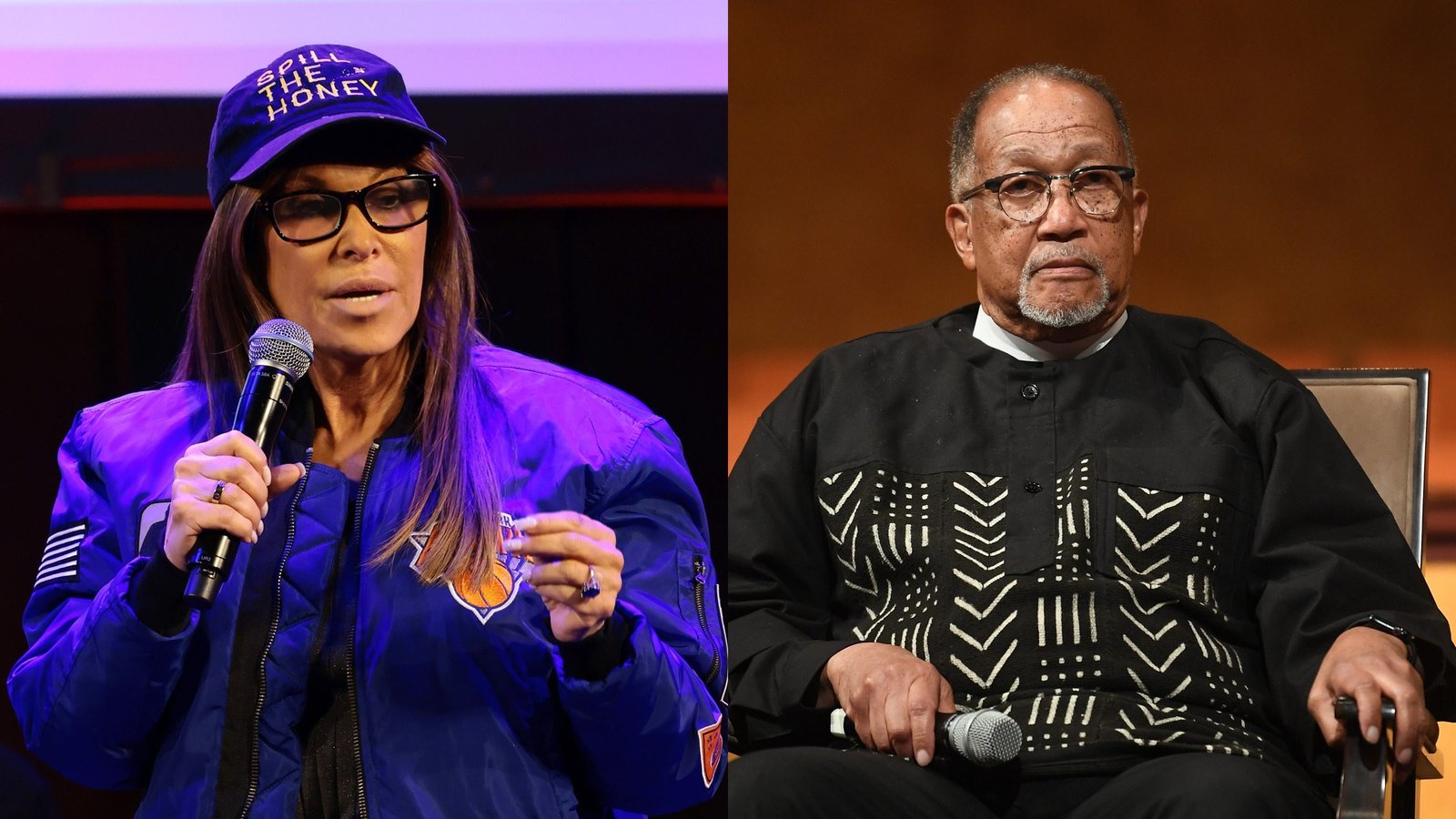
Through Spill the Honey, civil rights veterans and filmmakers are working to rebuild Black-Jewish solidarity at a time of rising antisemitism and racial tension
In the turbulent 1960s, an unbreakable bond was forged on the front lines of the American Civil Rights Movement. Black and Jewish activists didn’t just share a history of oppression and a fight for survival; they marched side-by-side, prayed together, and literally shed blood to transform the conscience of a nation. Yet today, amid a terrifying global resurgence of antisemitism and racism, the memory of that world-changing coalition is dangerously fading—threatened by a modern era of misinformation and deliberate historical erasure.
Refusing to let this legacy be forgotten, civil rights veteran and Black Jewish Action Alliance National Chairman Rev. Dr. Benjamin Franklin Chavis Jr. and documentary filmmaker Dr. Shari Rogers have launched a mission to reconnect the two communities. Their partnership began with a chance meeting in New York after the October 7, 2023, Hamas attack, when Chavis was speaking about empathizing with Jews who had just been murdered. “I met him in New York; we were staying at the same hotel,” Rogers recalled. Through Rogers’ documentary Shared Legacies and the work of Spill the Honey, the organization she co-founded and leads with Chavis as board chairman, they are trying to bring that story back into public view.
Chavis sees the danger first as a crisis of memory. “Well, I think there’s a challenge for the African American story. Similarly, there’s a challenge for the Jewish story,” he says. In his view, rising antisemitism and racial hatred have made both communities more vulnerable to distortion, forcing them to defend truths that should already be secure. “Unfortunately, … sometimes people become ahistorical. And when you become ahistorical, you become apolitical.” For Chavis, that loss of memory weakens public morality itself, leaving people less able to “speak truth to power.”
Rogers’ answer to the loss of memory has been witness. Her goal in making Shared Legacies was to preserve the voices of people who had lived the Black-Jewish coalition before those voices were gone. “My dream was that this history, one of the most important American history coalition stories, would be known to the entire country and to the world,” she says. The film became a repository of testimony from leaders whose memories now carry even greater weight because so many of them are no longer alive.
Some of those voices came to the project with a sense of urgency of their own. Rogers recalls that Congressman John Lewis “actually helped fundraise the remaining funds for this film,” while Harry Belafonte, overcome with emotion, “wanted to make sure that his voice was documented in this history.” The result is a work rooted not in abstraction, but in memory preserved before it vanished.
There has not been enough sharing of our stories
That shared memory, Rogers and Chavis argue, is still not widely understood. “There has not been enough sharing of our stories,” Chavis says. “It’s important for the Jewish community to know the Black narrative. It’s important for the Black community to know the Jewish narrative.” When those narratives are brought into conversation, the result is more than coexistence; it is a recognition of shared struggle and mutual responsibility. “These narratives do not just intersect; they are parallel, and they are in solidarity.”
Even religious life, according to Chavis, can become a focal point of that solidarity. He points to a growing Judeo-Christian observance of Passover in Black churches and describes the holiday as speaking to liberation, freedom, justice, and truth. From that perspective, Passover and Easter are not interchangeable traditions, but traditions that can illuminate one another for communities shaped by histories of bondage, endurance, and redemption.
For younger generations, however, history is increasingly competing with misinformation. Chavis warns that “there are Holocaust deniers” and “there are transatlantic slave trade deniers,” even in a world saturated with information. “In order to shape the future, you have to know the past,” he says. Rogers has watched that truth land with impact in classrooms, where students often encounter this shared history for the first time.
“It’s amazing how the younger generation, whether it’s in high schools or even colleges, really didn’t know this history,” she says. Yet once they do, the change can be immediate. One student told her, “If I would have known this history, you could have been my brother.” Rogers sees that as more than a moving, emotional response. It is the moment when history produces relationship, and relationship makes difficult conversations more possible.
That same idea is embedded in the name Spill the Honey. Rogers took it from the story of a Holocaust survivor whose mother gave him a cup of honey on the last day she would ever see him before he was sent to a concentration camp. Her wish for him was both simple and devastating: she wanted him “to have a sweet life and remain hopeful.” The cup broke, but the hope remained. For Rogers, that image became a kind of moral inheritance, one that points toward survival without bitterness and memory without despair.
She places Martin Luther King Jr. in that same lineage of hope. King, she says, “filled his cup up not with despair. He filled it up with love and positivity.” His voice still reaches people because it speaks to a possibility America has not fully realized but has never entirely lost.
That possibility depends on refusing to normalize hatred. Chavis is direct: “We should not allow antisemitism to become normalized. We should not allow racism to become normalized.” The answer, he believes, requires more than private agreement or symbolic support. It requires public witness.
It wasn’t a temporary march. It was a brotherhood. It was a solidarity that was expressed in public.
He remembers seeing Rabbi Abraham Joshua Heschel and King marching together during the civil rights movement, and what matters to him most is not simply that they stood side by side, but what that standing represented. “It wasn’t a temporary march. It was a brotherhood. It was a solidarity that was expressed in public,” he says. That remains his measure of the present. “We need more to stand together.”
Rogers sees reason for hope in places where institutions are choosing to make that history visible again. At Morehouse College, portraits of Jewish civil rights contributors now stand alongside Black civil rights leaders, ensuring that students encounter the Black-Jewish coalition not as a footnote, but as part of the school’s living inheritance. At Ebenezer Church, figures including Rabbi Heschel and Rabbi Jacob Rothschild have also been honored in connection with this shared history. Rabbi Rothschild’s temple was bombed because of his close work with King, and he helped ensure the first integrated dinner in Atlanta when King received the Nobel Peace Prize.
The story also has a wider lens. “Today we also have to talk about Jews of color and Black Jews,” Rogers says. That reminder complicates older binaries and makes the coalition more faithful to the present. Spill the Honey’s hip-hop pedagogist is Black and Jewish as well, reflecting identities that bridge categories too often treated as separate.
Education is where all of this comes together. Rogers says Spill the Honey has developed “a five-hour curriculum that supports the one-hour film on shared legacies,” and that it is already in high schools in Boston, California, and Detroit. Boston University Law School made the film mandatory for new law students, and UC Davis Law School is also part of the initiative’s expansion. Her hope is for much broader reach because this story, she says, “uplifts both the Black community and the Jewish community and serves as a template and a roadmap for all communities to learn how to bridge-build and remind people of our common humanity.”
The curriculum also reflects a sharp awareness of how young people learn now. Rogers points to hip-hop pedagogy as a way of carrying history into the present, teaching students the story and then asking them to create songs about it in a language that feels native to them. If music helped move the 1960s, it can still help transmit moral memory now.
The same philosophy shapes Rogers’ understanding of Holocaust testimony. Many survivors did not begin speaking publicly right away because the trauma was too great. “It took Steven Spielberg’s film Schindler’s List to really inspire many of the Holocaust survivors to start speaking about the horror that they witnessed,” she says. Through Shared Legacies, she has seen people begin speaking more openly about their own family histories as well. Testimony, in that sense, can encourage others to speak.
Chavis’ own life offers one of the clearest examples of what solidarity can look like across distance and struggle. While unjustly imprisoned as part of the Wilmington Ten, he wrote to Natan Sharansky, who was then jailed in the Soviet Union for resisting the oppression of Soviet Jewry. “I said, you know, let me write my fellow brother,” Chavis recalls. The letter was never delivered, but he kept a copy. Years later, he read the letter to Sharansky in person, turning an intercepted gesture into what he called “a great reunion, spirit of solidarity.”
For Rogers, the significance of that bond runs deeper still. Sharansky told her that one of the first places he wanted to visit in America after his release was the King Center, because King’s message about Soviet Jews had given him hope. That memory captures what Shared Legacies is trying to restore: the reality that Black freedom struggles and Jewish freedom struggles have often sustained one another in ways still insufficiently understood.
Neither Rogers nor Chavis avoids the pressures of the present. Chavis says African Americans are deeply concerned about the wars in the Middle East and insists that “Israel not only has a right to exist,” but should “be free of acts of terrorism and violence.” He describes October 7 as a world-shaking moment that horrified many in the Black community. Yet he also returns to a recurring warning that links current conflict to historical memory: “I think the same people that want to erase the Holocaust from history are the same people [who] want to erase slavery from history in the United States.”
Rogers points to social media as one reason these conversations have become harder. “I think social media preys on the young people,” she says. “They like negative stories. Negative stories sell.” Spill the Honey tries to answer that appetite not by avoiding pain, but by offering hopeful narratives strong enough to hold pain without being consumed by it. The shared history between Black and Jewish communities, she believes, creates a safer space for more difficult discussions, including the Middle East, because it begins with relationship rather than accusation.
Chavis returns, finally, to first principles. “I think there’s only one race, and that’s the human race,” he says. “And I think that we’re all part of one human family.” Against that moral vision stand what he calls “the two twin evils that divide humanity today”—antisemitism and racism.
Rogers reaches for the words of Dr. Samuel DuBois Cook to describe the same truth. After the deaths of King and Heschel, Cook brought Black and Jewish leaders together at Dillard University to rebuild the relationship, and he later wrote that “the terrible logic of antisemitism and racism is the same: the alienation of humankind from humankind.” The phrase remains striking because it names hatred not simply as prejudice, but as a break in the moral order itself.
That is why Chavis sees the Black-Jewish alliance as part of “the American story” and “the American journey.” He points to the Civil Rights Act of 1964, the Voting Rights Act of 1965, and the Fair Housing Act of 1968 as evidence of what that solidarity helped make possible. America, he argues, would not be what it is without either the Jewish community or the Black community, and its strength lies in inclusion rather than exclusion.
The soul of America is at stake
“The soul of America is at stake,” Chavis says. The task now is not only to honor the past, but to learn from it and build something worthy of it. “So that our shared legacies become our shared futures.”