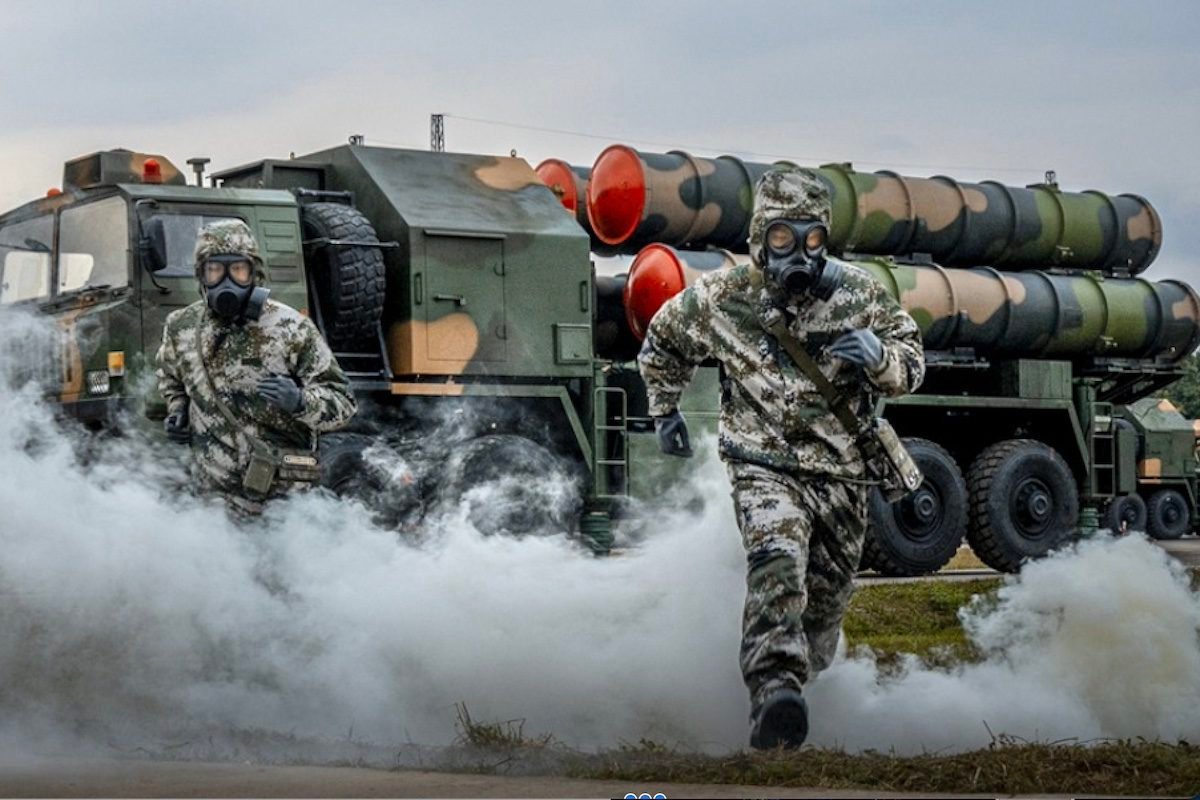
China’s latest nuclear-response drills in the Taiwan Strait suggest a Taiwan conflict could escalate into a limited but dangerously uncontrollable nuclear war in Asia.
This month, the South China Morning Post (SCMP) reported that China’s Eastern Theater Command conducted a military drill simulating a nuclear attack response, aimed at improving troop readiness in complex battlefield environments amid heightened regional tensions.
The exercise, held at an unspecified naval base within the command responsible for the Taiwan Strait and the East China Sea, involved rapid detection and decontamination operations in contaminated zones.
Units deployed chemical, biological, radiological and nuclear (CBRN) defense teams using uncrewed helicopters and handheld detectors to identify radiation spread, while specialized teams screened personnel and equipment before conducting full-scale decontamination procedures.
The drills took place as concerns rose following reported US and Israeli strikes near Iran’s Bushehr nuclear facility and warnings from the International Atomic Energy Agency (IAEA) about potential radiological risks.
Regionally, tensions remain elevated as Japan considers a possible role in a Taiwan conflict and continues missile deployments targeting China, while Chinese state media highlight Japan’s latent nuclear capability.
Several nuclear plants within the command’s area, including sites in Fujian and Zhejiang, are within range of potential adversaries, underscoring the operational context of such preparedness drills.
The drills suggest China is preparing for potential nuclear use in a Taiwan conflict. With the conventional military balance in the Taiwan Strait increasingly favoring China, the US and its allies may consider using tactical nuclear weapons to offset China’s conventional advantages – similar to the offset strategy employed by NATO against the Soviet Union during the Cold War.
Delving into that logic, Greg Weaver notes in a November 2023 Atlantic Council report that a Taiwan invasion scenario would expose China’s amphibious landing fleet to nuclear attack, as such operations are “almost uniquely vulnerable.”
Furthermore, Matthew Kroenig outlines in a September 2023 Atlantic Council report that in scenarios where US conventional forces are insufficient to stop a Chinese invasion, the US could consider limited nuclear first use against off-mainland targets, including People’s Liberation Army Navy (PLAN) vessels and invasion forces.
Together, Weaver and Kroenig imply that tactical nuclear weapons could rapidly destroy or cripple staging forces at sea, delivering decisive effects. By targeting maritime invasion assets rather than the mainland, such use could reduce collateral damage and signal limited intent, potentially constraining escalation while achieving the core objective of defeating the invasion force.
However, David Kearn argues in a March 2024 War on the Rocks article that the proposed US first use of tactical nuclear weapons in the Pacific is a short-sighted overreaction to China’s conventional gains, ignoring viable alternatives.
He contends such a threat lacks credibility given ambiguous US commitments to Taiwan and limited domestic support for escalation, while risking dangerous escalation, including likely Chinese retaliation against US forces and bases.
Kearn warns it would alarm allies, undermine alliance cohesion, weaken non-proliferation efforts, and damage US global standing.
While China might be worried about the US using tactical nuclear weapons as part of an offset strategy in a Taiwan crisis, a second driver of nuclear risk is the weakening of US extended deterrence guarantees.
Marigold Black and Iain MacGillivray note in a Lowy Institute article this month that US extended nuclear deterrence in the Indo-Pacific is under growing strain, as Cold War-era frameworks struggle to address a more complex, multipolar nuclear environment shaped by China’s rapid modernization and multiple nuclear actors.
Hans Kristensen and other writers mention in a March 2025 article for the Bulletin of the Atomic Scientists that China is estimated to possess approximately 600 nuclear warheads as of 2025, with additional warheads in production to arm expanding delivery systems.
Kristensen and others note China’s nuclear modernization is accelerating rapidly, marked by large-scale silo construction, new missile systems, and projections that its arsenal could exceed 1,000 warheads by 2030, making it the fastest-growing nuclear force among nuclear-armed states.
Black and MacGillivray point out that the US’s limited engagement on nuclear issues and fading confidence in US guarantees are raising doubts among allies about whether the US would risk its own cities in their defense.
They note that as US credibility declines, incentives for allies to remain non-nuclear weaken, prompting consideration of indigenous arsenals or alternative security arrangements, with risks of proliferation, fragmentation, and miscalculation in the regional deterrence landscape.
Nowhere is this more acute than in Japan—much to China’s concern. Highlighting Japan’s latent nuclear capability, the SCMP reported in December 2025 that Chinese nuclear experts believe Japan can build nuclear weapons in less than three years.
Chinese experts cited in the report say Japan may have the political motivation, along with plutonium reserves, uranium enrichment capability, a complete nuclear fuel cycle, advanced simulation capacity, and potential delivery systems such as the Epsilon-S rocket and improved Type-12 cruise missile.
However, Wakana Mukai argues in a June 2025 article in the Journal for Peace and Nuclear Disarmament that Japan faces significant constraints in re-evaluating its nuclear stance, shaped by its identity as the only country to have suffered nuclear attack, strong domestic anti-nuclear norms, and reliance on the US nuclear umbrella.
She highlights a persistent dilemma between nuclear deterrence and disarmament: strengthening deterrence risks undermining Japan’s credibility on disarmament, while prioritizing disarmament risks straining alliance dynamics and sustaining dependence on US security guarantees.
Absent clearer US commitments and stronger allied integration, the Indo-Pacific risks drifting toward a fragmented and unstable nuclear order in which attempts to offset China’s conventional gains could make limited nuclear war more thinkable — and far harder to control.