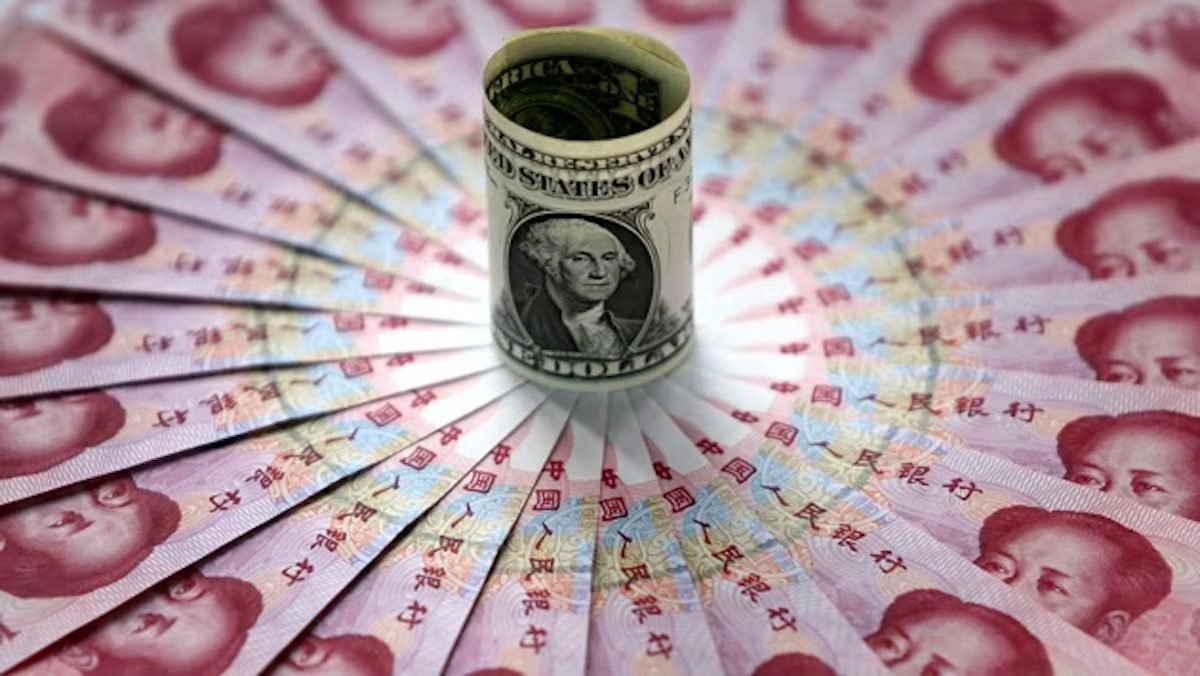
TOKYO — As US President Donald Trump’s tariffs and military adventurism chip away at the dollar’s credibility, the privilege may be all China’s.
The reference here is to the phrase coined by France’s finance minister in the 1960s, Valery Giscard d’Estaing, to criticize the dollar’s dominant role in the global economy. America’s “exorbitant privilege” enables it to sell 10-year US debt at 4.1% yields, even as the national debt nears US$40 trillion.
Trump’s trade war, regime-change gamble in Venezuela and joining hands with Israel to attack Iran also give investors valid reasons to worry about the stability of US assets. So do Trump’s attacks on the Federal Reserve, the most globally respected US institution.
It’s no coincidence that foreign central banks’ holdings of US Treasury securities are now the lowest since 2012. The amount of Treasuries held in custody for overseas institutions at the New York Fed was $2.7 trillion.
To be sure, some of the roughly $82 billion in sales since late February reflect governments freeing up cash to shore up national currencies and support flagging growth.
But the move away from dollar assets also reflects dwindling trust in the US government and its institutions. And China, it seems, is stepping up to assume the safe-haven role.
Along with 5% economic growth, notes Yu Lifeng, research director at Orient Golden Credit Rating, China is less at risk from the effects of surging oil prices.
That’s because Beijing has massive strategic oil reserves and ready access to cheap Russian oil and natural gas, not to mention long-standing ties with Iran that allow its ships to pass through the blocked Strait of Hormuz. It’s an advantage that neither Japan nor South Korea nor most Southeast Asian economies enjoy.
“In the face of frequent geopolitical risks, the safe-haven role of RMB bonds has emerged,” Yu says, noting that 10 years of yuan internationalization is starting to pay off in 2026.
Risks abound, of course. The glacial pace at which Chinese leader Xi Jinping is making the yuan fully convertible, increasing financial transparency and letting the People’s Bank of China make its own policy decisions is limiting the potential of mainland assets.
Meanwhile, the underlying financial system remains too fragile for investor comfort. China’s property crisis has now entered its fourth year, keeping a lid on consumer spending. Deflation also remains a clear and present danger to China’s trajectory.
Yet China has a literal trump card. The ways in which Trump World is taking a wrecking ball to US institutions risk forfeiting Washington’s exorbitant privilege altogether.
His assaults on the Fed, Congress, the judiciary, the press and the economics community, not to mention a wildly unpredictable and destructive foreign policy, are not doing the dollar or US government debt any favors.
“Tariffs and strong-arm trade tactics, challenges to the independence of the Federal Reserve and now military incursions in Latin America and the Middle East, as well as saber-rattling over Greenland, are combining with lofty American stock market valuations and a soaring federal deficit and prompting investors to reassess the narrative of American exceptionalism,” says Russ Mould, investment director at AJ Bell.
As Mould notes, it’s been a year since Trump’s reciprocal tariff “Liberation Day.” That gambit, Mould says, “took trade policy to a whole new level.” Yet, he adds, “investors do seem to have thought carefully about where to allocate capital in a post-liberation-day world, and one where presidential social media posts carry heft politically, economically and militarily.”
The US stock market, Mould says, “may have bounced back strongly from the Liberation Day low, but it has not been the first destination of choice, as had been the case for most of the time since the conclusion of the great financial crisis in 2009. In other words, it is no longer a case of America first and the rest nowhere.”
Data suggest that an increasing number of investors are “deliberately excluding the US,” Mould adds.
Daniel Casali, an investment strategist at Evelyn Partners, tells CNBC that the “relative weakness in US equities likely reflects the impact of President Donald Trump’s ‘America First’ policies, which have prompted Europe to ramp up defense and infrastructure spending as part of a broader fiscal stimulus.”
Casali adds that “expectations that the US growth premium over Europe will narrow have also supported European valuations relative to the more expensive US market — particularly against the backdrop of increasingly erratic decision‑making from the White House.”
It matters, Mitul Kotecha, a strategist at Barclays, tells the Financial Times, that “China is less affected by this pass-through of the energy and the economic starting point is quite different. The PBoC is in a different position” to other central banks. He adds that we’re still looking at potential easing from China, which is “a very different monetary backdrop than what we’re seeing elsewhere.”
This is hardly the first moment when global investors have rediscovered China’s comparatively isolated bond market. Since Chinese government bonds (CGBs) are, like Japan’s, dominated by domestic investors, they are less vulnerable to massive capital flight.
“Since 2012, investing in CGBs has been one of the only ways for global government bond investors to outperform US inflation,” notes Charles Gave, co-founder of research firm Gavekal. Gave adds, “all other major bond markets have delivered meaningful real losses and some, such as Japan, Germany and the UK, have even delivered negative nominal returns over this 14-year period.”
Jason Pang, portfolio manager at JPMorgan Asset Management, adds that Chinese government debt currently offers the “very low correlation” at a uniquely chaotic moment for world affairs.
Jacky Tang, a chief investment officer at Deutsche Bank’s Private Bank, agrees that the “uniqueness” of China’s energy dependence is a key “differentiation factor” for global investors.
This dovetails with the belief that Xi’s Communist Party stands ready to stabilize mainland markets, including stocks, offering global investors a shock-absorbing mechanism in 2026.
“The ‘slow bull market’ remains the mantra,” says Christopher Wood, equity strategist at Jefferies. “The goal remains clear: for the stock market to replace the deflating property market as the main source of wealth generation.”
Yet the onus remains on Xi to ensure that structural reforms on the ground in China keep pace with the influx of foreign capital. In the long run, China’s prospects as a reliable, stable investment destination hinge on how quickly Team Xi implements meaningful economic reforms.
The most urgent task is to end the property market crisis. It’s no small feat in an economy where roughly 70% of household wealth is tied to real estate.
From there, loosening the yuan and granting the PBOC greater independence would signal a genuine shift toward Adam Smith’s ethos. Abandoning rigid annual growth targets – arbitrary goals that distort incentives across the economy – would be another important step.
Above all, Xi’s team must stop prioritizing short-term wins over doing the heavy lifting needed to achieve them. Since Xi took office in 2013, his finance team has treated foreign capital inflows as a reform in and of itself.
Inclusion in global indexes such as MSCI or FTSE Russell does not, on its own, make Chinese companies more transparent, reduce the dominance of state-owned enterprises, or convince 1.4 billion citizens that equities are as reliable an investment as property. Only substantial structural work can ensure China grows in a healthier, more sustainable way—not merely at a faster pace.
The good news: Beijing’s latest Five-Year Plan recognizes that China must accelerate its structural transition toward a consumption-led model.
As economist Keyu Jin at the Hong Kong University of Science and Technology puts it, the shift is “not only about rebalancing growth, but also about anchoring it more firmly at home. Domestic demand offers insulation from external shocks, and along with developed capital markets, it can go a long way toward strengthening autonomy.”
Thanks largely to the “Made in China 2025” program that Xi launched in 2015, China is putting some big tech wins on the scoreboard. They include electric-vehicle maker BYD, which now tops Elon Musk’s Tesla in global sales, and artificial intelligence upstart DeepSeek, whose lower-cost model sent shockwaves through Silicon Valley.
Yet Xi’s bold designs on global tech leadership could be undermined by a shaky underlying financial system.
“China manifests a striking paradox,” Jin notes. “It’s among the world’s most dynamic technological powers, producing breakthroughs in AI, electric vehicles, and advanced manufacturing at an accelerating pace, yet economic growth continues to slow. The reason is no mystery. As the government’s latest Five-Year Plan recognizes, China is experiencing a structural transition, not a cyclical slowdown. The old model is giving way to a new one, which has yet to take hold.”
As longtime China watcher Bill Bishop, author of the Sinocism newsletter, puts it, last month’s policy planning meetings in Beijing did “acknowledge overcapacity and deflation – a notable rhetorical concession – and there are some new measures aimed at mitigating the domestic fallout from large-scale industrial subsidies. But nothing in the report challenges the fundamental growth model. The accompanying 15th Five-Year Plan draft reinforces these themes.”
Despite these economic growing pains, Chinese government bonds are having a real moment – with a powerful assist from Trump.
The geopolitical chaos emanating from the White House has created a unique opening for Xi to showcase how the dollar’s long-standing dominance is withering away in real time. And to prove to the world that Chinese debt is a trustworthy alternative.
Follow William Pesek on X at @WilliamPesek