Japan’s 12,000-ton Aegis ships promise stronger missile defense—but may concentrate risk in ways that echo past naval failures.
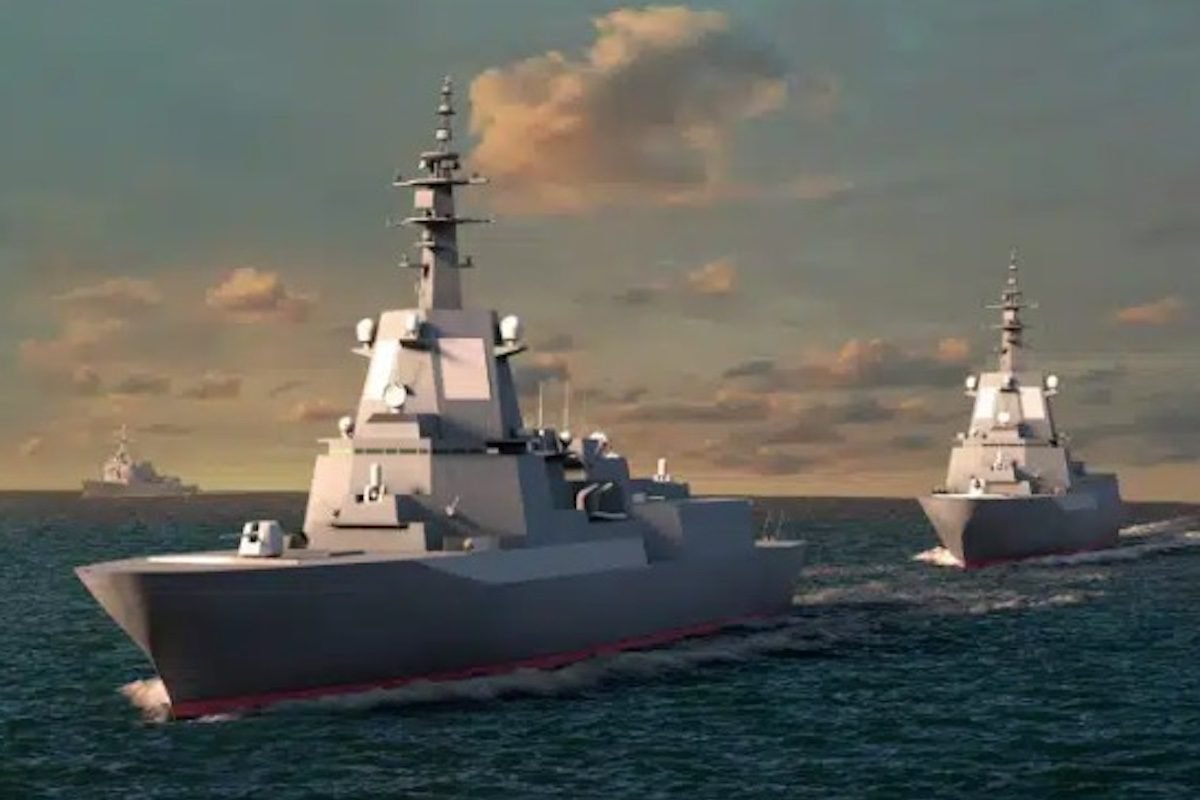
Last month, Naval News reported that Japan’s Ministry of Defense confirmed construction of two Aegis System Equipped Vessels (ASEV) had entered the main production phase following the successful keel-laying of both hulls at major domestic shipyards.
The program, which emerged as a sea-based alternative to the canceled Aegis Ashore system, represents a significant investment in Japan’s ballistic missile defense architecture.
This concentration of capability in a small number of high-value platforms echoes a recurring dilemma in naval warfare: whether greater power in fewer hulls enhances deterrence—or invites catastrophic loss.
The first hull was laid down at Mitsubishi Heavy Industries’ Nagasaki shipyard in July 2025, with the second following at Japan Marine United’s Isogo facility in February 2026. These milestones mark a shift toward persistent, sea-based missile defense coverage of the Japanese archipelago.
Scheduled for commissioning in 2028 and 2029, the 12,000-ton vessels—approximately 190 meters in length—are expected to be classified as guided-missile cruisers (CG) due to their size.
Each ship will be equipped with 128 vertical launch cells, exceeding the 96 cells on Japan’s latest Aegis destroyers, and will deploy SM-3 Block IIA and SM-6 interceptors, along with Tomahawk cruise missiles in support of Japan’s emerging counterstrike capability.
At the core of the design is the AN/SPY-7 radar, intended to provide long-duration surveillance and tracking of ballistic missile threats. The ships are designed to conduct continuous missile-monitoring missions, providing coverage of the Japanese archipelago. They will also relieve existing Aegis destroyers of persistent ballistic missile defense duties, allowing them to return to broader multi-mission operations.
The scale of regional missile inventories underscores the rationale for this approach. According to the US Department of Defense’s (DoD) 2025 China Military Power Report (CMPR), China possesses approximately 500 intermediate-range ballistic missiles (IRBM) with ranges up to 5,000 kilometers, 1,300 medium-range ballistic missiles (MRBM), and 400 ground-launched cruise missiles, many of which have ranges sufficient to strike targets in Japan.
This threat is compounded by North Korea’s increasingly sophisticated missile program, which Missile Threat notes emphasizes asymmetric deterrence through IRBM and MRBM platforms like the Nodong-1 and Hwasong-12. The report further highlights that North Korea is refining tactics such as salvo launches and multi-azimuth attacks specifically designed to overwhelm traditional BMD systems.
These developments, combined with the deployment of hypersonic weapons and drone swarms, have created a threat environment where Japan’s 2025 Defense White Paper admits it is becoming increasingly difficult to respond effectively with the current two-tier network of eight Aegis destroyers and Patriot batteries.
Dimitris Mitsopoulos and Kosuke Takahashi argue in a March 2025 Naval News article that the ASEV’s greater displacement and expanded launch capacity enhance its ability to sustain missile defense operations, while the transition from the SPY-1 to the SPY-7 radar provides substantially greater tracking capability, including the ability to handle multiple simultaneous ballistic missile threats.
However, Sidharth Kaushal, writing in a March 2023 European Security and Defense article, argues that large warships remain vulnerable due to the proliferation of advanced anti-ship weapons.
He notes that modern missiles, particularly hypersonic systems combining speed and maneuverability, can strain shipboard air and missile defenses, while cost asymmetry favors the attacker, who can absorb more failures than defenders can tolerate successful hits.
These vulnerabilities extend beyond high-end missiles to low-cost attrition. Small, low-flying drones can “mission-kill” a vessel like the ASEV by targeting exposed systems such as radar arrays, communications nodes, and engine intakes. Optimized for tracking high-speed ballistic threats, shipboard sensors may struggle to detect slow, low-signature targets, allowing drones to approach undetected.
Even limited damage to these critical components can disable combat functions without sinking the ship, forcing lengthy repairs and removing it from the fight. In this sense, survivability is not simply a function of defensive systems, but of how much risk is concentrated in a single hull.
At the same time, the ASEV’s larger size may provide the space, weight, and power margins needed to accommodate future systems such as railguns, which Japan has already tested at sea.
Unlike traditional guns, railguns use electromagnetic force to propel projectiles at hypersonic speeds, potentially offering a lower-cost means of countering missile salvos and drone swarms if the technology matures. But such potential adaptations do not resolve the fundamental issue of concentrating critical capabilities in a small number of high-value platforms.
Kaushal emphasizes that large warships are neither obsolete nor invulnerable, and that their survivability depends on fleet size, coordination, and the ability to absorb losses in contested environments. This raises concerns that Japan may be preparing for a future naval conflict with past approaches to naval power.
This necessity for a more flexible fleet architecture may be why Ridzwan Rahmat notes in a June 2023 Janes report that the ASEVs will allow Japan to revert its existing Aegis destroyers to fleet air defense roles, supporting Japan’s incremental return to carrier-based aviation. The shift is most evident in the conversion of the JS Izumo and JS Kaga helicopter carriers to operate F-35B fighters, a project expected to be completed this year.
Brendon Cannon and Ash Rossiter note in an October 2021 article in the Asian Security Journal that these carriers will function as mobile airbases, providing essential air cover for remote territories such as the Senkaku Islands, where land-based airfields are either absent or highly targeted.
However, Olli Suorsa and John Bradford argue in an October 2021 War on the Rocks article that the strategic value of these carriers remains debatable. Suorsa and Bradford point out that, with a capacity for only about a dozen aircraft, these ships lack the sortie-generation capability of full-sized carriers and are missing critical enablers such as organic airborne early warning and refueling.
They suggest that dispersed land-based airpower might offer a more resilient and cost-effective solution to the anti-access/area denial (A2/AD) threat posed by China.
Ultimately, the ASEV program and Japan’s broader force restructuring represent a high-stakes bet on concentrating capability in a small number of large platforms. While specialization may enhance performance, it also creates lucrative targets in the era of precision strike and massed attack.
The parallel with the battleship Yamato is not merely historical symbolism, but strategic logic: when too much combat power is concentrated in too few hulls, survivability becomes a question not of strength, but of exposure.