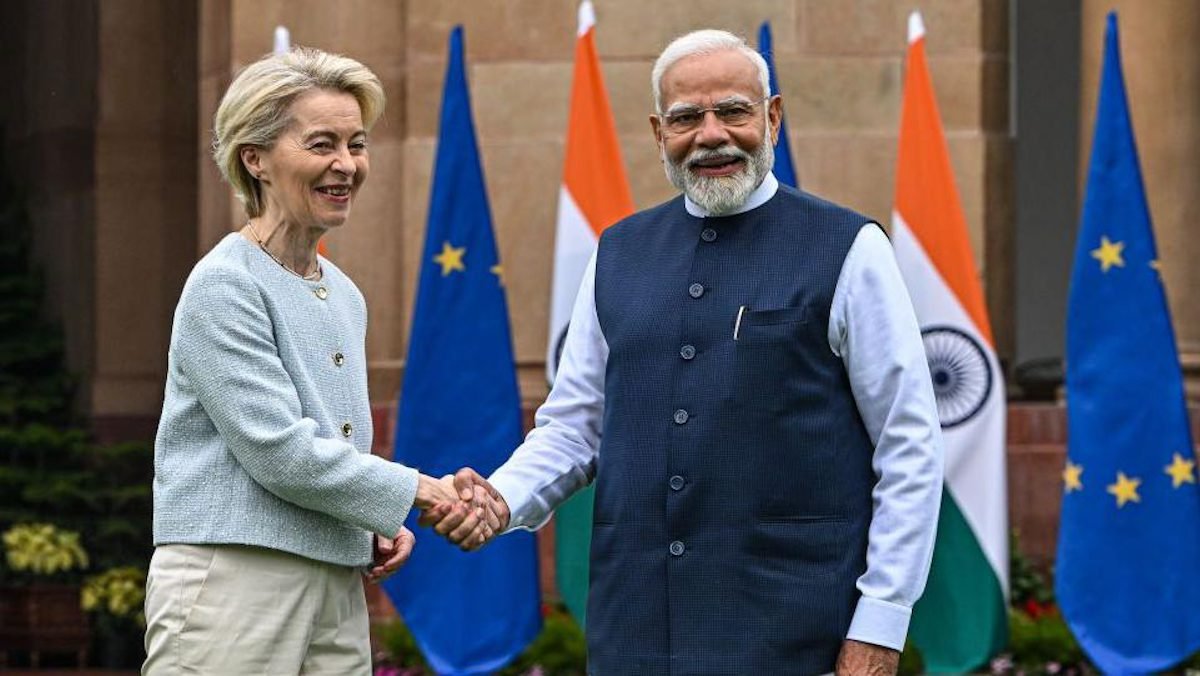
On March 30, as an 11-member delegation from the European Parliament touched down in New Delhi, the choreography of diplomacy unfolded with familiar optimism.
Meetings with Indian Foreign Minister Subrahmanyam Jaishankar and Commerce and Industry Minister Piyush Goyal were cordial, the language upbeat and the ambition unmistakable: fast-track the implementation of the long-negotiated India-European Union Free Trade Agreement (FTA), with signatures expected by the third quarter of 2026 and entry into force the following year.
Yet behind the pleasantries lay a deeper question: is this the beginning of a transformative economic partnership between two of the world’s largest markets—or merely a pragmatic alignment born of geopolitical anxiety?
For Brussels, the urgency is palpable. As European Parliament member Angelika Niebler put it bluntly, India represents a “trustworthy partner” in a world increasingly defined by fragmentation. The subtext is clear: Europe is hedging.
The aftershocks of the Russian invasion of Ukraine, tensions with China and a more transactional United States have forced the EU to rethink its economic dependencies. The result is a strategic pivot towards “friend-shoring”—and India, with its demographic heft and geopolitical autonomy, fits the bill.
Strategic trade calculus
For India, the calculus is equally strategic. New Delhi’s multi-alignment doctrine seeks to maximize economic opportunity without binding political commitments. An FTA with the EU—its second-largest trading partner—offers precisely that: access without entanglement.
The numbers alone justify the enthusiasm. Bilateral trade in goods between India and the EU reached roughly US$136 billion in fiscal year 2024–25, while services trade added another $83 billion. Together, the two economies account for nearly a quarter of global GDP and a third of world trade.
The FTA promises to deepen this relationship dramatically.
For India, the most immediate gain is market access. The EU’s single market remains one of the most lucrative in the world. Lower tariffs and regulatory alignment could propel Indian exports—particularly in engineering, pharmaceuticals, and textiles—towards the government’s ambitious $300 billion engineering export target.
For Europe, the appeal lies in diversification. India offers an alternative manufacturing base to China, a rapidly expanding consumer market, and a skilled workforce increasingly integrated into global value chains.
If implemented effectively, analysts estimate the agreement could increase bilateral trade by 40–60% within a decade, adding tens of billions of euros annually to both economies.
Notably absent from the deal, however, is agriculture—a deliberate omission designed to avoid the political backlash seen after the EU’s Mercosur agreement. This omission is tactically clever but strategically limiting.
Agriculture remains a sensitive sector on both sides. European farmers fear competition from lower-cost imports, while India is wary of exposing its vast rural population to global price volatility. By sidestepping the issue, negotiators have ensured smoother ratification—but at the cost of leaving a significant portion of trade untapped.
In its essence, the FTA is ambitious but not comprehensive.
Regulatory fault lines
If tariffs are the easy part, regulation is where the real battle begins. The EU’s regulatory framework—particularly mechanisms like the Carbon Border Adjustment Mechanism—poses a significant challenge for Indian exporters. Designed to prevent carbon leakage, CBAM effectively taxes imports based on their carbon footprint.
For Europe, this is a non-negotiable pillar of its climate policy. For India, it risks becoming a de facto trade barrier.
This tension encapsulates a broader dilemma: can a rules-based, sustainability-driven EU align with a rapidly industrialising India prioritizing growth?
There are also concerns around intellectual property, data protection, and labor standards. European firms will push for stronger protections, while India will resist measures perceived as constraining its policy autonomy.
As Niebler herself acknowledged, “the devil is in the details.” The European Parliament’s scrutiny process—though unlikely to derail the agreement—could yet reshape its contours.
Beyond economics, the FTA carries significant geopolitical implications.
For the EU, closer ties with India strengthen its Indo-Pacific strategy, offering a counterweight to China and reinforcing supply chain resilience. For India, the agreement enhances its global standing as a pivotal economic and diplomatic actor.
Yet this alignment is not without friction. Europe’s expectations on issues such as the Ukraine war—and its criticism of India’s continued purchases of Russian oil—highlight underlying divergences. Similarly, India’s independent foreign policy may occasionally clash with European priorities.
The risk is that economic cooperation outpaces political convergence, creating tensions that could spill over into trade relations.
Domestic dimensions
Both sides must also contend with domestic politics.
In Europe, trade agreements have become increasingly contentious, with environmental and labour groups demanding stricter safeguards. While the exclusion of agriculture reduces the risk of mass protests, scrutiny from civil society remains intense.
In India, the challenge is different but equally significant. The government must ensure that the benefits of the FTA are widely distributed, particularly among small and medium-sized enterprises (MSMEs), which form the backbone of the economy.
If the gains are perceived to accrue disproportionately to large corporations or urban centers, political support could quickly erode.
For the FTA to deliver on its promise, both sides must move beyond transactional thinking.
First, regulatory cooperation must become a priority. Rather than imposing standards unilaterally, the EU should work with India to build capacity and gradually align frameworks. This is particularly crucial in areas such as sustainability and digital trade.
Second, investment must accompany liberalization. European firms should not merely export to India but invest in its manufacturing ecosystem, fostering technology transfer and job creation.
Third, the agreement must remain flexible. As global economic conditions evolve, the FTA should include mechanisms for periodic review and adaptation, ensuring it remains relevant in a rapidly changing world.
Finally, both sides must recognize that trust—not just tariffs—is the foundation of any successful trade partnership.
A defining moment—if seized
The visit of the European Parliament delegation may, in retrospect, be seen as a footnote in the long history of EU–India relations. Or it may mark the moment when two economic giants decided to align their futures.
The truth likely lies somewhere in between. This is not a perfect agreement. It leaves gaps, avoids difficult questions and reflects the compromises inherent in any negotiation of this scale. But it is, undeniably, a significant one.
In a world drifting toward fragmentation, the India-EU FTA offers a rare counter-narrative: that cooperation, however imperfect, remains possible. Whether it becomes a genuine win-win — or merely a cautious experiment — will depend not on the text of the agreement, but on the political will to make it work.