Ramat Gan has absorbed wave after wave of alerts, cluster munitions, and direct hits, forcing families, medics, and city officials into a month of relentless adaptation
In Ramat Gan, the war with Iran is not something people follow through headlines or military briefings. It plays out inside homes, in stairwells, in the rush to reach a safe room before missile impact. For nearly a month, residents in this central Israeli city have been living under constant alerts, with daily routines repeatedly interrupted by sirens and the need to find shelter.
Ramat Gan Deputy Mayor Assaf Weiss, speaking to The Media Line from one of the impact sites, described the past 30 days as “an extremely, extremely difficult month” for the city. He said residents have faced nearly 150 sirens, forcing repeated runs to bomb shelters as Iranian missiles, cluster munitions, and falling shrapnel hit or threatened to hit residential areas.
We are within the city, within civilian population, within places where small kids are playing. And this is the front line of this war.
For Weiss, the key point is that the front line of the war is not a distant location. Quite the opposite is true. The war is right on their doorstep. “A lot of people, when they think about battles and war, they think about war zones and the front line as being something that soldiers are attacking—tanks, bombs, things like that,” he said. “This is the front line in this war. We are within the city, within civilian population, within places where small kids are playing. And this is the front line of this war.”
That framing is not the rhetorical flourish of a local official trying to dramatize a difficult situation. In Ramat Gan, the physical consequences are visible. Buildings have been damaged. Families have lost homes or been forced into temporary arrangements. Public infrastructure has had to be repaired under fire. Municipal services have had to function not just as administrative bodies but as crisis response mechanisms.
Cluster bombs [are] … targeted to harm as much casualties, as much damage to civilian population
The deputy mayor used unusually stark language when describing the use of cluster munitions. “We are currently in the location of a war crime,” he said. “This is a civilian population that is being targeted by cluster bombs. Cluster bombs don’t differentiate between army forces, bases, whatever. They’re targeted to harm as much casualties, as much damage to civilian population.”
He then pointed to the difference between a strike site where damage is survivable and one where it is not. “Here we have an apartment that was hit. Thank God, no one was harmed here,” he said. “But in a different location, two people died … They were just sitting in their living room. Suddenly, a bomb broke [through] their ceiling and exploded within their home. This is a big tragedy, and it’s a war crime.”
That contrast, between chance survival and catastrophic loss, runs through many of the testimonies emerging from the city. Osnat Tzemach, a Ramat Gan resident whose apartment was struck by a cluster munition, told The Media Line that the incident has blended into broader disorientation. “For a month now, we’ve been living through this,” she said. “Two weeks ago, one of the launches hit here and spread everywhere.” She said she had been in the shelter when she heard “a huge explosion,” and when she emerged, the street was already full of people and rescue personnel.
Sometimes I don’t even know what day it is anymore. Everything just blends together.
“The ceiling collapsed into the balcony,” she said, describing the damage simply. Yet even in the midst of visible destruction, she focused on the narrow line between damage and displacement. “We can still live in the house, which is very comforting after everything we see around us,” she said. Asked about the emotional toll, she added, “Sometimes I don’t even know what day it is anymore. Everything just blends together.”
That sense of blurred time appears repeatedly in conversations with residents. The strain is not only reflected in the fear felt during the attacks themselves, but also in the way regular routines are continually interrupted.
Children are out of school, and parents are constantly weighing small decisions which no longer feel so small—whether to stay at home or go to work, whether to keep their children inside or take them somewhere. Checking the location of a protected space is an integral part of the decision-making process.
Gili Lewinstein, a mother of five from Ramat Gan, told The Media Line that at the beginning of the escalation, her family barely left home, trying to remain as close as possible to shelter. But over time, she said, that became impossible to sustain. “We understand that we cannot stop our life at all,” she said. “And we need to try to do something like in routine.”
That has meant a different kind of routine rather than a return to normal. Lewinstein said her children remain at home while the family tries to keep moving through the day as best they can. “So, we’re trying to go to work,” she said. “And we’re trying to do shopping. … We go with the kids to the mall. Because also there is a shelter in the mall. And we’re trying to find the closest shelter. And to go there.”
It’s very, very difficult to go to work in a situation like this, when every few minutes there’s a siren, and you’re afraid
For Limor Dimbord, the pressure is felt both at home and on the job. Dimbord, a paramedic and ambulance driver in Ramat Gan, told The Media Line that the situation has become increasingly harder as the alerts continue. “It’s very, very difficult to go to work in a situation like this, when every few minutes there’s a siren, and you’re afraid,” she said.
She described a reality in which the frequency and spread of alerts leave little room to adjust. “There are sirens all the time. You constantly have to look for a protected place,” Dimbord noted. “It’s not easy. Not easy at all.”
Weiss said the municipality is dealing not only with the damage left behind by each strike, but with what happens after each siren. He described a situation in which daily life is repeatedly disrupted, and much of the work is about helping residents navigate that reality.
He said the focus has been on keeping essential systems working, from ensuring shelters are accessible to reaching residents who need more support. “We need special assistance in these types of things,” he added, referring to the elderly, people with disabilities, and families with young children.
With schools and kindergartens closed, the city has also tried to organize activities for children. “They don’t have school … they’re constantly going to bomb shelters and safe rooms,” Weiss said, describing the effort as a way to give them something to hold on to during a month that has been repeatedly disrupted.
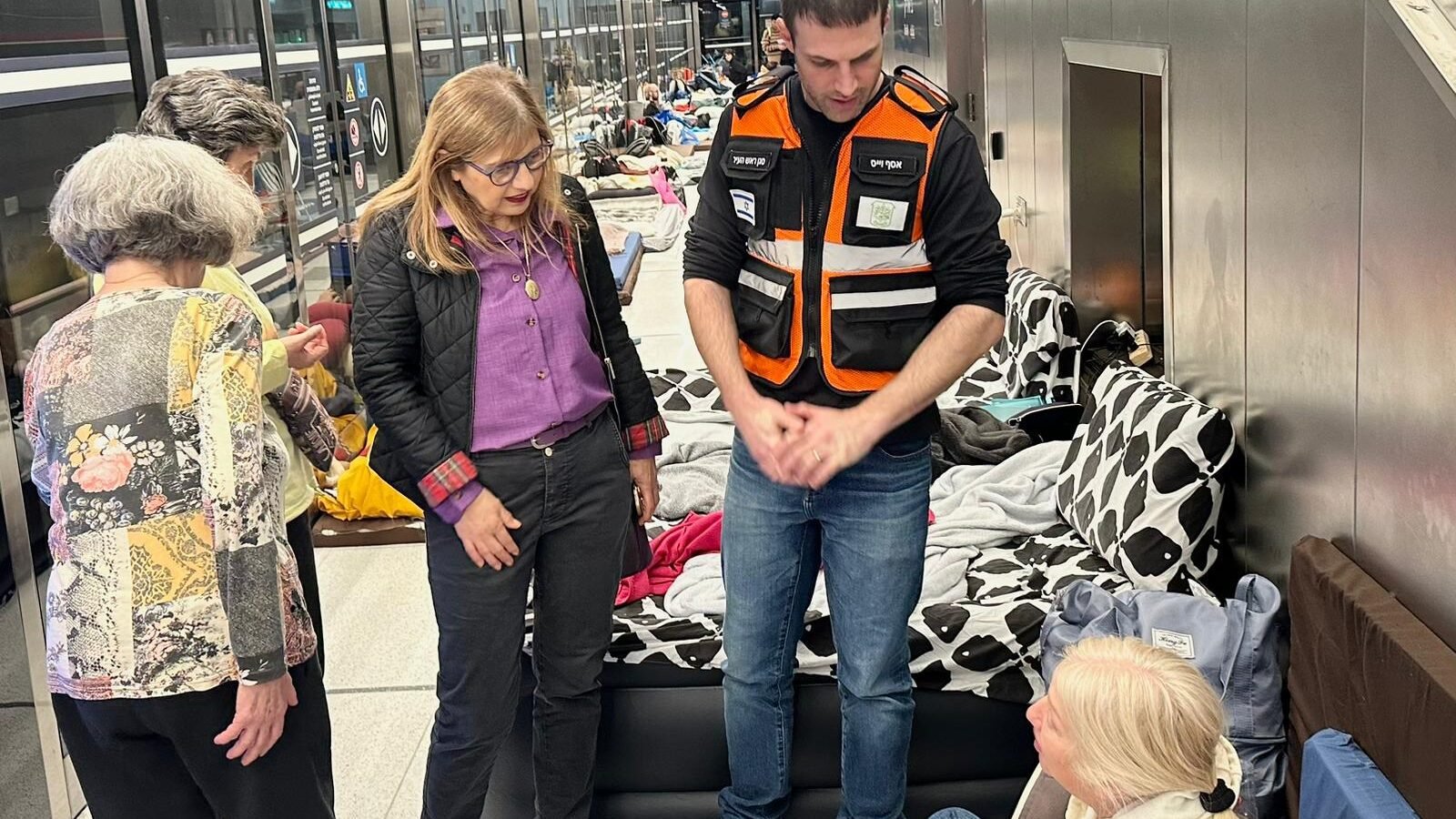
The practical burden is also financial. Every impact site creates not only personal trauma but administrative demands, from damaged streets and disrupted utilities to temporary shelter and support for residents who cannot safely remain at home. Weiss said the city is also dealing with people sleeping in train stations because they lack access to safer, protected spaces.
He emphasized that the most important response comes in the first minutes after an impact. “Whenever we arrive to a hit zone, for us it’s already unfortunately one of the dozen times that we’ve been to a hit zone,” Weiss explained. “For a person who just got hit by a bomb, it’s the first time they experience it.”
A person just got out of the safe room or was just sitting at home. Suddenly, his entire life exploded in front of his eyes.
“A person just got out of the safe room or was just sitting at home,” he said. “Suddenly, his entire life exploded in front of his eyes.”
That may be the clearest way to understand what this past month has meant for Ramat Gan. The number of sirens and the scale of the damage are harrowing, but so is the everyday experience of living in a city on the front line, where life continues but can be interrupted at any moment.