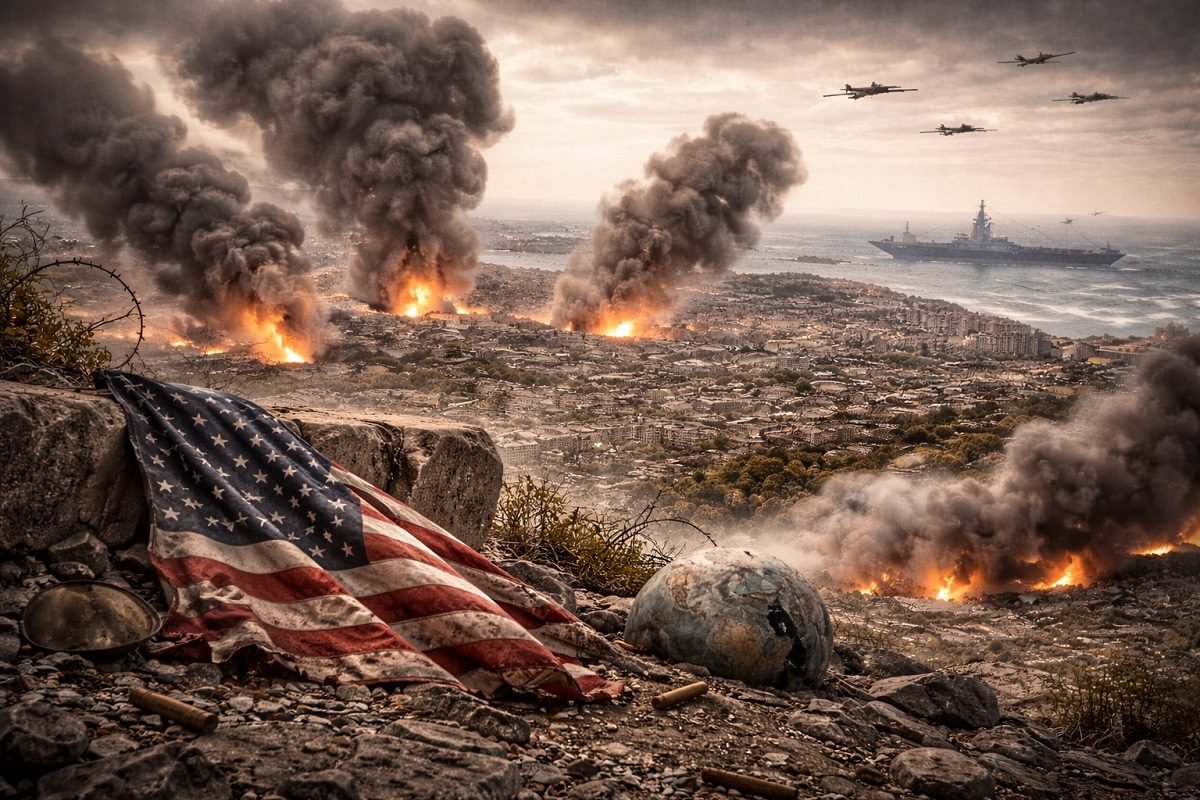
As the Middle East war between Iran, the United States, and Israel, enters its 34th day, it has become evident that we are witnessing more than just another chapter in the long and bloody annals of Middle Eastern strife.
The preceding 33 days have already accomplished what decades of geopolitical maneuvering could not: they have delivered a decisive, and likely irreversible, blow to the architecture of the American-led unipolar world order. What began as a regional confrontation has evolved into the ultimate stress test for a global system that has defined international relations since the end of the Cold War.
The military, diplomatic, and economic outcomes of this conflict are no longer mere battlefront statistics; they form a stark epitaph for a bygone era. The message is clear: American power can no longer serve as a credible security guarantee, and the hegemony that underpinned Pax Americana is undergoing a systematic, accelerating collapse.
In its place, the world is pivoting – with breathtaking speed – toward a complex tapestry of multilateralism and multipolarity. The new equilibrium will not be defined by a single superpower but forged through the partnership of emergent powers: China, Russia, Iran, Brazil, and others. For nations like India, a long-standing strategic partner of the United States, this realignment poses an existential question: can it navigate this transition, or will it be defined by its inability to do so?
In the successive paragraphs, we analyze the seismic shifts triggered by this war and forecast the contours of the global order now emerging from the rubble.
1. The end of invincibility: rethinking military supremacy
The 33-day conflict has done what no adversary had managed in decades: It has shattered the myth of American military invincibility. Despite the deployment of the most advanced air defense networks, radar systems and naval assets ever assembled, Iranian drones and missiles repeatedly penetrated the vaunted shield of US technology.
Systems like THAAD, Patriot and Aegis – long marketed by Washington as an “impenetrable armor” – proved incapable of neutralizing asymmetric threats. Precision strikes successfully targeted strategic oil facilities and military installations, demonstrating that sophisticated technology alone does not guarantee security for the Arabian Gulf’s emirs, sheikhs and beyond. This is a sobering revelation for allies who have staked their defense on American hardware.
The implications are profound. Over the next half-decade or more, we can expect a fundamental reconsideration of defense postures worldwide. Nations that once viewed their arsenals as inextricably linked to American supply chains will now diversify.
Indigenous development will surge, and markets will open for Chinese and Russian alternatives. The U.S. military-industrial complex, long a pillar of American economic and strategic power, faces a significant erosion of its market dominance. While the United States remains the largest defense spender, this war has proven that the effectiveness of that spending – its ability to project credible deterrence – is in steep decline.
No nation, whether in NATO, the Gulf Cooperation Council or the Quad, will henceforth treat US intervention as an inevitability or a guarantee.
2. The alliance system is in crisis and a credibility vacuum
The crisis of hardware is matched by a crisis of trust. For decades, the United States anchored its global influence on a network of ironclad security guarantees. This war has revealed those guarantees to be hollow.
When the Strait of Hormuz – a chokepoint for global energy – became a theatre of conflict, NATO allies stood silent. Asian partners, including Japan and South Korea, adopted a posture of strategic silence. The Gulf monarchies watched as American fleets and radar arrays failed to protect their sovereign assets.
This performance has accelerated the unravelling of the “hub and spoke” alliance model. Saudi Arabia and the UAE are no longer waiting for Washington to reaffirm its commitment; they are actively diversifying their strategic portfolios – deepening economic ties with China and defense cooperation with Russia.
In Europe, the appetite for a European army will grow as faith in NATO’s American anchor wanes. In Asia, the credibility of Quad and AUKUS will be shadowed by doubts about Washington’s ability to project power in a contested theatre in the future.
The lesson for the international community is clear: Hedging is no longer a strategy of the cautious; it is a necessity. Nations will cultivate balanced relationships with multiple powers, abandoning the rigid bipolarity of the Cold War and the unipolarity that followed. The credibility of the American-led alliance structure has been the bedrock of global stability for a generation; this war has cracked that bedrock.
3. From hegemon to primus inter pares
The post-World War II order, painstakingly constructed by Washington, is now approaching its historical terminus. The cracks that appeared during the Obama administration’s “Pivot to Asia” and “Leading from Behind” policies were deepened by “Indo-Pacific Strategy” and the “America First” unilateralism of the Trump years. With this war, those cracks have given way to a full collapse.
The United States can no longer credibly act as the world’s sole policeman. Its $1 Trillion defense budget, once a symbol of unchallengeable supremacy, now appears as an insufficient bulwark against asymmetric warfare. Simultaneously, the economic foundations of U.S. dominance are eroding. The American share of global GDP is declining, while China’s is rising. The expansion of BRICS challenges the dollar’s monetary hegemony.
Looking toward 2030, we foresee a world structured around three or four principal poles: the United States, China, a Russia-India partnership and a more autonomous European bloc. The U.S. will remain powerful, but it will be primus inter pares – first among equals – rather than the singular superpower. This is not merely a shift in the balance of power; it is a fundamental transformation of its nature.
4. The rise of multipolarity
If the old order is dying, what is being born? This war has rendered multipolarity not a theoretical concept but an operational reality. The “rules-based international order” – a phrase often used as a synonym for American primacy – is being supplanted by the construction of new norms.
Platforms like the Shanghai Cooperation Organization (SCO), an expanded BRICS and ASEAN are gaining influence that was unimaginable a decade ago. Calls for reforming the United Nations Security Council will grow from a murmur to a roar. The war has demonstrated that no single power can guarantee peace; the future demands partnership.
This transition will be built on new global structures for trade, energy, and finance. The Belt and Road Initiative, the Digital Silk Road, the Eurasian Economic Union and the African Continental Free Trade Area are creating economic blocs that operate outside traditional Western frameworks.
In finance, the dollar’s monopoly will give way to a more diverse ecosystem featuring the yuan, the rupee, and the ruble. In this new order, the United States will be a key participant, but its role will shift from wielding a veto to casting a vote – one voice among many in a concert of powers.
5. The American dilemma for managing decline or risking ruin
For the United States, the path forward demands a level of strategic restraint not seen in a century. The first and most critical step is acceptance: The era of hegemony is over. In the name of G2 the bipolar vision of a “new Cold War,” often favored by Washington’s policy establishment, has already been rejected by Beijing and does not align with the reality of a multipolar world.
The longer Washington clings to unilateralism, the more it accelerates its own marginalization. Should it, in a fit of military adventurism, commit a major miscalculation against Russia or China, it risks a strategic overreach that history judges harshly – a fate harking back to empires that mistook ambition for strength. The true measure of America’s power in the coming decades will not be its ability to wage war alone but its capacity to address internal decay: a crippling national debt, deepening economic inequality and political polarization that paralyzes decision-making.
Diplomacy, strategic restraint, and a genuine embrace of multilateral partnership are no longer idealistic preferences; they are necessities for survival.
The multipolar century
In a nutshell, the 34-day war with Iran will be remembered not for its tactical details but for its strategic consequences: It marked the end of American hegemony and opened the door to a new, more complex, more balanced, and just world order. In this multipolar century, peace and prosperity will not be dictated from a single capital but forged in the crucible of partnership.
This transformation will bring turbulence, but also opportunity. The old unipolar order is receding into history. The question that remains is not whether a new order will emerge – it is already emerging – but whether the great powers, particularly the United States, will accept this reality and adapt with wisdom.
Those who adapt swiftly will shape the future; those who resist will be shaped by it. The Iran war is merely the first chapter of this new epoch. The world must now prepare to embrace the dawn of the multipolar century.
This article was first published on Bhim Bhurtel’s Substack and is republished with permission. Become a subscriber to Bhim’s Substack here.