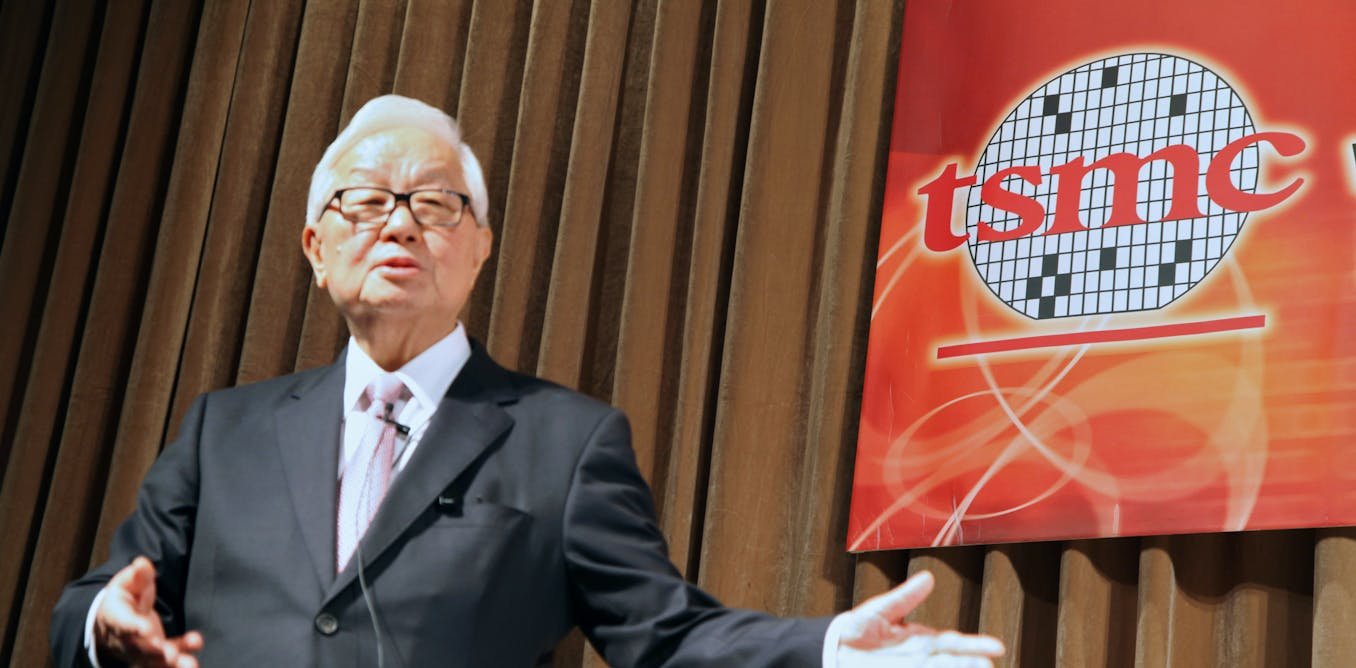
One firm, Taiwan Semiconductor Manufacturing Company (TSMC), produces more than 90% of the world’s most advanced semiconductor chips. These chips are essential for smartphones, artificial intelligence, high-performance computing and cutting-edge military systems.
Taiwan’s dominance of advanced chips acts as a chokepoint for the global economy. Days or weeks without their manufacturing would affect the supply and price of numerous products around the world. This is comparable to how the current disruption to shipping in the Persian Gulf due to the Iran war is affecting oil-dependent markets globally.
Taiwanese semiconductor manufacturing supremacy has transformed the island nation into what I have described in my research as a “niche superpower”. It wields outsized global influence by commanding a strategically indispensable industry.
Taiwan did not stumble into this position. In the 1970s, Taiwanese technocrats recognised that the nation could not immediately compete at the world’s electronics frontier. One of them was Kwoh-Ting Li, then minister of economic affairs, who is often referred to as the “father of Taiwan’s economic miracle”.
At that time, Taiwan lacked the financial capital and technological skills to compete with industry leaders such as Japan and the US. So rather than trying to dominate the entire semiconductor industry from design through to production, Taiwanese policymakers focused on building capabilities in precision manufacturing. This is the most operationally demanding part of the semiconductor value chain.
Established in 1973 by the Taiwanese government, the Industrial Technology Research Institute carefully acquired semiconductor process technology through licensing agreements with the now defunct US firm Radio Corporation of America (RCA). It then trained a generation of Taiwanese engineers.
The pivotal moment came in 1987, when Morris Chang established TSMC. Chang, a US-trained engineer who had spent decades at American semiconductor multinational Texas Instruments, devised what is now known as the “pure-play foundry” model.
Rather than designing and manufacturing its own branded chips, this meant that TSMC would manufacture chips for other firms. This strategic choice was transformative because it reassured American and European semiconductor companies that TSMC would not compete with them. It allowed major tech firms such as Qualcomm and later Nvidia to outsource chip production to Taiwan without fear of intellectual property leakage or strategic rivalry.
The Taiwanese semiconductor industry grew within the Hsinchu Science Park, a major industrial cluster south of the Taiwanese capital of Taipei. By the early 1990s, Hsinchu Park hosted more than 140 chip manufacturing firms and employed around 30,000 workers. The strength of the cluster attracted legions of Taiwanese engineers back from the US, helping Taiwan become the global leader in the production of advanced semiconductors.
The ‘silicon shield’
Taiwan’s semiconductor dominance has played an overt role in protecting the island from its existential threat – a Chinese invasion. This phenomenon was explicitly named in 2021 in an article published in Foreign Affairs magazine, where the former Taiwanese president, Tsai Ing-wen, argued that Taiwan’s semiconductor industry acts as a “silicon shield”.
The dependence of the global economy on Taiwanese-made advanced chips, she argued, means the disruption caused by a Chinese invasion would trigger catastrophic global economic consequences. Taiwan’s allies would thus be compelled to come to its defence.
In recent years, Taiwan’s silicon shield has come under threat. Following the start of US export restrictions on advanced chipmaking equipment to China in 2020, Beijing has accelerated its efforts to build indigenous capacity in chip manufacturing. It has significantly increased investment in its semiconductor industry.
Semiconductors were the underperformer in the Made in China 2025 strategy, through which Chinese leadership aimed to transform their nation into a high-tech manufacturing superpower. China fell short of its goals for the localisation of semiconductor production and global market share, missing targets by the 2025 deadline.
However, Chinese chip manufacturers like HiSilicon and Semiconductor Manufacturing International Corporation have been gaining momentum. A proposal by 13 Chinese chip industry executives in March outlined aims to increase self-sufficiency to 80% by 2030. China’s semiconductor self-sufficiency is currently around 33%.
At the same time, Washington is pushing to bring semiconductor manufacturing back onshore. Biden-era initiatives such as the Chips and Science Act offered incentives for TSMC’s sprawling manufacturing facility in Arizona, which opened in 2022 as part of US efforts to boost domestic chip production.
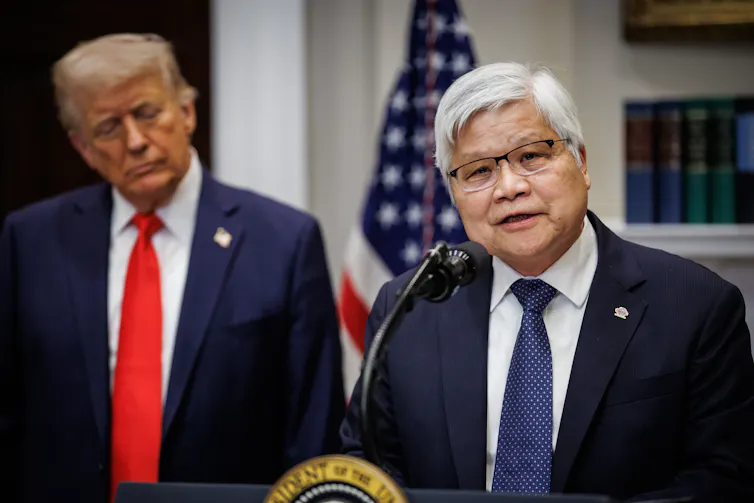
These incentives for TSMC included up to US$6.6 billion (£5 billion) in direct investment and significant tax credits. TSMC committed an initial US$65 billion to the plan, with the Trump administration announcing in March 2025 that the company would boost its US investment by a further US$100 billion.
Elon Musk also recently announced plans for advanced chip facilities in Texas for his two companies, Tesla and SpaceX. In light of Musk’s concerns that companies like TSMC are not producing the volume of chips his companies need, the so-called “Terafab” venture aims to consolidate every stage of the semiconductor production process under one roof and is expected to cost in the range of US$25 billion. Other companies investing in chip fabrication in the US include Micron, Texas Instruments and Intel.
Despite US and Chinese efforts, replicating Taiwan’s manufacturing ecosystem is difficult. It requires not only capital and equipment, but also knowledge that has been accumulated over decades as well as dense supplier networks and an unparalleled engineering workforce.
TSMC has struggled to hire talent in Arizona, and has resorted to flying thousands of workers in from Taiwan in a bid to improve the skills of locals. And while TSMC is now producing semiconductors at the cutting edge of 2-nanometre scale, the Chinese self-sufficiency goals aim to have “entirely domestically produced equipment” for the less sophisticated 7-nanometre and 14-nanometre generations of chips.
The difference between 2nm and 7nm chips is significant – a 45% increase in performance while using 75% less power. The narrower chips are used for advanced processes such as cutting-edge AI, while the wider ones are used in a broader range of electronics, like smartphones, desktop processors and automobiles.
Taiwan’s semiconductor story is ultimately one of strategic foresight. By choosing manufacturing over design, embedding itself within US-led technological networks and cultivating world-class process expertise, Taiwan transformed structural vulnerability into structural power.
Through its semiconductor dominance, Taiwan stands out as the quintessential niche superpower. But history shows that superpower status, including in niches, is never permanent. The technological frontier moves, rivals learn and allies hedge.
For Taiwan, remaining indispensable to the global economy will require not only staying ahead technologically. It will also require carefully orchestrating the political, financial and human capital foundations that made its silicon shield possible in the first place.