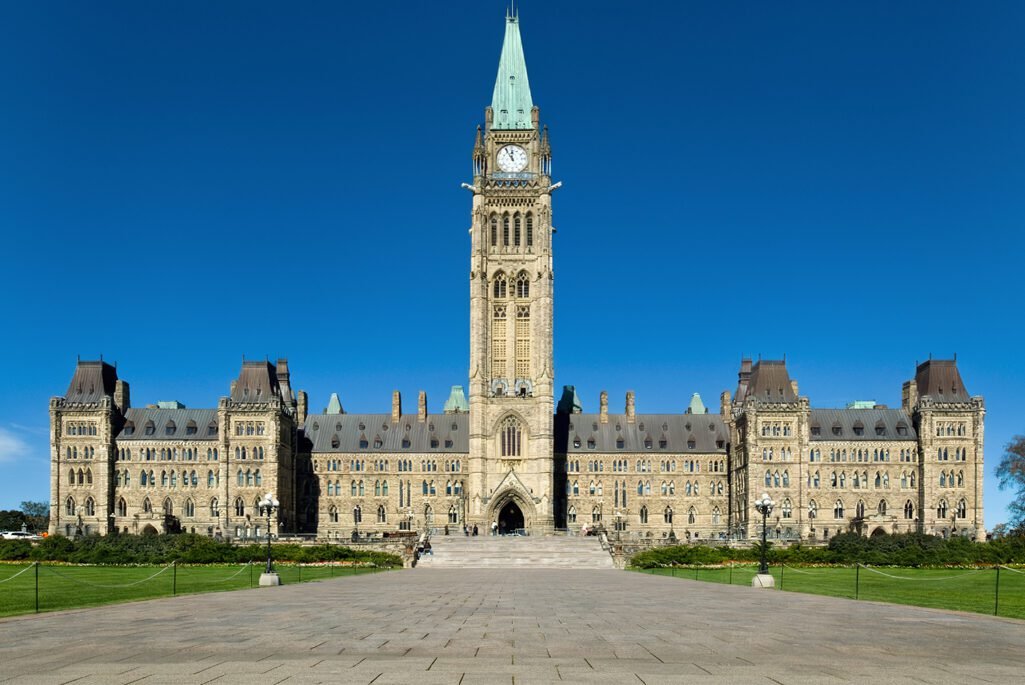
As Canada’s Parliament moved to pass legislation that could penalize the public quoting of certain biblical passages, a very different scene was unfolding in Ottawa. The inaugural Jerusalem Prayer Breakfast brought together Canadian politicians, Jewish leaders, Christian pastors, Indigenous faith voices, and international guests in a rare moment of unity. Hosted by Member of Parliament (MP) John Williamson and former federal minister Stockwell Day, the event reflected something increasingly absent from Canadian public life: a shared moral language rooted in faith.
Those in attendance included MPs Andrew Lawton, Richard Bragdon, Melissa Lantsman, Tamara Kronis, Shuvaloy Majumdar, Kelly DeRidder, Scott Aitchison, and James Bezan. Israel was represented by Ambassador Iddo Moed, former Member of Knesset (MK) Yehudah Glick, and Jerusalem Prayer Breakfast Global Director Albert Veksler. MK Ohad Tal sent a recorded video message commending the moral clarity of the participants.

Israeli Ambassador to Canada Iddo Moed receives a memorable gift from Christian leaders at the inaugural Jerusalem Prayer Breakfast in Ottawa, Canada, March 2026. (Albert Veksler)
The timing could hardly have been more striking. While hundreds gathered to pray for the peace of Jerusalem, Parliament debated measures that would criminalize the public expression of biblical teachings, especially passages related to sexual ethics, such as Leviticus 20:13, Romans 1:26–27, and passages in Deuteronomy. The question many are now asking is simple yet profound: Where does it stop?
For decades, Canada has prided itself on being a defender of religious freedom. Yet the country’s trajectory now appears increasingly confused. If quoting foundational religious texts becomes legally risky, it would signal not merely a policy shift but a troubling erosion of fundamental freedoms.
Nor does it seem that Parliament is alone in its hostility toward the Bible. Since 2021, more than 60 churches across Canada have been damaged or destroyed by fires, with 40 completely burned to the ground. In March 2026 alone, three synagogue shooting incidents occurred within days of one another in the Toronto area, targeting Shaarei Shomayim, Beth Avraham Yoseph, and Temple Emanu-El. These are not abstract statistics; they are symptoms of a society in a downward spiral.
At the Jerusalem Prayer Breakfast, Rabbi Idan Scher delivered a deeply personal account that captured this reality. He described how his young son, preparing for his bar mitzvah, became afraid to wear his kippah in public after enduring verbal abuse on the streets of Ottawa. Their home was later attacked. A colleague’s synagogue in Toronto was shot at shortly after a community gathering. “These are real people, real communities, and devastatingly real fear,” he said.
Scher’s words cut through the political rhetoric. They pointed to something more fundamental: a fraying social fabric in which religious identity, once a source of pride, is dangerously becoming a liability.
Meanwhile, Canada’s relationship with Israel has been strained. While not broken, the shift in tone and policy reflects a broader repositioning. This is precisely where faith-based initiatives like the Jerusalem Prayer Breakfast may offer a path forward. Governments change, but faith networks endure. Soft power grounded in shared values often outlasts formal alliances.
The success of the Jerusalem Prayer Breakfast in Ottawa suggests that there is still a hunger for unity, moral clarity, and courage. But as Rabbi Scher urged, that unity cannot remain confined to a single room. It must extend into public life, into policy, and into the daily reality of Canadians of all faiths. Canada’s government should take concrete steps to address rising antisemitism, including adopting the International Holocaust Remembrance Alliance definition. It should also reaffirm its commitment to protecting freedom of religious expression, not selectively but universally.
Canada now stands at a crossroads. As US President Woodrow Wilson said in his 1911 address, “The Bible and Progress,” delivered at the tercentenary celebration of the Bible’s translation into the English language, “A nation which does not remember what it was yesterday does not know what it is today, nor what it is trying to do.” Once a society begins to silence the Bible, even as biblical verses remain inscribed in Canada’s Parliament buildings, it risks losing its moral compass.