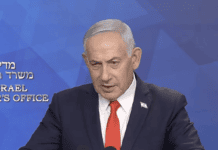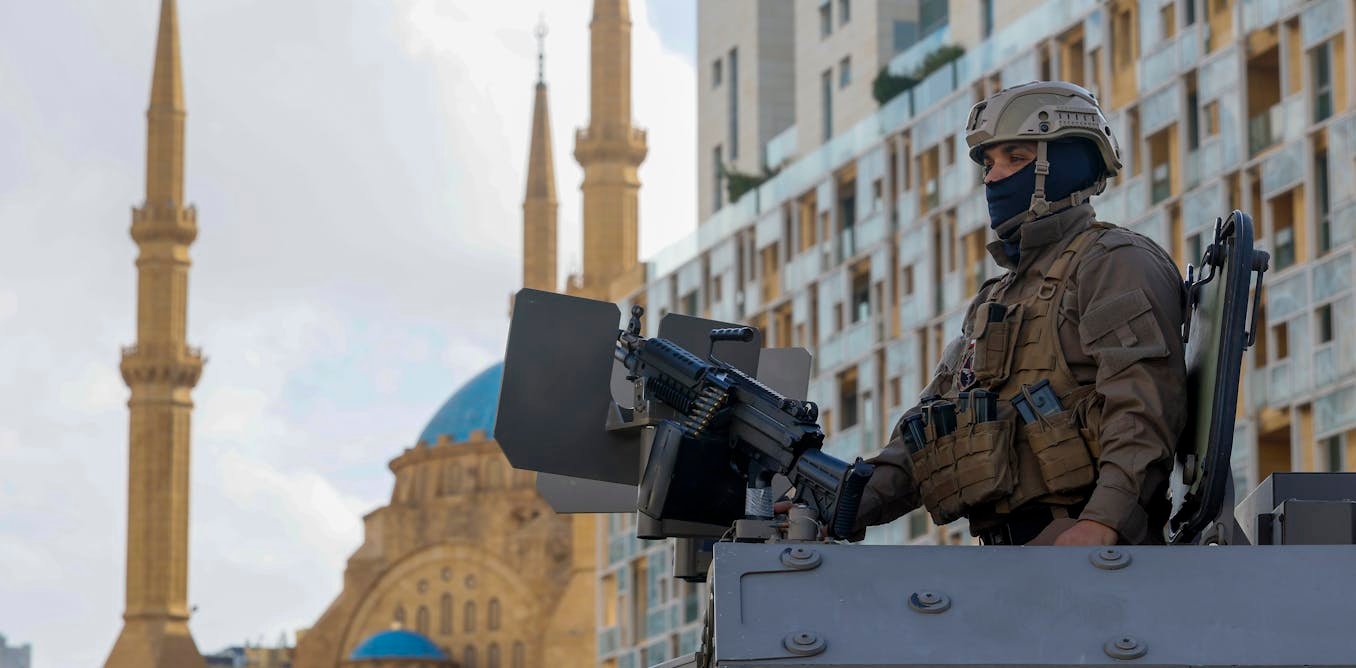
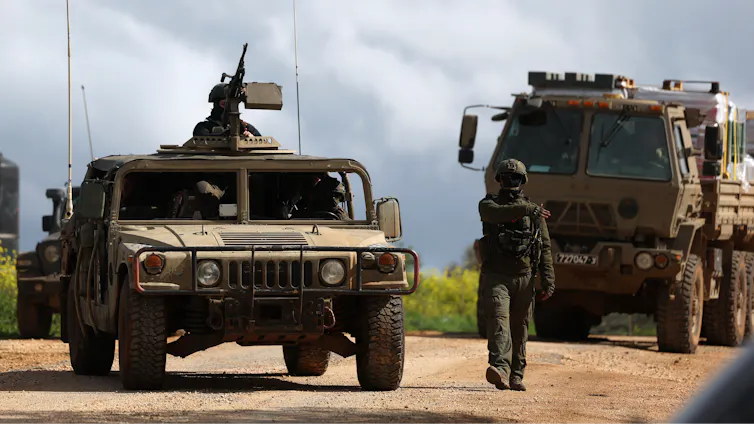
Israel’s prime minister, Benjamin Netanyahu, instructed the military on March 29 to expand its operations in southern Lebanon. It is the latest conflict between Israel and Hezbollah, in which Netanyahu has again promised to dismantle the Lebanese Shia group, and does not seem close to a conclusion.
This is not the first time Israel has invaded southern Lebanon. And people across the country are bracing themselves knowing that previous Israeli invasions have almost always resulted in longer-term occupation. Lebanese fears are worsened by the opaque situation on the ground.
Contradictory reports regularly break about the success or failure of Israeli incursions. The latest of these is a widespread but unconfirmed rumour that Israeli troops have captured the Beaufort Castle, a 12-century fortress that overlooks the Litani River.
The Litani splits Lebanon horizontally to form the country’s southernmost region, which is seen by Israeli officials as a buffer zone that can help protect it from Hezbollah attacks. More recently, however, extremist Israeli groups have begun to aspire to settle the area.
As Hezbollah fights the Israeli military in the south, a different kind of battle is taking place north of the Litani. Since the start of the war in early March, more than a million people have been forced to leave their homes. These people are mainly Shia Lebanese from the south and Beqaa Valley.
In a deeply divided society where most areas are clearly – even if unofficially – demarcated along religious lines, the influx of huge numbers of displaced Shia into traditionally Christian and Sunni areas was always bound to heighten sectarian tensions.
Reports have circulated of displaced women and children being accused of bearing loyalty to Hezbollah and turned back in some places. Many displaced men have also been judged to be Hezbollah operatives whose presence in non-Shia areas could result in targeted Israeli strikes.

The last round of conflict between Hezbollah and Israel in 2024 was met with a feeling of unity inside Lebanon. Sparked by a shocking attack in which Israel blew up communication devices used by Hezbollah operatives, killing 42 people and wounding thousands more, this conflict led to a general sense of injustice among Lebanese people.
This time, however, the war is seen by most to have been started after Hezbollah fired rockets towards Israel in retaliation for the killing of Iran’s supreme leader, Ali Khamenei. As a result, it has left many Lebanese people feeling dragged into a war they did not want.
Combined with the fact that Israel has not refrained from attacking non-Shia areas of Lebanon where it has identified targets for assassination, Christian and Sunni residents across the country have felt less ready to welcome those who have been displaced.
The government’s lack of preparation for the task of providing shelter and food for more than a million people has only aggravated the situation. While over 1,000 public schools have been converted into shelters, many displaced people are renting from private landlords. The result has been a direct integration of the displaced population into non-Shia areas.
On March 24, missile fragments that were later revealed to have originated from an intercepted Iranian missile fell over the Christian area of the coastal city of Jounieh. Within hours, a group of residents were filmed attempting to expel displaced people from their area, blaming them for what had happened.
A few days prior, a planned shelter in the Christian-dominated Karantina neighbourhood of the capital, Beirut, had to be cancelled because of a public campaign by residents who feared it would “bring strikes to the area”.
There is some evidence that Israel is using heightened sectarian tensions to provoke some kind of uprising against Hezbollah in Lebanon. Israeli warnings for residents in southern Lebanon to evacuate in early March included specific instructions to “move north toward [Sunni-dominated] Tripoli … and east toward [Christian-dominated] Mount Lebanon”.
And days later, on March 13, Israeli planes dropped leaflets over Beirut telling citizens that “Hezbollah is turning your homes into terrorist hideouts”.
Incoming political battle
Another difference to the 2024 conflict is the government in place in Lebanon. At that time, a caretaker government was in charge, while the presidential position remained vacant. In early 2025, a new president (Joseph Aoun) and prime minister (Nawaf Salam) were sworn into office and have since promised to tackle Hezbollah’s military capabilities.
Widely seen as pro-US, this government – which does include two Hezbollah ministers – has tried to take overt steps to distance itself from Hezbollah’s military operations against Israel in a clear attempt to safeguard the rest of the country.
On March 1, it became the first Lebanese government to ban Hezbollah’s military activities. And more recently it has attempted to expel the Iranian ambassador, Mohammad Reza Shibani, from the country in protest at Iran’s involvement in Lebanese politics.
The fact that Hezbollah has continued fighting Israel and the ambassador has defied the government’s orders gives a clear indication of how little power the Lebanese government holds. Still, the consequences of its declarations are felt in the country as they give anti-Hezbollah elements of society grounds to accuse the party of acting against the Lebanese state.
The last time such a direct confrontation of Hezbollah occurred within Lebanon was in 2008, when the government attempted to take down the group’s clandestine infrastructure. The result of this was violent sectarian clashes in Beirut.
Hezbollah has rejected the government’s actions. The deputy head of Hezbollah’s political council, Mahmoud Qomati, insisted on March 17 that the group is “able to upend the country … and upend the government in the face of such decisions”. He then implied a comparison between the Lebanese government and Vichy France, the collaborationist regime that governed southern France during the Nazi occupation in the second world war.
Past experience shows that there is no hope for an end to the hostilities in Lebanon so long as Hezbollah and the Lebanese government remain as diametrically opposed as they currently are. As it stands, there is no Shia representative in the proposed Lebanese delegation for ceasefire negotiations – highlighting how distant a resolution remains.
As Hezbollah continues to fight Israel in the south, the rest of Lebanon is facing the prospect of another devastating civil conflict.