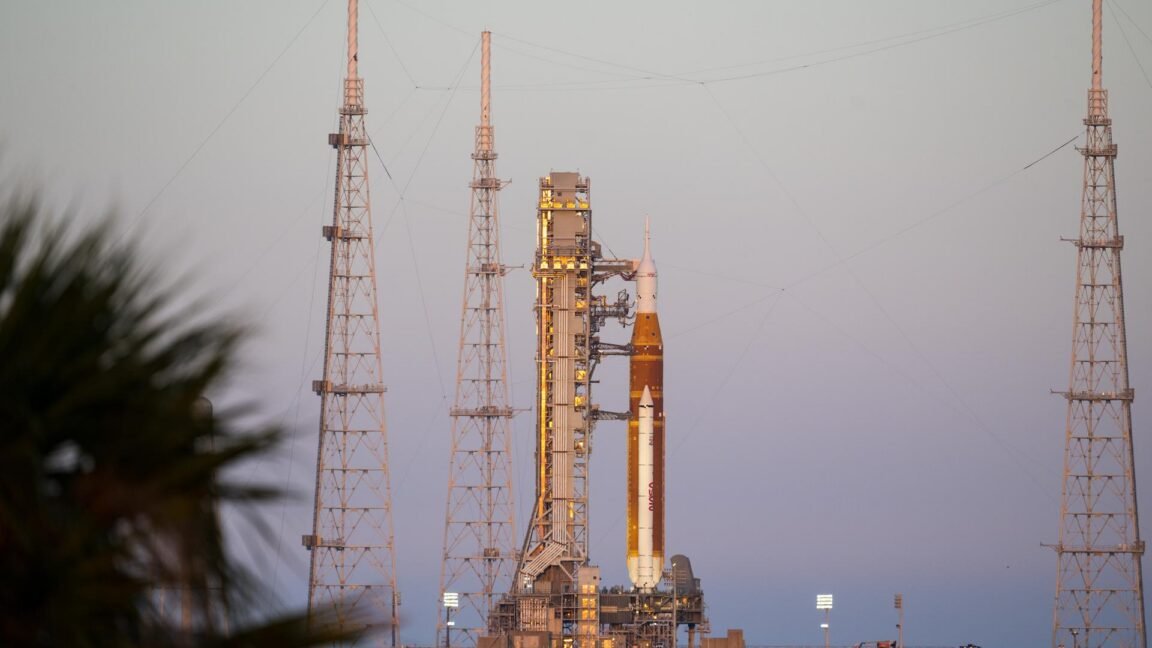
KENNEDY SPACE CENTER, Florida—The two-day countdown for the launch of NASA’s Artemis II mission began Monday evening, with clocks timed for the first of six opportunities in early April to send a crew of four astronauts around the far side of the Moon.
Liftoff from Launch Complex 39B at Kennedy Space Center in Florida is scheduled for a two-hour launch window opening at 6:24 pm EDT (22:24 UTC) on Wednesday. NASA has backup launch opportunities each day through Monday, April 6, or else the mission will have to wait until the end of the month.
Mission managers said Monday that all systems were looking good for launch this week. The weather forecast is favorable, with an 80 percent chance of acceptable conditions for liftoff Wednesday. The only weather concern at the launch site in Florida is a low chance of rain showers and cloud cover that could present a risk of lightning. But with a two-hour launch window, there should be plenty of time to wait out any scattered storms.
John Honeycutt, chair of NASA’s mission management team, told reporters Monday that there were “no showstoppers” for launch on Wednesday. Ground teams powered up the Space Launch System rocket and Orion spacecraft for final checkouts early Tuesday, setting the stage for loading super-cold liquid hydrogen and liquid oxygen into the rocket Wednesday morning.
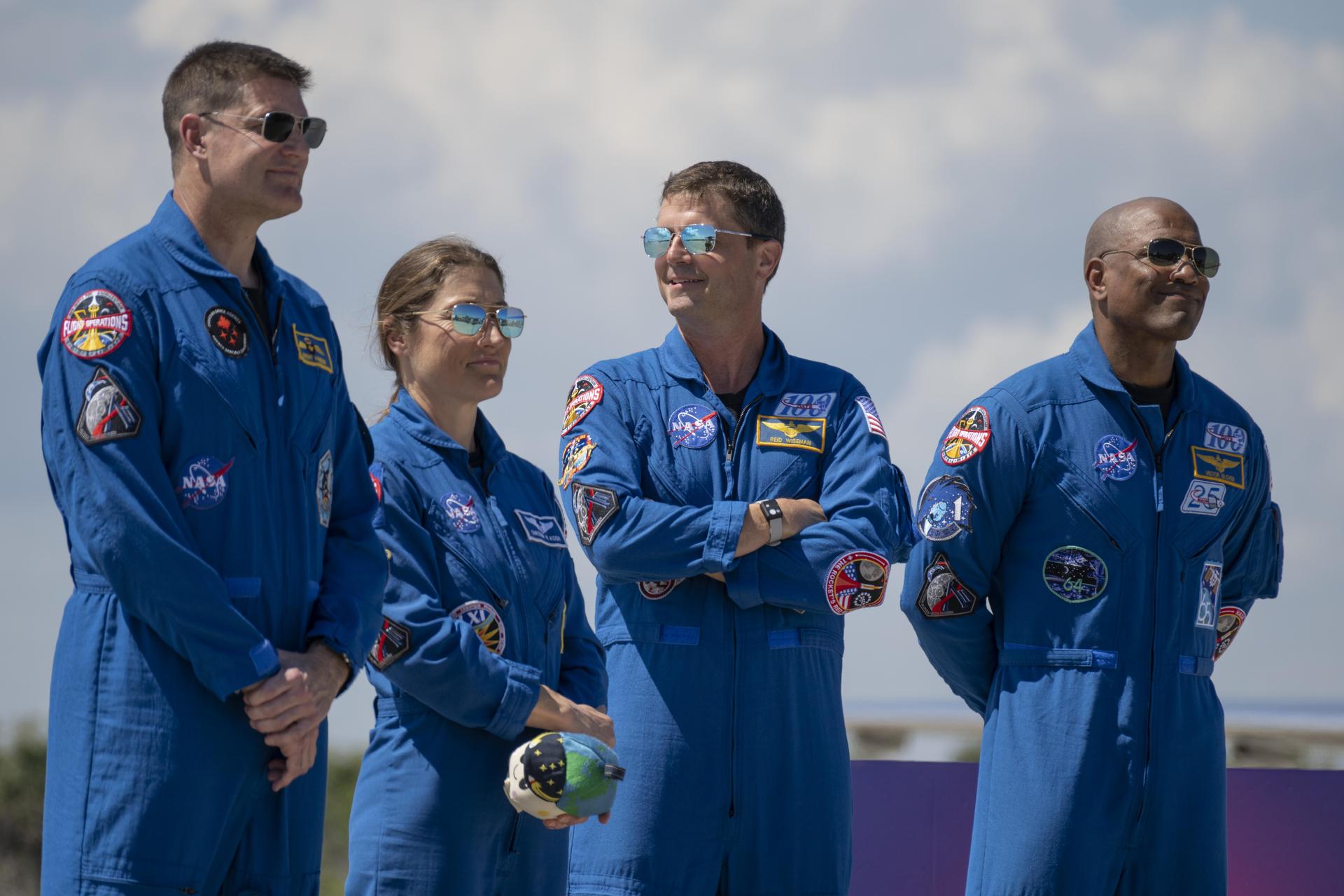
Commander Reid Wiseman, pilot Victor Glover, mission specialist Christina Koch, and Canadian astronaut Jeremy Hansen will strap into their seats inside the Orion crew capsule on Tuesday afternoon. If all goes according to plan, the 322-foot-tall (98-meter) rocket will ignite its four RS-25 main engines and twin solid rocket boosters at the opening of the launch window to propel itself off the launch pad with 8.8 million pounds of thrust.
Starting to feel real
There are several key milestones that the rocket, spacecraft, and launch team must get through before Artemis II can head for the Moon. Chief among these is fueling the SLS rocket, which hasn’t proven easy during past countdowns. Leaky seals have been a persistent problem for the SLS rocket, causing numerous delays during preparations for the rocket’s first test flight in 2022.
Another hydrogen leak cropped up during a practice countdown for this mission in January. Technicians replaced seals in the rocket’s hydrogen fueling line, and the problem did not recur during a second countdown rehearsal in February, before a separate issue forced NASA to return the rocket to the Vehicle Assembly Building for repairs.
Now, the rocket is back on the pad, and NASA officials shared cautious optimism that fueling for Wednesday’s launch attempt will proceed without any significant problems. If everything else is “go” for launch, the astronauts inside the spacecraft will be ready.
“Things are certainly starting to feel real here at the Cape,” said Koch. The crew members arrived in Florida on Friday, flying a set of T-38 supersonic trainer jets from their home base in Houston.
“Hey, let’s go to the Moon!” Wiseman said as he greeted VIPs and news media at the Florida spaceport. “I think the nation and the world has been waiting a long time to do this again, and on behalf of myself, Victor, Christina, and Jeremy, we are really pumped to go do this for this entire team. It has been a lot of work. It’s been a great journey.”
It has been a long wait. NASA and the world’s other space agencies have not ventured beyond low-Earth orbit since 1972, when the last Apollo mission returned from the Moon. The farthest anyone has traveled from Earth in that time was in 2024, when a team of commercial astronauts flew to an altitude of 870 miles (1,400 kilometers) on SpaceX’s Polaris Dawn mission.
Artemis II will reach a distance of more than a quarter million miles from Earth, looping thousands of miles beyond the far side of the Moon before Earth’s gravity pulls the Orion spacecraft back home for a scorching 25,000 mph (40,000 km/hr) reentry and splashdown in the Pacific Ocean.
Depending on the launch date (the exact trajectory varies day to day), the crew will fly farther than any humans in history and set a reentry speed record on the way home.
The mission will last more than nine days from liftoff to splashdown. After separation from the SLS rocket, the Orion spacecraft will spend a little more than a day in an elliptical altitude orbit ranging more than 40,000 miles from Earth. The astronauts and mission controllers in Houston will spend this time activating and testing the spacecraft, with a particular focus on Orion’s environmental control and life support systems, which were not part of an unpiloted Orion test flight four years ago.
Glover and Wiseman will take manual control of the spacecraft to assess Orion’s handling characteristics, commanding thrusters to guide the capsule back toward the SLS rocket’s upper stage to practice for docking maneuvers on future Artemis missions. Assuming everything checks out, Orion will fire its main engine for a translunar injection, or TLI, burn about 25 hours into the mission. This is the event that will send the astronauts toward the Moon.
This mission will not land. That will come on a future Artemis mission—currently slated for Artemis IV—no earlier than 2028. NASA is working with SpaceX and Blue Origin to develop commercial human-rated landers to ferry astronauts from the Orion spacecraft in lunar orbit down to the Moon’s surface and back. Those landers, along with new lunar spacesuits, won’t be ready for a landing mission next year, as NASA officials hoped.
NASA Administrator Jared Isaacman announced a shakeup of the Artemis program last week, shifting focus from building a space station in orbit around the Moon to constructing a base on the lunar surface. The program changes also included replanning the next Artemis mission—Artemis III—from a landing mission to a flight to dock an Orion crew capsule with one or both commercial landers closer to Earth.
The change will increase the chances of launching Artemis III next year. Sending SpaceX or Blue Origin’s landers to the Moon will require a mastery of in-orbit refueling, and neither company has demonstrated the capability yet. Refueling is not required for a test mission in low-Earth orbit on Artemis III.
“Over the last 10 weeks, the agency has prepared a crewed lunar test vehicle and also restructured the program that it belongs to,” said Amit Kshatriya, NASA’s associate administrator. “This was done deliberately. A crew that understands that campaign flies with greater purpose, a workforce that sees the road ahead holds a higher standard. This flight and the future reinforce each other. This is how Apollo worked, and this is how we will work.
“Behind this flight stands a campaign, landings, a lunar base, nuclear propulsion into deep space. That begins, not ends, with what happens on Wednesday evening,” Kshatriya said.