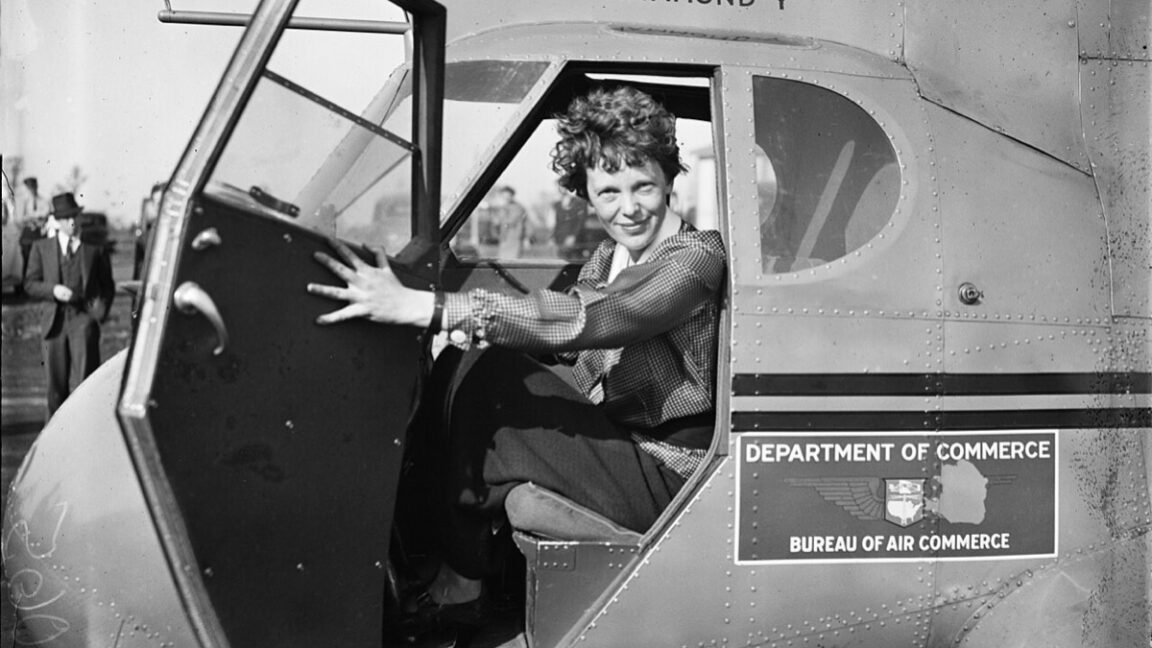
Famed aviator Amelia Earhart mysteriously disappeared in 1937 during an attempt to become the first female pilot to circumnavigate the globe. Speculative theories abound about what really happened to Earhart, but while tantalizing hints of her fate have popped up from time to time over the last 90 years, none have proved conclusive. The people behind those theories, and the extraordinary woman who still inspires them, are the focus of an eminently readable new book, Lost: Amelia Earhart’s Three Mysterious Deaths and One Extraordinary Life, by Rachel Hartigan.
A former editor of The Washington Post’s Book World, Hartigan worked for National Geographic magazine for 12 years, covering such diverse topics as the genetics of persimmon trees and the history of women’s suffrage. So why a book about Amelia Earhart? Hartigan acknowledged that she asked that question herself “in the darkest moments of writing.”
After all, there are countless biographies for readers of all ages, as well as books touting various theories about Earhart’s disappearance, not to mention occasional news coverage about the latest attempts to locate Earhart’s plane or her remains. (Just last fall, we reported on Laurie Gwen Shapiro’s The Aviator and the Showman, a biography exploring Earhart’s unconventional marriage to George Putnam, a flamboyant publisher with a flair for marketing.) “I just didn’t feel there was a book that tied everything together,” Hartigan told Ars. “You get these news stories of people saying they know where Amelia Earhart is, but you don’t have any context beyond the immediate story, all the things that make it a full picture.”
Hartigan hadn’t been particularly fascinated by Earhart when she got the chance to join a 2017 National Geographic-funded expedition to Nikumaroro Island to search for any evidence that the aviator and her navigator, Fred Noonan, may have been castaways there. “I definitely stumbled into it as a journalist,” she said. “I was literally on my way to the copy room and my editor said, ‘Oh, we have a berth on a ship going to the island where people think Amelia Earhart died. Do you want to go?’” Hartigan accepted, ultimately writing two feature stories for the magazine about the 2017 expedition and its 2019 follow-up (led by Robert Ballard). And those blossomed into a full-length book.
Three main theories
There are many theories about what happened to Earhart, including a 1970 book claiming that Earhart had not only survived the flight, she changed her name and remarried, becoming Irene Craigmile Bolam. Bolam herself vehemently denied this and sued the publisher, which pulled the book off the market and eventually reached a settlement. But three theories in particular have come to dominate among Earhart enthusiasts. First, she and Noonan lost their bearings, ran out of gas, and crashed in the ocean. Second, one or both of them ended up as castaways on Nikumaroro Island (formerly Gardner Island), eventually dying there of starvation or injury. Third, Japanese forces captured Earhart and Noonan and (most likely) executed them.


Hartigan takes on these three theories in turn in Lost, interweaving efforts to find evidence for each with an account of Earhart’s life. She admits that originally, she had been quite impressed with the case for the island castaway hypothesis, given that the 2017 expedition had found such telltale 1930s objects as a zipper pull and pocket knife, as well as a fire feature and water bottles. And trained cadaver dogs had identified the campsite as a place where there might be human remains.
“But none of that is actually tied specifically to Amelia Earhart or Fred Noonan,” said Hartigan. “It’s just confirmation that somebody died there and we don’t know who it was. No bones have been found. So by the second trip, I was a little more skeptical. There’s so many things I like about the castaway theory. But if I’m thinking about the most likely thing to have happened, the simplest explanation that matches with most of what we know, it’s that she got lost, ran out of gas, and crashed.”
In some sense, there has never been a better time to hunt for Earhart, given all the new science and technology at our disposal, particularly for deep-sea exploration. In 2003 and 2006, for example, David Jourdan used deep-sea sonar devices to search a 1,200-square-mile area north and west of Howland Island. His company, Nauticos, even conducted an elaborate experiment using 1930s equipment to determine how far off course Earhart and Noonan might have been when she sent her various radio messages. Most recently, a 2024 expedition searched for Earhart’s plane around Howland Island, the original planned landing site, but found no evidence of it.
Per Hartigan, it’s a little unfair to lump the men (and it is mostly men) hunting for Earhart into the same group as conspiracy theorists; it’s more akin to a scholar falling in love with their own pet theory. They can’t resist all the tantalizing hints that the proof they need might be lurking just around the next corner. “I respect all the work they’ve done,” said Hartigan of the enduring fascination. “They have dived into archives. They’ve traveled all over. They’re curious people, very diligent, they’re not amateurs. But I think it’s hard to resist the pull of the next little bit of evidence. So they just can’t let it go.”
Perhaps we will never solve the mystery of what happened to Amelia Earhart. Amelia’s niece, Amy Kleppner, believes Earhart likely ran out of fuel and crashed into the sea. Hartigan, who spoke with Kleppner and several other relatives, found herself commiserating with the fact that their grief “would forever be interrupted by people with new theories about how their loved one died”—even more so since Hartigan also suffered several family deaths while writing her book. “That really colored the last chapter,” said Hartigan. “This is a person, with a husband and a family, who disappeared and wrecked their lives—not on purpose, obviously. But there’s a big, giant hole left behind, and it’s not a celebrity hole. It’s a sister, a wife, a friend, an aunt.”