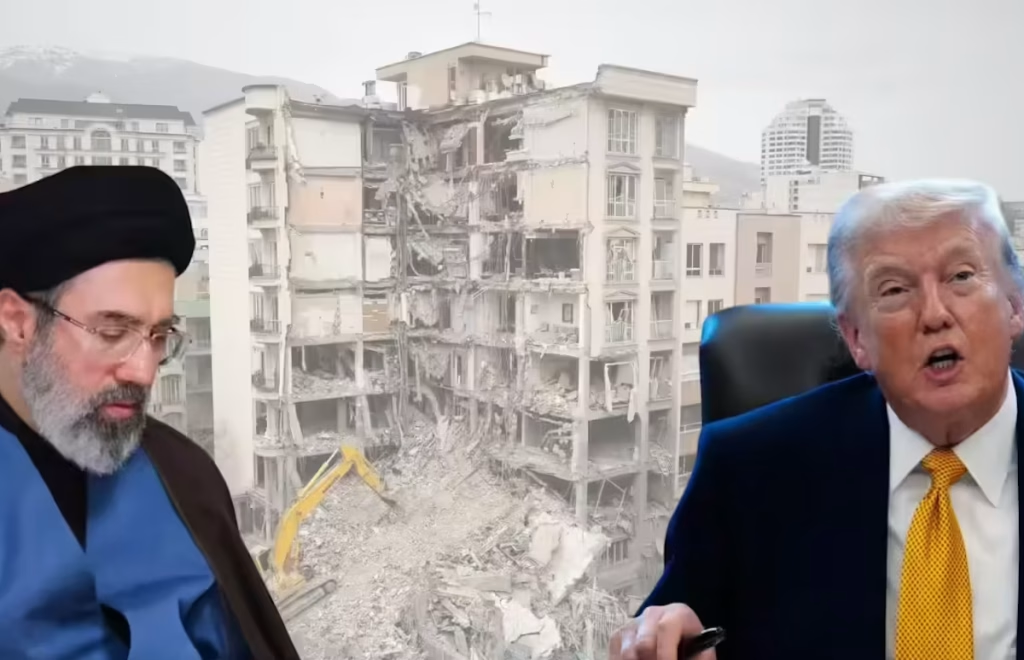
President Donald Trump is reportedly preparing to launch some kind of ground assault on Iran in the coming weeks, but one prominent military strategy expert believes he’s heading straight for defeat.
The Washington Post on Saturday reported that the Pentagon is preparing for “weeks” of ground operations in Iran, which for the last month has disrupted global energy markets by shutting down the Strait of Hormuz in response to aerial assaults by the US and Israel.
The Post’s sources revealed that “any potential ground operation would fall short of a full-scale invasion and could instead involve raids by a mixture of special operations forces and conventional infantry troops” that could be used to seize Kharg Island, a key Iranian oil export hub, or to search out and destroy weapons systems that could be used by the Iranians to target ships along the strait.
Michael Eisenstadt, director of the Military and Security Studies Program at the Washington Institute for Near East Policy, told the Post that taking over Kharg Island would be a highly risky operation for American troops, even if initially successful.
“I just wouldn’t want to be in that small place with Iran’s ability to rain down drones and maybe artillery,” said Eisenstadt.
Eisenstadt’s analysis was echoed by Ret. Gen. Joseph Votel, former head of US Central Command, who told ABC News that seizing and occupying Kharg Island would put US troops in a state of constant danger, warning they could be “very, very vulnerable” to drones and missiles launched from the shore.
Lawrence Freedman, professor emeritus of war studies at King’s College London, believes that the president has already checkmated himself regardless of what shape any ground operation takes.
In an analysis published Sunday, Freedman declared Trump had run “out of options” for victory, as there have been no signs of the Iranian regime crumbling due to US-Israeli attacks.
Freedman wrote that Trump now “appears to inhabit an alternative reality,” noting that “his utterances have become increasingly incoherent, with contradictory statements following quickly one after the other, and frankly delusional claims.”
Trump’s lone real option at this point, Freedman continued, would to simply declare that he had achieved an unprecedented victory and just walk away. But even in that case, wrote Freedman, “this would mean leaving behind a mess in the Gulf” with no guarantee that Iran would re-open the Strait of Hormuz.
“Success in war is judged not by damage caused but by political objectives realized,” Freedman wrote in his conclusion. “Here the objective was regime change, or at least the emergence of a new compliant leader… .Trump’s problem is that whatever the claims he might make about the damage to Iran’s nuclear and military capacity, which is substantial, the regime survives, the international economy has been severely disrupted, and the bills keep on coming in.”
Houthis
The Houthis on Saturday took credit for launching a ballistic missile at Israel, opening a new front in the war Trump started nearly one month ago.
As reported by Axios, the attack by the Houthis signals that the Yemen-based militia is joining the conflict to aide Iran, which has been under aerial assault from the US and Israel for the past four weeks.
Although the Houthi missile was intercepted by Israeli defenses, it is likely just the opening salvo in an expanding conflict throughout the Middle East.
Axios noted that while the Houthis entered the war by launching an attack on Israel, they could inflict the most damage on the US and its allies in the region by shutting down the strait of Bab al-Mandeb in the Red Sea.
“Doing that,” Axios explained, “would dramatically increase the global economic crisis that has been created due to the war with Iran” and its closure of the Strait of Hormuz, which has sent global energy prices skyrocketing.
Sky News international correspondent John Sparks reported on Saturday that the Houthis’ entrance into the war shows that “this crisis is expanding, it is escalating.”
Sparks argued that the Houthis’ decision to fire a missile at Israel signals that “the geographical spread of this conflict is expanding,” adding that “the Houthis have shown the ability to attack shipping in the Red Sea and the waters around the Arabian Peninsula.”
Sparks said that even though Trump and Secretary of State Marco Rubio “have been projecting confidence” about having the war under control, “it’s not playing out that way … on the ground.”
Danny Citrinowicz, senior researcher at the Institute for National Security Studies, argued that the Houthis’ main value to Iran isn’t launching strikes on Israel, but their ability to increase economic pressure on the US.
Citrinowicz also outlined ways the Houthis could further drive up the global price of energy.
“This raises a key question: whether the Houthis will escalate further by targeting Saudi infrastructure and shipping lanes more directly, or whether they will preserve this capability as an additional lever of pressure as the conflict evolves,” he wrote. “With each passing day of the conflict, particularly in light of its expanding scope against Iran, the likelihood of this scenario materializing continues to grow. It is increasingly not a question of if, but when.”
Journalist Spencer Ackerman similarly pointed to the Houthis’ ability to cause economic havoc as the biggest concern about their entrance into the conflict.
“You thought it was bad when Iran throttled the Strait of Hormuz?” he asked rhetorically. “The Houthis have already proven they can keep the Red Sea closed despite a year of US Navy skirmishing.”
Originally published by Common Dreams, this article is republished under a Creative Commons license.