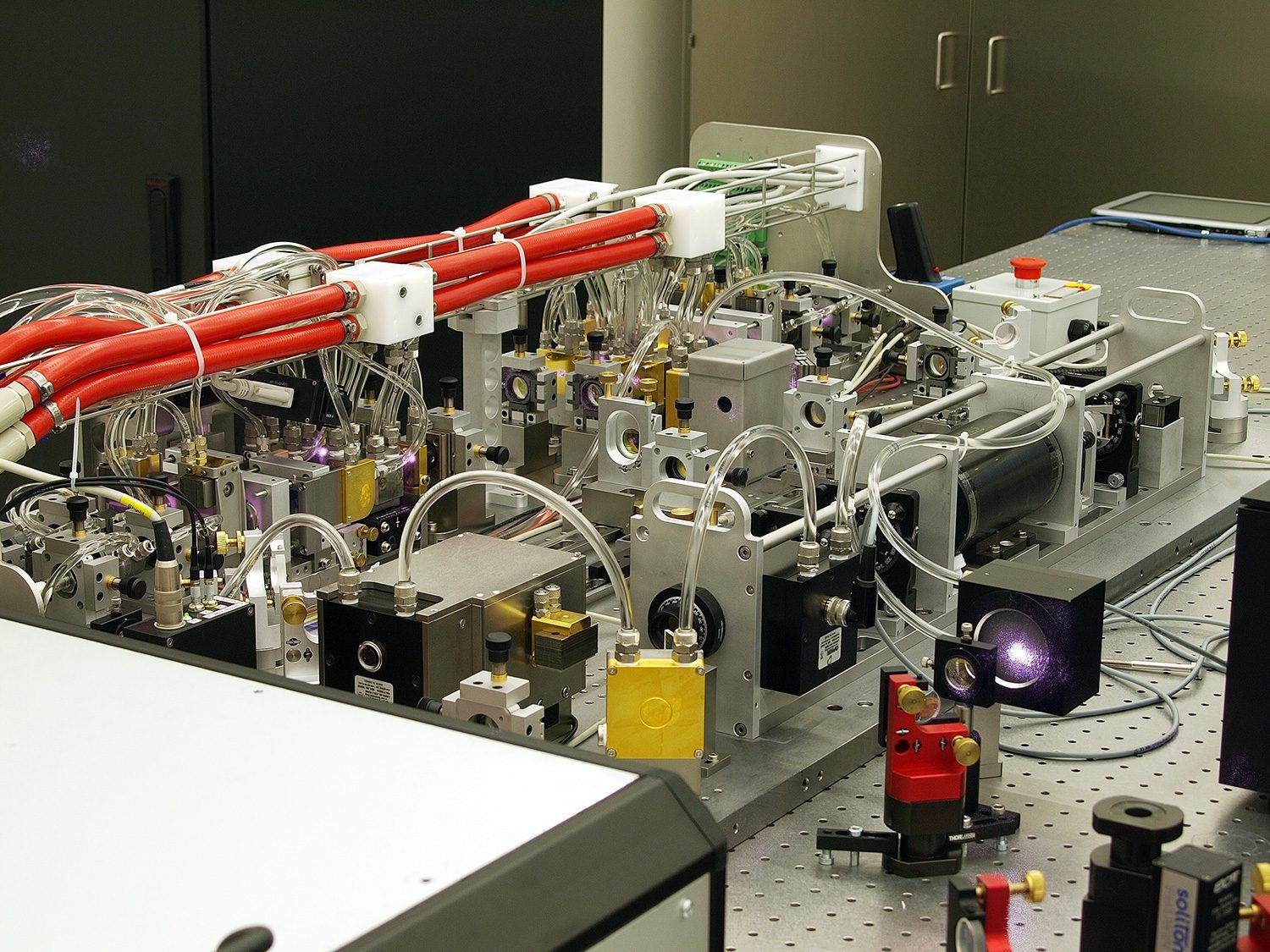
Over a decade ago, when I was first starting to pretend I could write about quantum mechanics, I covered a truly bizarre experiment. One half of a pair of entangled photons was sent through a device it could navigate as either a particle or a wave. After it was clear of the device, the other half of the pair was measured in a way that forced the first to act as one or the other. Once that was done, the first invariably behaved as if it were whatever the measurement made it into the whole time.
It was as if the measurement had reached backward in time to alter the photon’s behavior, raising questions about whether causality itself actually applied to quantum mechanics.
Unbeknownst to me, physicists have been asking the same question and have designed experiments to probe it in detail. A few weeks back, they provided an experiment that seems to indicate it’s possible to create quantum superpositions of two different series of events, essentially making the question of whether A or B happened first a matter of probability*. While the current experiment leaves a few loopholes, the researchers behind the work think they could ultimately be eliminated.
Causality
The term for the issue at play here, “indefinite causal order,” seems to imply causation, where event A compelled a second event, B, to occur. You see that in the experiment I described above. The measurement happened after a photon had traveled through the device yet seemed to be determining how that travel took place—on some level, it “caused” particle- or wave-like behavior. While a need for causality would seemingly determine the order in which the events had to take place, quantum mechanics was seemingly indifferent to that need.
And that’s what indefinite causal order really gets at: the temporal order of things. Did A or B happen first?
Addressing this scientifically has typically involved creating paths that force a causal order on things: If you go through A first, you will necessarily go through B next, and vice versa. And the experiments done so far seemed to suggest it’s possible to put these two alternative timelines into a superposition, an indeterminate state where the particle has experienced a mixture of both temporal orders. So far, at least, all these experiments have shown that this is what seems to be happening.
But the experiments were set up in ways that meant we could only use them to determine that this superposition occurred in this particular setup. They suggested that an indefinite causal order was a general feature of quantum mechanics, but they didn’t demonstrate it.
Ringing Bells
The new work, done by a team at the University of Vienna, addresses the generalization issue by turning to something that’s familiar to people with a background in quantum mechanics: Bell’s inequalities. Bell’s inequalities can be thought of as a way to address whether the weird quantum behavior we see reflects the nature of reality or whether there’s some hidden physical property we’re unaware of that’s somehow influencing what we measure.
In essence, Bell’s inequality allows us to predict a specific correlation of outcomes in an experiment. If the actual ratio of those outcomes we measure differs from that by a sufficiently large amount, we can rule out local hidden variables (“local” meaning “influence that doesn’t move faster than light”). Much of the study of entanglement over the last few decades has focused on designing experiments that gradually close loopholes through which variables could remain hidden, work that eventually earned some physicists a trip to see the King of Sweden.
The team from Vienna figured out how to create a Bell equivalent for indefinite causal order and set up a system to do the measuring. The system was arranged to produce entangled photons, one of which would be sent through a device so that it either experienced manipulation A first, then manipulation B, or the opposite. The order depended on its polarization. Its actual path was then measured. The second photon was simply measured to determine its polarization, which in turn tells us which path the first must have taken.
The results were 18 standard deviations away from what you’d expect based on Bell’s theorem, which is a strong indication that superposition of temporal order is a fundamental feature of quantum mechanics.
But the experiment remains where entanglement was a few decades ago: There are plenty of loopholes. For example, many photons are lost during the experiment (about 1 percent of those sent into it come out the other side to be measured). It remains technically possible that the losses were preferentially occurring among a subset of photons that would otherwise restore correlations that are compatible with hidden variables.
The team also hasn’t separated the hardware by far enough distances to rule out sub-light-speed influences, and there are a few potential oddities specific to indefinite causal-order experiments as well. But the work points the way toward experiments that could close these loopholes, and we already have a history of slamming the door shut on them.
Normally, when covering something weird like this, all we’re left with is the ability to gape at just how weird our world actually is compared to our expectations. But this is one of those cases where understanding the physics is already known to have many practical applications.
“The [device used in this work] may also be interesting for applications as it has been shown that it can outperform causally ordered processes at a wide variety of tasks such as channel discrimination, promise problems, communication complexity, noise mitigation, various thermodynamic applications, quantum metrology, quantum key distribution, entanglement generation, and distillation, among others,” the authors write.
In other words, getting confused about the time might actually be useful.
* I wouldn’t even be aware that this work was done if I hadn’t seen an excellent summary of it on the American Physical Society news site.
PRX Quantum, 2026. DOI: 10.1103/5t2y-ddmt (About DOIs).