Most elements of a major NASA event this week that laid out spaceflight plans for the coming decade were well received: a Moon base, a focus on less talk and more action, and working with industry to streamline regulations so increased innovation can propel the United States further into space.
However, one aspect of this event, named Ignition, has begun to run into serious turbulence. It involves NASA’s attempt to navigate a difficult issue with no clear solution: finding a commercial replacement for the aging International Space Station.
During the Ignition event on Tuesday, NASA leaders had blunt words for the future of commercial activity in low-Earth orbit. Essentially, they are not confident in the viability of a commercial marketplace for humans there, and the agency’s plan to work with private companies to develop independent space stations does not appear to be headed toward success. Plenty of people in the industry share these concerns, but NASA officials have not expressed them out loud before.
“We’re on a path that’s not leading us where we thought it would,” said Dana Weigel, manager of the International Space Station program for NASA.
NASA proposed a new solution that would bind the private companies more closely to NASA, requiring them not to build free-flying space stations but rather to work directly with the space agency on modules that would, at least initially, dock with the International Space Station. This change was not well-received.
By Wednesday morning, Dave Cavossa, president of the Commercial Spaceflight Federation, whose organization represents several of the companies proposing to build commercial space stations, shot back during a previously scheduled hearing before Congress.
Of NASA’s new solution, he said, “It is sowing concern—and really sowing confusion—among the commercial space companies I represent.” Cavossa compared NASA’s action to the famous Peanuts gag in which Lucy repeatedly pulls the football away from Charlie Brown as he tries to kick it: “It reminds me of sort of Lucy and Charlie Brown with the football.”
After speaking with a number of officials both in industry and the government, here’s an overview of what I believe is happening.
How we got here
NASA has never been good at transitions, be it from the end of Apollo to the space shuttle or the painful period from 2011 to 2020 when the shuttle stopped flying and the US space agency had to turn, hat in hand, to Russia to get its astronauts to the International Space Station.
As far back as 2018, then-NASA Administrator Jim Bridenstine was sounding the alarm about the need to find a replacement for the space station if the United States wanted to maintain an ongoing human presence in low-Earth orbit. By December 2021, NASA had established support, generally at the level of a few hundred million dollars, for four different companies to work on developing private stations: Axiom Space, Blue Origin, Nanoracks (later became Voyager), and Northrop Grumman (which later withdrew).
Since then, each company has substantially modified its approach, and a new player, Vast Space, has entered the competition. All were waiting for clarity from NASA on what, exactly, it wanted. This would come as part of a “requirements” document that would kick off a second round of competition. It was generally expected that this second phase would winnow the competition to two private vendors. NASA intended to help the companies develop their stations with funding and expertise and then become one of several customers.
Since 2021, the companies have faced a series of difficulties, and from the outside, it was never clear that any were on track to have a viable, independent station by 2030, when NASA intended to deorbit the space station.
At the same time, the US space agency has dragged its feet on initiating the second phase of the competition. Then, last August, the acting director of NASA, Sean Duffy, issued a “directive” that brought significant revisions to the program. Almost immediately, though, it seemed like key elements of this directive might be walked back, leading to additional months of confusion.
Clarity would only come through the issuance of a “request for proposals” that would lay out specifically what NASA wanted. For example, would it require stations to remain in orbit permanently? How much crew space did it need? And so on. Imagine being an engineer for one of these space station companies designing a station but not knowing exactly what the primary customer wanted. It was difficult. In January, a key Senate staffer reflected the frustrations of these companies when she said she was “begging” NASA to release the request for proposals document.
And still, it didn’t come. Then the Ignition event happened. Instead of announcing a release date for an RFP, however, NASA said it was scrambling the options again.
What is NASA thinking?
I’ve spoken with leaders at some of the private space station companies, and they’re not happy. At all.
“This could get ugly,” said one person familiar with the thinking of the private companies.
So what is NASA thinking? Why didn’t it just release the long-promised request for proposals?
We can get a sense both from comments made at the Ignition event by Weigel, Isaacman, and others during a news conference later in the day and from discussions with sources. Basically, NASA did not think the existing commercial space program would be successful.
Some points to consider:
Building space station modules is really hard. Despite billions of dollars and efforts by NASA and the European Space Agency to build new deep space station modules—the HALO and iHAB elements of the now-shelved Lunar Gateway—have both faced significant delays. There are rumors that both modules are actually corroded, perhaps beyond repair. Inevitably, NASA expects private providers to face similar delays.
It’s very expensive. Privately, the space station companies have told NASA they generally expect their stations to cost a few billion dollars to construct. NASA believes a truer estimate is probably in the range of $5 to $10 billion. And then it costs hundreds of millions of dollars a year to operate, on top of approximately $2 billion in crew and cargo transportation costs for continuous presence.
Stations are operationally challenging. NASA has to deal with debris-avoidance maneuvers, equipment failures, medical emergencies, and more. It is a big step up for any private company to handle that, and none of them have operational experience in these areas.
Who will come to the space stations? It’s not at all clear that the European Space Agency would pay private stations (or transportation providers such as SpaceX) directly for time on orbit. Typically, they have “bartered” services with NASA for crew time on the International Space Station. NASA is also dubious that the “orbital economy” touted by the private companies will come to pass. “We can’t entertain fiction,” NASA Associate Administrator Amit Kshatriya said this week. “It has to be grounded in reality.”
After Isaacman became administrator four months ago, the issue of what to do with commercial space stations has been one of several raging fires his team has had to put out. In some ways, it now appears to be the most intractable. The agency is forecasting about $250 million a year to spend on this program for the next half-decade. It does not believe that is enough money to credibly support more than one company. So agency leaders feel like they have to down-select to a single provider when history says that keeping competition in such commercial programs is essential.
“In the absence of a mature market and the current budget we’ve been allocated, we cannot fund a path to two stations,” Kshatriya said. “We cannot continue to maintain the illusion that the path that we’re on is going to close.”
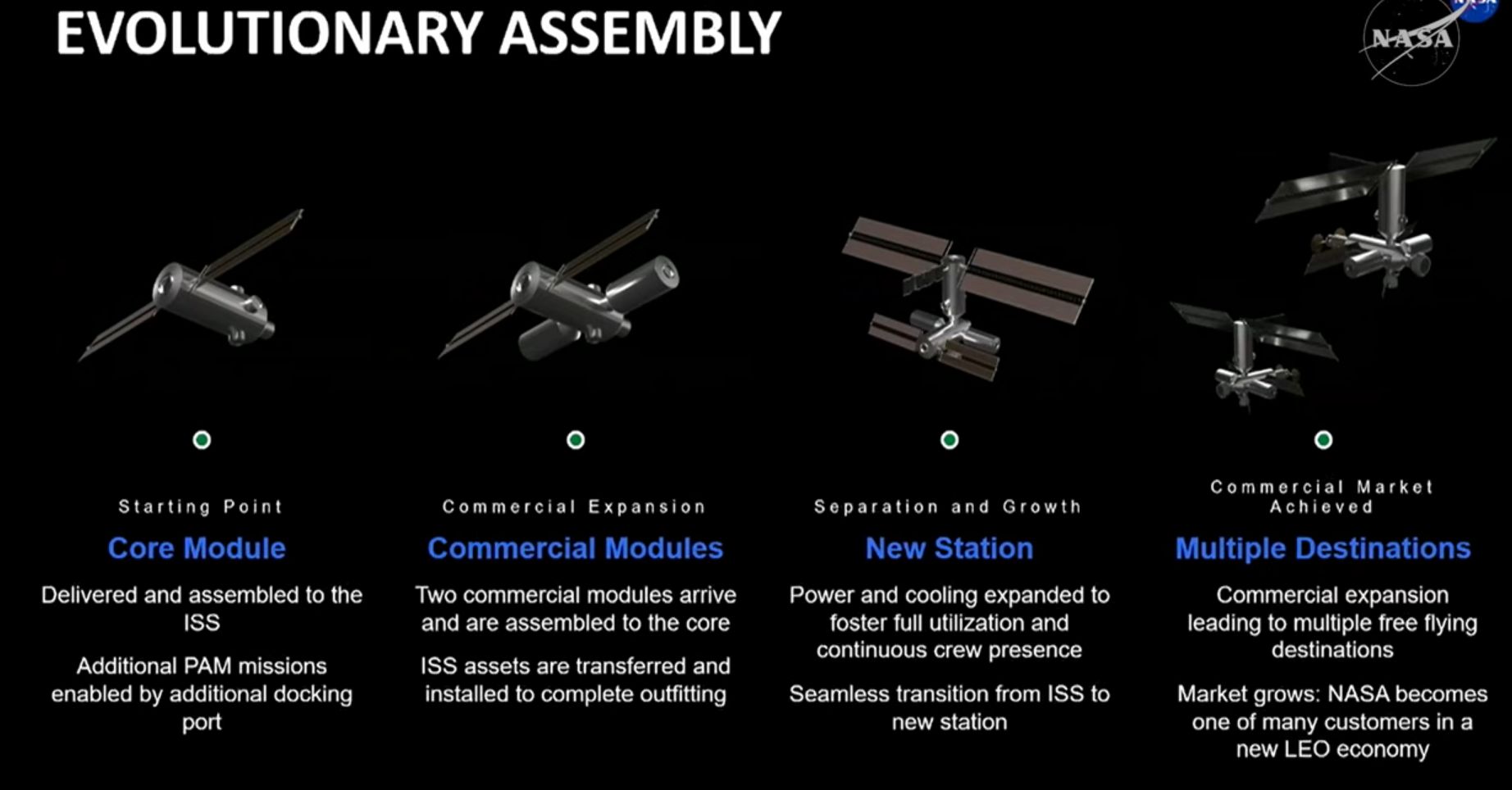
Because of these challenges, NASA offered private providers another way this week. The agency said it would procure a new “core module” to dock with the space station that would allow for multiple commercial providers to dock there. NASA invited companies to bring their first module to the International Space Station, where they could safely learn to operate in space while taking advantage of the power, propulsion, and transportation services the International Space Station program has to offer.
Essentially, NASA said the companies could learn to walk before they run. NASA officials stressed this was just an option, not a binding change yet. They have asked for industry feedback.
“I don’t see how this plan benefits industry”
I would imagine they’re getting an earful of it. In my discussions with private industry leaders, almost none of them like NASA’s new plan. They have various objections.
Some are concerned that it appears to be a giveaway to Axiom Space, which seemingly is already building the core module that NASA is seeking (this is the Payload Power Thermal Module). Axiom is already under contract with NASA to launch and attach this module to the International Space Station in a couple of years. There have been longstanding concerns that Axiom, co-founded by a former director of the International Space Station Program, has been subject to agency favoritism.
NASA officials insist that is not the case, however. The space agency said it is simply looking for a logical and achievable plan to transition from the International Space Station to private providers.
The architect of the original Commercial LEO destinations (CLD) program, a longtime NASA official named Phil McAlister who retired last year, does not believe NASA’s new option meets those goals.
“I don’t see how this new plan benefits industry at all,” he told Ars. “This new plan destroys the development work the companies have accomplished over the last several years, and it ensures NASA and the nation will see no benefit from the hundreds of millions of dollars that NASA has spent on CLD designs that are now obsolete.”
This is because the other three companies in play, Voyager, Blue Origin, and Vast Space, have all designed “free-flying” stations from the beginning. Their intent is to never dock with the International Space Station, nor go through the ultra-rigorous and expensive certification process such a maneuver would require.
Other commercial space advocates say NASA’s assessment of the commercial market is not credible.
“Commercial industry is already investing over twice as much as NASA has spent on CLDs over the past five years, but NASA thinks it understands commercial market potential better than private investors and want to cut CLD’s budget while extending ISS’ lifetime,” said Jim Muncy, co-founder and policy chair of the Space Frontier Foundation. “If NASA had held commercial ISS cargo resupply to this standard, they never would have funded Cargo and Commercial Crew, and much of today’s revolution would not be happening.”
So what happens now? I don’t know. These private companies (except for Blue Origin, backed by Bezos’ billions) have spent years fundraising from investors, basing business plans on a flourishing commercial market. NASA now says that does not reflect the reality of an orbital economy. It also wants to fly the ISS through at least 2032, giving providers even more uncertainty about when their services will be required.
Isaacman’s team feels like they’ve inherited a mess, and they’re searching for tenable solutions.
I would expect Congress to get involved fairly soon to settle the debate, perhaps as part of the coming fiscal year budget process, or maybe even before.