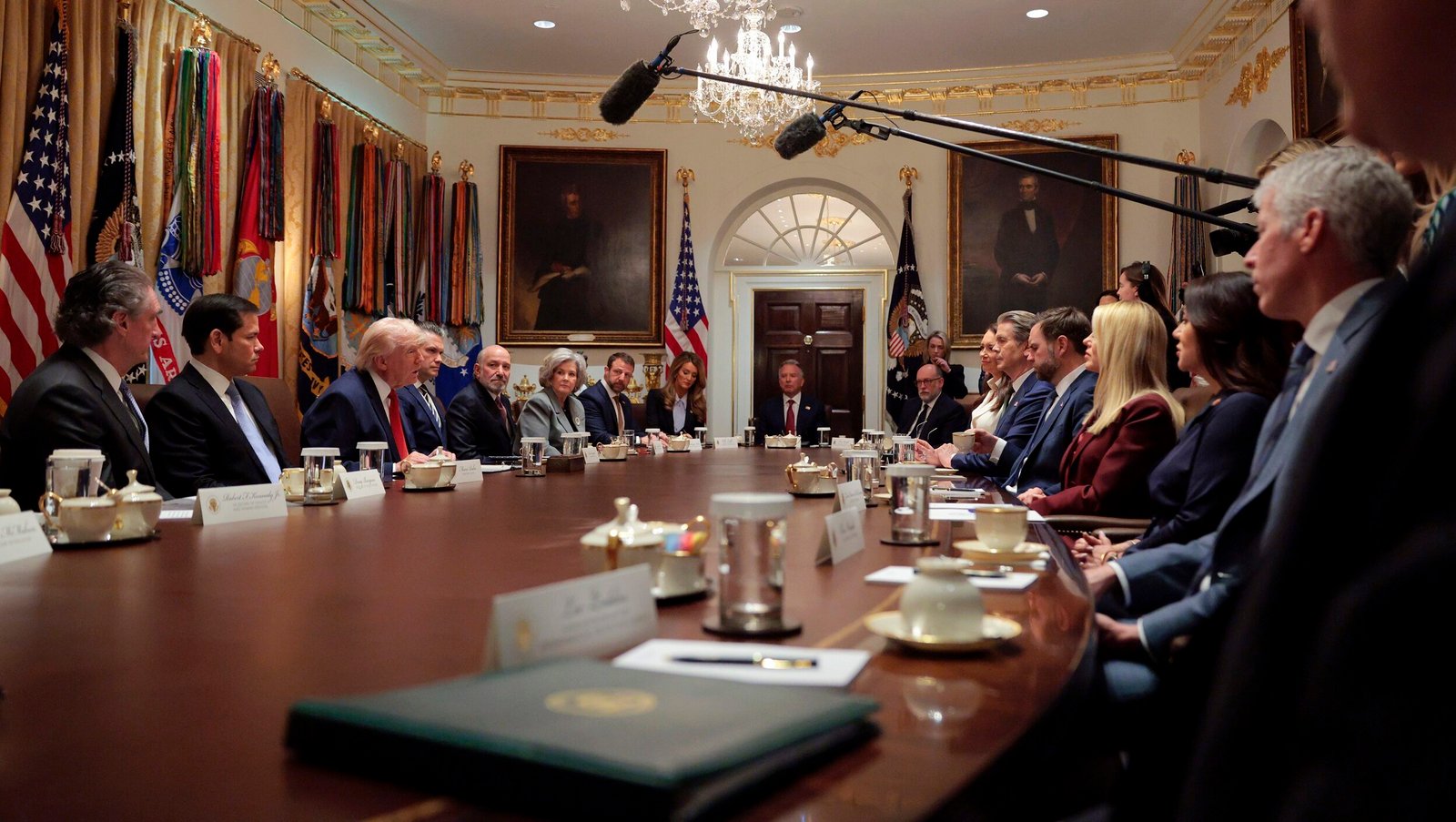
Washington is weighing diplomacy against continued military pressure as Iran resists direct talks and the Strait of Hormuz drives global economic risk
Over recent days, President Donald Trump has publicly shifted between threatening overwhelming force against Iran and suggesting Tehran wants a deal. With the Strait of Hormuz disrupting oil flows and jolting markets, Washington’s message has swung between coercion and diplomacy at the very moment the economic stakes are rising.
The result is an administration that still appears to be defining its strategy for an increasingly costly conflict. The question now driving debate in Washington and across the Middle East is whether the US president is seeking a real off-ramp after discovering that a prolonged Strait of Hormuz crisis is too dangerous to sustain, or whether the diplomatic messaging is simply another layer of pressure meant to buy time, calm markets, and preserve military options.
Available reporting suggests Washington is trying to keep both paths open. Reuters reported that President Trump said the US was in contact with Iranian officials and that Pakistan had expressed willingness to facilitate discussions. Several international outlets also reported that a 15-point US proposal had been passed to Iran through intermediaries, with Pakistan playing a central role and Turkey and Egypt also discussed as possible diplomatic channels.
Tehran, for its part, has publicly rejected the American framework in its current form while leaving room for indirect diplomacy. Iranian officials speaking on national television said Iran is “reviewing the US proposal” but is not engaging in direct negotiations under pressure. They also laid out their own conditions for any agreement: an immediate halt to US and Israeli military operations, guarantees against future attacks on Iranian territory, payment of war reparations, recognition of Iran’s sovereignty over the Strait of Hormuz, and acknowledgment of Iran’s right to maintain a civilian nuclear program. Those demands diverge sharply from reported US terms and show how wide the gap remains.
Nor has the US military posture in the region settled into any clear pattern of de-escalation. Additional troops have reportedly been readied or deployed as the war continues. Current estimates place roughly 45,000 to 50,000 US troops across the Middle East, with major concentrations in Qatar, Bahrain, Kuwait, and the United Arab Emirates, alongside deployments in Iraq and Syria and naval assets in the Gulf and Arabian Sea.
The public record on the US proposal remains incomplete. What has been reported suggests Washington is seeking major concessions from Tehran in exchange for sanctions relief and an end to hostilities. Those reported elements include dismantling or surrendering Iran’s enriched uranium stockpile, halting enrichment, curbing ballistic missile activity, cutting support to regional allies and proxy networks, and restoring shipping flows through the Strait of Hormuz. That is enough to sketch the broad American objective, but not enough to claim the full 15-point plan is known in detail.
At the end of the day, if there are differences between Israel and President Trump, the differences are with regard to tactics, not even strategy
From an Israeli perspective, the United States and Israel still appear aligned on core objectives even if their tactical approaches differ. Kobi Michael, a political analyst at the Institute for National Security Studies and the Misgav Institute, told The Media Line, “I think that at the end of the day, if there are differences between Israel and President Trump, the differences are with regard to tactics, not even strategy.” He added that both sides remain focused on outcomes. “President Trump is fully devoted, he is fully invested in this war, and he will not finish the war without achieving significant achievements. He understands that beyond press conferences and tweets, there are facts on the ground, and people will judge whether this was a success or a fiasco.”
Iran’s response matters just as much because it helps explain why the Strait of Hormuz has become the real pressure point in the war. Tehran has denied that meaningful direct talks are underway and rejected the American framing, even while signaling that it is reviewing the proposal. Iran also reportedly informed the United Nations and the International Maritime Organization that “nonhostile vessels” could transit the strait if they coordinated with Iranian authorities and were not involved in hostile action against Iran. That is not the same as reopening the waterway on normal commercial terms. It suggests Tehran is trying to turn access itself into leverage.
The stakes are global. Roughly one-fifth of the world’s oil and a significant share of liquefied natural gas trade pass through the strait. Reuters reported that the disruption has produced the biggest oil shock of the conflict, while hopes of a ceasefire were enough to push prices sharply lower in a single day. Kuwait’s oil chief described Iran as “holding the world’s economy hostage,” a sign that the war is being shaped not only by missile exchanges but also by the cost of uncertainty.
Against that backdrop, President Trump’s endgame looks less ideological than reactive. His administration appears to be trying to preserve four objectives at once: avoid looking weak after military escalation, prevent the Strait of Hormuz from remaining partially closed, reassure Gulf partners that have come under direct Iranian retaliation, and stop the war from hardening into an open-ended regional conflict that would pull the US deeper in. Those goals do not fully align. A deal that calms markets may look too soft to Gulf states and Israel if it leaves Iran’s regime, missile program, or proxy structure largely intact. Yet a strategy of “finishing the job” carries the risk of a longer war with heavier economic and military costs.
That tension is especially clear in the Gulf. Gulf Arab states told the UN Human Rights Council that Iranian strikes posed an “existential threat” after attacks on infrastructure and civilian sites across the region. Yet not all Gulf capitals appear to want the same outcome from Washington. The Wall Street Journal reported that Saudi Arabia and the UAE are uneasy with a quick diplomatic exit if it leaves Iran able to rebuild pressure. Other states, especially those more exposed to energy-market disruption and maritime insecurity, have stronger reasons to welcome even an imperfect arrangement that reopens the strait.
A Qatari-based political analyst speaking to The Media Line said any Gulf opening to talks would be driven first by relief at the possibility of de-escalation, particularly after earlier mediation efforts failed to prevent war. “If those reports turn out to be true, then the Gulf will feel relieved. Oman, in particular, will feel vindicated, as its foreign minister served as mediator between the US and Iran previously. Unfortunately, the US and Israel did not give Oman’s mediation efforts a chance, choosing instead to undermine them by attacking Iran just after a successful round of negotiations,” he said.
The same analyst said President Trump’s apparent shift reflected not just one political calculation, but a mix of international and regional pressure. “It was a combination of factors. Trump was dismayed when NATO allies like the UK and Germany chose not to intervene in the Strait of Hormuz,” he said. “That was a reflection of global sentiment towards this war; if Washington’s closest allies are unhappy, then you can assume that the rest of the world feels even worse,” he added.
He also said Gulf states have wanted the war to end from the start, even as Iranian aggression forced them to strengthen defenses while still favoring diplomacy. “Ultimately, a prolonged conflict will be too costly for the Gulf. So, while the region is ready to defend itself from any aggression, it would rather see all sides reach a negotiated settlement as soon as possible,” he said.
On the politics of a possible deal, he rejected the idea that a negotiated outcome would necessarily amount to a US defeat. “Regardless of what the media will say, the truth is that the US decimated Iran’s military capabilities and handicapped its economy. It will be very difficult for Iran to recover from this war,” he said.
Still, he warned that Israel may not share Washington’s appetite for de-escalation. “Israel will attempt to impede the negotiations. Pro-Israel factions in Washington will do their best to prevent peace and continue the violence,” he said, adding that Israel may continue striking Iran during talks, undercutting Washington’s position. “At best,” he said, “Israel may tolerate a brief truce before continuing its war against Iran.”
Michael, from the Israeli side, argued that diplomacy may be unfolding alongside military preparations, though he did not present that as confirmed policy. “Israel knew Trump’s intentions to opt for negotiations with Iran but for sure Israel won’t be able to face the Iranian threat and Hezbollah simultaneously. Trump is planning to do something else. This is the reason for the arrival in the region of the 82nd division and the Marines … in order to launch a very comprehensive ground military operation that will change the entire face of the war.” He added that diplomacy and force buildup should be understood as parallel tracks. “For two purposes: first, to build legitimacy, and second, to finalize the military preparations required to launch a comprehensive ground operation.”
Ahmad Sharawi, a research analyst at the Foundation for Defense of Democracies, focused instead on Gulf fears about what happens if the Iranian regime survives. “Gulf states have historically hedged in their approach to Iran, balancing engagement with deterrence, and it remains unclear what outcome they ultimately view as most favorable. What is clear, however, is that their assessment will be driven by competing considerations,” he told The Media Line.
He continued: “On one hand, the fall of the Iranian regime would significantly reduce the immediate threat to their infrastructure and remove a system that has targeted them relentlessly in recent weeks. On the other hand, such an outcome could introduce a new layer of uncertainty and instability, raising concerns about what might follow.”
Gulf capitals are not choosing cleanly between war and peace. They are weighing the risks of a damaged but surviving Iranian regime against the unknown consequences of regime collapse.
Anna Jacobs Khalaf, Gulf regional adviser at the European Institute of Peace and a nonresident fellow at the Arab Gulf States Institute in Washington, said the war has fundamentally changed Gulf threat calculations. “This war has completely exposed the Gulf states to Iranian retaliation. They are the ones directly in Iran’s line of fire, and this is only escalating. It has really become a series of worst-case scenarios for the Gulf states,” she told The Media Line.
Iran’s attacks are directly threatening the national security of the Gulf states, as well as their economic models, and they seem poised to become much worse
She added, “Iran’s attacks are directly threatening the national security of the Gulf states, as well as their economic models, and they seem poised to become much worse. Iran has crossed all the red lines for the Gulf states.”
Her view points to diverging paths within the Gulf. Saudi Arabia and the UAE appear increasingly drawn toward a more assertive deterrence posture, while Oman and Qatar continue to prioritize mediation and de-escalation.
Jacobs Khalaf, by contrast, said Gulf states are caught in a difficult position, wanting the war to end without allowing Iran to emerge emboldened. “The Iranian threat has become their top concern. The longer this war goes on, the more aggressive many Gulf states will become, except for Oman, probably,” she said.
She also gave weight both to improvisation and to a genuine search for de-escalation on President Trump’s part. “I think Trump is genuinely looking for off-ramps where he can. He got himself into a war that his administration was completely unprepared for. It doesn’t seem coordinated very well with Israel,” she said, adding that she expects several more weeks of war and some US troop involvement.
Michael also cautioned that while objectives remain aligned, Israel is alert to possible changes in US policy. “In principle, we are on the same page, but Israel understands that President Trump is unpredictable,” he said, noting that Israel must consider the possibility that Washington could change course or pursue an agreement that leaves Israel facing Iran largely alone, as happened earlier with the Houthis.
Much of the public debate assumes the conflict can be organized around a bilateral US-Iran process. In reality, the war spans at least three overlapping tracks: US-Iran bargaining, Israel’s military campaign and threat perceptions, and Gulf security concerns tied to trade routes and infrastructure vulnerability.
That wider regional picture includes a growing debate over the long-term cost of hosting American military assets. The Qatari-based political analyst argued that the conflict is forcing Gulf governments to reassess that balance. “For the Gulf, American military assets have increasingly become a liability. While they still value the security umbrella provided by Washington, the presence of these bases also exposes them to retaliation. If the threat level continues to rise, Gulf countries may reconsider hosting such assets in the future, especially if they are seen as drawing attacks onto their territory,” he said.
He also noted the strategic narrative Tehran may draw from the conflict if the regime survives. “Iran will also see a negotiated settlement as a victory because, from its strategic perspective, simply not losing is tantamount to victory,” he said.
Sharawi also argued that even a US-Iran understanding would not necessarily end the broader conflict. “Even if Washington pursues a deal, is it realistic to expect de-escalation between Israel and Iran? Could the Israeli-Iranian confrontation continue independently of US-Iran diplomacy, creating parallel and potentially conflicting tracks? This ultimately depends on what the deal entails,” he said.
It remains highly uncertain whether any agreement would compel Iran to halt support for its proxy networks or meaningfully constrain its ballistic missile and nuclear programs
He added, “It remains highly uncertain whether any agreement would compel Iran to halt support for its proxy networks or meaningfully constrain its ballistic missile and nuclear programs. If these core elements—proxies, missiles, and nuclear capabilities—are not comprehensively addressed, the underlying drivers of the Israel-Iran conflict will persist.”
Michael framed the preferred end state as an Iran so weakened that it could no longer rebuild its regional influence or continue financing proxy networks. “I hope that eventually the war will not last too long, but will last until the stage that this regime will be so weak that it will not be able to reconstitute itself and to become once again a severe security threat on Israel and on the region, and it will not be able to continue supporting and financing its proxies,” he said, adding that such an outcome “will impact very positively the entire region.”
For now, the American endgame looks less like a fully formed doctrine than a search for an exit that does not look like retreat. President Trump’s rhetoric suggests he wants to present any settlement as proof that maximum pressure worked: the US struck Iran hard, Tehran blinked, shipping resumed, and Washington imposed terms. But the reporting so far does not support the idea that Tehran would simply accept that version of events. Iran has denied direct talks, rejected the American framing, and tried to turn Hormuz itself into leverage.
At the same time, Gulf governments remain divided between relief at any path that lowers immediate exposure and concern that an incomplete deal could leave Iran wounded but not constrained. Israel, meanwhile, appears unconvinced that diplomacy can substitute for continued force.
The most plausible reading of Washington’s behavior is not that President Trump has cleanly chosen between war and diplomacy. It is that he is trying to preserve both, using talks to reduce pressure while holding escalation in reserve if the terms are rejected. That may calm markets for a time. It may even produce a short-term arrangement around shipping and ceasefire mechanics. But unless the underlying disputes over Iran’s missile program, regional proxies, nuclear capacity, and freedom of navigation are addressed in terms the main actors are actually willing to accept, this looks less like a stable ending than a pause before the next phase of the war.