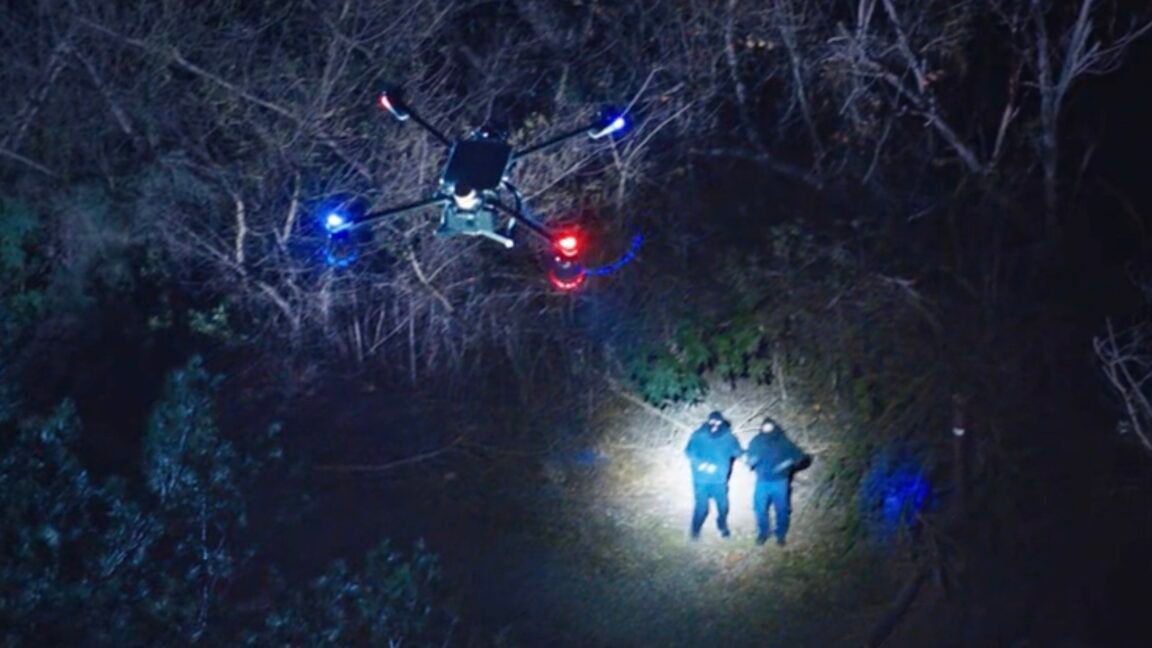
Drone startup BRINC announced Tuesday a significant upgrade for its law enforcement drones. BRINC’s newest model, Guardian, will have Starlink connectivity on every unit—a first for commercially available drones.
This new model, which will enter production later this year, has a flight time of over an hour and can reach a top speed of over 60 miles per hour. BRINC calls it the “first drone that can pursue vehicles.”
Additionally, Guardian can carry numerous payloads from its charging “nest,” including a floatation device, a defibrillator, epipens, the overdose-reversal drug Narcan, and more. The nest can also robotically swap batteries in about a minute, the company claims.
Guardian also has much better imaging capabilities, with dual 4K visual sensors and 640x total zoom, which the company says can “provide a clear view from over a thousand feet away.”
“It’s really the most capable 911 response drone ever,” BRINC’s founder, Blake Resnick, said during a presentation on Tuesday. “Guardian is more of a direct police helicopter competitor than the drone industry has produced to date.”
Additionally, Resnick said, the drone has a very loud siren, capable of emitting at 130 dB—roughly equivalent to a jackhammer or a jet takeoff.
“If you had Guardian playing a siren tone that was tuned to match the frequency of the speaker and a police car playing as the siren tone next to it, Guardian would be three times louder,” he said.
The Seattle-based BRINC makes drones currently used by over 900 American cities, including Laredo, Texas, and Chattanooga, Tennessee, as part of the growing “drone as first responder” (DFR) system.
Typically, cities pay a few hundred thousand dollars per year per drone—with contracts reaching into the millions with more drones and more capabilities. A year ago, Newport Beach, California, announced a $2.17 million, five-year contract with BRINC for seven drones. (According to Forbes, BRINC is valued at around $480 million as of last year.)
One existing customer, the Redmond Police Department in the state of Washington, told Ars that this new model was a “completely new and different airframe.”
“This is a huge step in DFR innovation and possibility,” emailed Jill Green, a police spokesperson.
Still, one longtime drone watcher and analyst, Faine Greenwood, wasn’t as taken with this news.
“Even if these claims are true (which I doubt at the moment), the speed/battery life is an incremental improvement over other comparable drone platforms,” Greenwood told Ars by email. “This is not a game-changer situation, and I don’t see it as really changing the calculus for police who are on the fence about drones.”