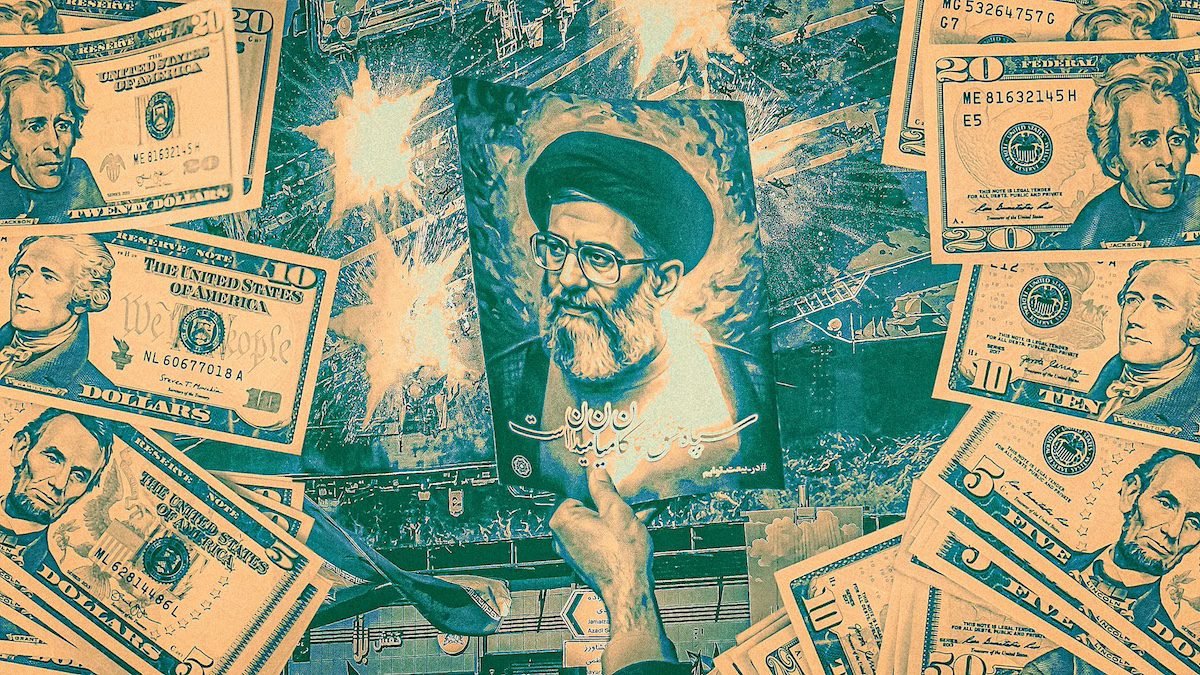

War exposes truth faster than any policy paper ever could. The US-Israeli confrontation with Iran is stripping away assumptions that have underpinned global capital allocation for decades.
Oil above $100 and disruption through the Strait of Hormuz are only part of the story. Markets have absorbed energy shocks before.
What stands out in this episode is something more structural: growing uncertainty about the consistency of US policy under President Donald Trump, and what that means for investors around the world.
For decades, geopolitical crises reinforced American financial dominance. Capital moved toward the dollar, Treasuries and US equities because Washington was seen as the anchor of the system.
Stability, predictability and institutional continuity mattered more than any single policy decision. But confidence in those attributes is now being tested in ways that are harder to dismiss than a temporary spike in oil prices.
The Iran conflict has exposed a policy approach that appears fluid in both direction and execution. Markets are not assessing the merits of individual moves so much as trying to interpret the broader framework guiding them — and finding it elusive.
Energy markets provide the most immediate transmission mechanism. The Strait of Hormuz remains a critical artery for global oil and liquefied natural gas. Disruption feeds directly into inflation expectations, currency volatility and central bank positioning across Asia and Europe.
Geopolitical risk has always been embedded in energy pricing. What’s changed is the additional layer of uncertainty tied specifically to US decision-making. Policy risk is becoming internal to the system rather than external.
Iran sits within a wider pattern that investors are beginning to price more explicitly. Trade policy has shifted away from rules-based predictability toward discretionary deployment.
Tariffs are no longer confined to narrow sectors or framed as temporary negotiating tools — they are being applied at scale, including against major trading partners such as China, often with limited lead time and no clearly defined endpoint.
In strategic sectors, headline tariff rates now exceed 100%. Markets increasingly interpret them as structural rather than transitional.
The consequences for capital allocation are concrete. Supply chains become less efficient, investment horizons shorten and corporate decision-making grows more cautious as forward visibility weakens. Sanctions policy reinforces the same dynamic.
The willingness to penalize third countries for engaging in energy trade with Venezuela has introduced a more expansive form of extraterritorial risk. Investors operating across emerging markets must now account for US intervention even where direct exposure to the US economy is limited. Compliance complexity rises. Transaction certainty declines.
Allies are receiving parallel signals. Rhetoric surrounding Greenland has been interpreted beyond its immediate geopolitical context, suggesting a shift in how long-standing partnerships are framed.
Security relationships that were once treated as foundational appear more conditional. Policy reversals elsewhere — including the hardening of the US stance toward Cuba — reinforce the perception that continuity is less assured.
The US remains the world’s largest economy. Its capital markets remain the deepest and most liquid. No immediate alternative exists to the dollar’s central role. But dominance is not synonymous with trust, and the distinction is starting to matter.
Foreign capital has accumulated in US assets over decades on the assumption of stability and institutional consistency. Large-scale withdrawal is not required to alter market dynamics — incremental reallocation, sustained over time, is sufficient.
Market behavior is already reflecting early signs of that adjustment. Periods of global stress have not consistently produced the traditional flight into US assets. Treasury yields have at times risen alongside equity market weakness. The dollar has shown episodes of vulnerability where strength would historically have been expected.
These aren’t definitive breaks, of course, but they are notable deviations. A repricing of risk follows. Investors require greater compensation to hold assets in an environment where policy direction is less predictable.
Higher yields become embedded across the curve, raising borrowing costs for both the government and private sector – at a time of elevated fiscal deficits.
The effects compound beyond financial markets. Foreign direct investment is sensitive to policy clarity. Projects dependent on stable trade conditions and predictable regulatory frameworks become harder to justify.
Countries that perceive increased exposure to US policy risk begin to diversify — regional trade agreements gain traction, payment systems develop with reduced reliance on US channels and energy supply chains adjust where feasible.
The dollar retains its dominant position, but incremental diversification becomes more attractive to sovereign wealth funds and institutional investors hedging against uncertainty. The Iran war has accelerated this process by forcing investors to confront a question that had previously been less urgent.
To be sure, the US retains formidable advantages — its institutions, markets and innovation capacity continue to underpin its global position, and no direct substitute is available. But a system built over decades can be weakened through incremental changes in how it is perceived. And the current geopolitical environment is bringing those shifting perceptions into sharper focus.
Global investors aren’t questioning the power of the US. They are, however, reassessing its reliability. And that distinction will become increasingly central to how capital is deployed globally.