There is a particular frustration that comes with being a Cassandra in Washington.
You spend three decades writing books titled “Quagmire” and “Sandstorm”, you warn in magazine after magazine, op-ed after op-ed, that America’s compulsive entanglement in Middle Eastern politics would one day produce a catastrophe of its own making — and then you watch, in real time, as Operation Epic Fury unfolds exactly as advertised.
The bombs fall on Tehran. American soldiers die in Kuwait and Saudi Arabia. The Strait of Hormuz is choked. Oil markets convulse. And the foreign policy establishment that drove the United States into this war is already busy drafting the talking points that explain why none of this was their fault.
“Foreign policy paradigms die hard,” I wrote in the preface to “Quagmire” in 1992. I had no idea they were immortal.
Let us be clear about what has happened. The US and Israel, calculating that Iran’s weakened position after years of sanctions, the 2025 12-day war and the collapse of its regional allies provided a strategic window, launched nearly 900 strikes in the opening 12 hours of what they dubbed Operation Epic Fury on February 28, 2026.
The stated justifications shifted almost daily. Trump administration officials have offered conflicting explanations ranging from averting an imminent Iranian threat, to pre-empting retaliation after an expected Israeli attack, to destroying missile capabilities, to preventing a nuclear weapon, to securing Iran’s natural resources, to achieving regime change.
When a government cannot settle on a single casus belli, it is usually because none of them is fully honest. What is honest is the cost already being paid.
A single Iranian drone strike on a base in Kuwait resulted in six US military fatalities. American soldiers have also been killed in Saudi Arabia, and six airmen died when a KC-135 aerial refueling aircraft crashed in western Iraq — the grinding, unglamorous attrition that inevitably follows when you plant your forces across a region that does not want them there.
The war has disrupted global travel and trade, halted flights across the Middle East and sent shipping rerouting to avoid both the Strait of Hormuz and the Red Sea. With over 3,000 vessels stranded, the Persian Gulf has become a massive parking lot for ships waiting for a resolution to the near-total halt of traffic through the Strait.
This is the bill that comes due when American strategy is outsourced to Jerusalem.
I do not use that phrase carelessly. Oman’s Foreign Minister and lead mediator Badr bin Hamad Al Busaidi, after hostilities broke out, commented that nuclear negotiations had been making progress — and that the US-Israeli war against Iran was solely an attempt to reorder the Middle East in Israel’s favor.
This assessment was reinforced by reporting that Gulf diplomats alleged that US intermediaries Steve Witkoff and Jared Kushner were acting in Israeli interests to pressure the US into a military confrontation.
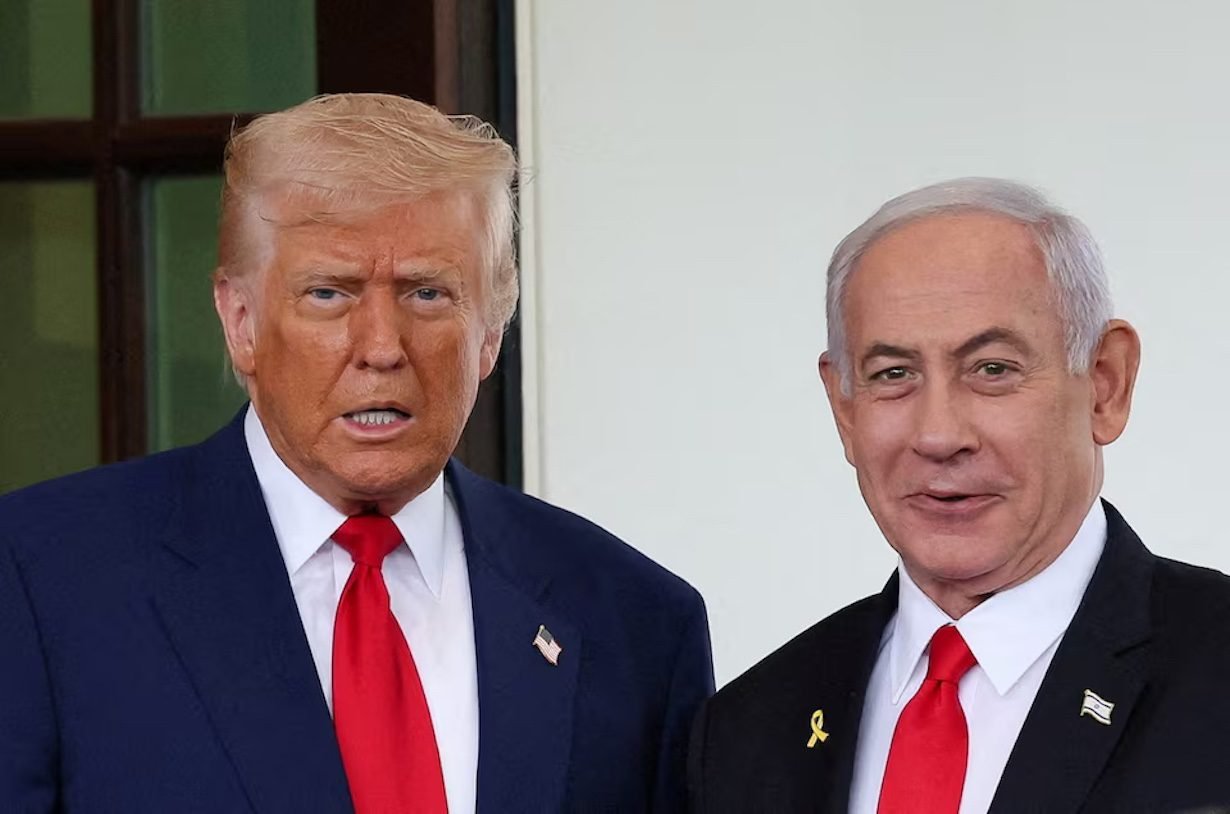
Meanwhile, Israeli Prime Minister Netanyahu, reportedly “increasingly alarmed” that negotiations would succeed, met with Trump to push for military action just as diplomacy was showing signs of life.
The pattern is familiar. It is the same playbook that preceded the 2003 invasion of Iraq — a diplomatic path deliberately sabotaged by those who wanted war, and an American administration too ideologically committed, or too strategically confused, to resist.
The irony is almost unbearable. This was an administration that came to power partly on a promise of restraint — a promise to put American interests first, to end the era of nation-building and endless wars.
And yet here we are, with the largest US military buildup in the Middle East since the invasion of Iraq, with two carrier strike groups, B-2 stealth bombers, and an estimated two-thirds of the Air Force’s AWACS fleet deployed in Operation Epic Fury assets being stressed in ways that will hollow out American readiness in every other global theater, including the Pacific, where the real strategic competition of this century is being decided.
That is the deepest strategic wound inflicted here, and it is self-inflicted. China condemned the war. Russia abstained from defending Iran at the UN. But Beijing is watching with great interest as America’s military inventory is consumed in the Persian Gulf, as its political credibility in the Muslim world craters and as energy markets convulse in ways that stress American allies far more than they stress China, which purchases Iranian oil regardless.
Chinese President Xi Jinping did not need to fire a single shot to extract enormous strategic value from Operation Epic Fury.
The Washington foreign policy establishment will, of course, disagree. It will argue that Iran’s nuclear program had to be destroyed, that the window of opportunity was narrow, that weakness invites aggression. All of these arguments deserve a response.
Iran’s nuclear program was, as the IAEA itself acknowledged, lacking evidence of a structured nuclear weapons program at the time the bombs fell — even if enrichment levels were troubling and transparency was insufficient. More importantly, the argument that a military solution to the nuclear problem is sustainable ignores 30 years of evidence: regime behavior is not changed by bombs.
It is changed by political accommodation, economic incentives and the slow work of diplomacy. Iran may be militarily degraded today. What comes next — the successor to Supreme Leader Ali Khamenei, the reconstituted Islamic Revolutionary Guard Corps (IRGC), the popular rage now fused with nationalist fury — is a harder problem than the one we imagined we were solving.
This is the essence of what I called, in “Sandstorm”, “destructive disengagement” — the worst of all worlds, in which America is too entangled to ignore the region, but too impulsive and ideologically confused to manage it wisely.
A genuine strategy of constructive disengagement would have looked different: reinforcing diplomatic channels in Oman, pressing Israel to accept constraints in exchange for security guarantees, working with European partners on a credible nuclear framework, and recognizing that the Iranian regime — however repressive — was more deterrable than it was existentially threatening.
Instead, the administration allowed Israeli anxieties, neoconservative ambitions and a president’s instinct for theatrical confrontation to collapse a diplomatic process that, according to Oman’s lead mediator, had actually been making progress.
On March 20, Trump suggested he might be looking for an off-ramp, writing that the US is “getting very close to meeting our objectives” and considering “winding down” military efforts. One hopes this is genuine and not merely a pause before the next escalation. But “winding down” does not constitute a strategy.
The Strait of Hormuz remains contested. Iran’s successor government remains an unknown. The militias of Iraq and Lebanon are watching their next move. The regional architecture, never stable, has been further destabilized by the assassination of Khamenei and the fog of a multi-front war that no one fully controls.
I have been writing about America’s Middle East quagmire since 1992. I wish, deeply, that I had been wrong. The gravestones of American soldiers and the faces of Iranian civilians buried under rubble are not vindication for anyone who spent decades warning that this moment would come. They are simply the cost of a political culture that refuses to learn.
Foreign policy paradigms die hard. But if there is anything left of American strategic wisdom, the lesson of Operation Epic Fury must be registered before the next crisis is manufactured: the Middle East does not reward crusaders.
It never has. And no amount of air power can substitute for the patient, interest-driven, diplomatically serious engagement that Washington has consistently refused to pursue. The sandstorm continues. We built it ourselves.
This article was originally published on Leon Hadar’s Global Zeitgeist and is republished with kind permission. Become a subscriber here.