Following President Trump’s threat to destroy Iran’s power plants within 48 hours if the Strait of Hormuz was not reopened by the Islamic Republic, many Iranians inside the country voiced concern over the potential devastation of the nation’s economic infrastructure. However, on Monday, he announced a five-day delay in targeting Iran’s energy facilities and signaled the possibility of reaching an agreement with the regime ruling Iran. Despite this, fears inside the country have not subsided.
A resident of Karaj told The Media Line that President Trump had promised Iranians that help was on the way, but that it was never supposed to mean depriving them of electricity, water, and other basic necessities of life under the ayatollahs’ dictatorship.

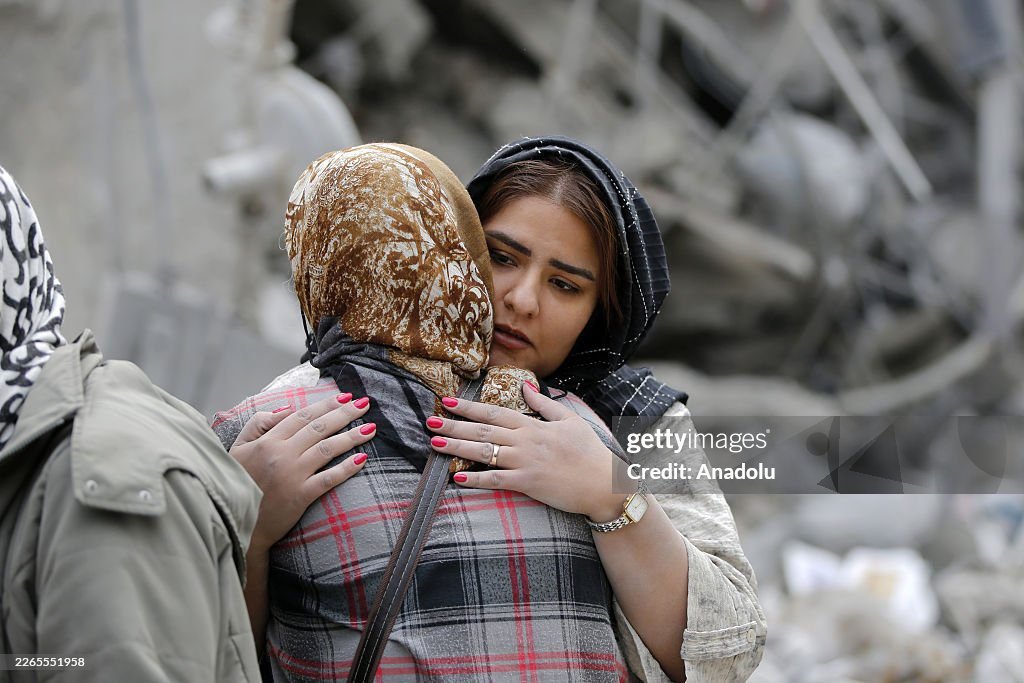
A young Iranian woman walks past the Gandhi Hospital, which is damaged after U.S.-Israeli strikes on a state TV telecommunication tower nearby in Tehran, Iran, on March 2, 2026. Iranians are worried about power outages and the loss of basic necessities of life. Tens of thousands of people in Tehran have already had their homes destroyed, and the number of civilian deaths continues to rise. (Morteza Nikoubazl/NurPhoto via Getty Images)
Immediately after President Trump’s threat to strike Iran’s power plants, the spokesman for the Khatam al-Anbiya Headquarters—considered the regime’s war room—announced that any attack on these facilities would result in strikes against all American-linked energy infrastructure across the region.

State-affiliated media also reshared a tweet from Ali Larijani, the assassinated secretary of the Supreme National Security Council, who was widely regarded as the behind-the-scenes architect of events following Khamenei’s death, warning that an attack on Iran’s power plants would plunge the entire region into darkness.
Mohammad Bagher Ghalibaf, speaker of Parliament, also posted on X—a platform that has been blocked in Iran for years—declaring: “Immediately following any strike on our country’s power plants and critical infrastructure, energy and oil infrastructure across the entire region will be considered legitimate targets and will be irreversibly destroyed.”
President Trump @realDonaldTrump, The Islamic Republic doesn’t care about Iranians, Iran or its infrastructure. IRGC wants you to attack Iran’s power plants. They thrive on chaos and misery. Focusing on the IRGC / regime facilities and personnel is a much more effective way to… pic.twitter.com/CIHGgp0H8D
— Shahriar Etminani (@Etminani_S) March 22, 2026
Despite these warnings, ordinary citizens are deeply worried about power outages that would, in most cases, be accompanied by cuts to water, gas, fuel, and communications. Many who still manage to access the internet through various means have taken to social media to say that this was not the kind of help they had expected or been promised from President Trump.
Meanwhile, opponents of the Islamic Republic have also criticized both Trump and Netanyahu, stating that while strikes on military and security installations and regime leadership have been met with joy and celebration among Iranians inside and outside the country, the Iranian people should not have to pay the price of this war through civilian casualties and deprivation of their most basic daily necessities.
Secular republicans, democrats, nationalists, and leftists alike have warned of the devastating consequences of attacking Iran’s power plants. Some opposition figures have also sharply criticized the phrase “wiping Iran off the map” that appeared in President Trump’s Truth Social post. The backlash was so significant that even Reza Pahlavi—who had previously described the Israeli and American campaign as a “humanitarian intervention”—was compelled to call on President Trump not to target Iran’s civilian infrastructure.
Democratic congresswoman of Iranian descent Yassamin Ansari also criticized President Trump, accusing him of seeking to “destroy Iran along with the world.” In a Sunday interview with Israel’s Channel 13, the president stated: “You’ll soon see what happens with the power plant ultimatum—the outcome will be very good.” He added: “The complete destruction of Iran will take place, and it will go well.” Israeli Prime Minister Netanyahu, for his part, also emphasized: “Israel and America will continue their operations against the ayatollahs’ terror regime with great force.”
Given that Trump has threatened to begin with Iran’s largest power plants, it appears the first American target would be the 2,868-megawatt Pakdasht (Damavand) facility near Tehran, the primary power source for Iran’s capital of 11 million people, on which approximately half the megacity’s electricity depends. The destruction of this plant would severely disrupt Iran’s entire national power grid, its replacement would be virtually impossible, and some 16 million people across Tehran province and Karaj would face total blackouts.
Iran’s large power plant list also includes the Bushehr nuclear power plant, an attack on which could trigger an environmental catastrophe across Iran and the wider region. As President Trump’s ultimatum nears its deadline, the Khatam al-Anbiya spokesman issued a further warning: should Iran’s power plants be struck, the Strait of Hormuz would be completely closed, all power plants and energy and IT infrastructure in Israel would be targeted, all companies of a similar nature in the region with American shareholders would be attacked, and power plants in the region hosting American military bases would be considered legitimate targets.
As the war escalates to dangerous new heights with mounting civilian casualties increasingly affecting daily life in Iran, there are growing signs of fractures within the regime — driven by the unprecedented and ongoing crisis, as well as the uncertain status of Mojtaba Khamenei. Nevertheless, security forces and the Revolutionary Guards remain widely deployed on the streets of Tehran and other major cities, and despite the heavy blows dealt to their command structure, their communications network appears to remain largely intact.
On Sunday evening, as Israeli overnight strikes on various Iranian cities, including Tehran, continued, a citizen in Bandar Abbas reported to The Media Line that intense fighter jet attacks in the area had caused widespread power outages across large parts of the city.
Shahnaz a teacher in southern Tehran, also told The Media Line on Monday that the economic situation has deteriorated to such an extent that power cuts and the potential loss of drinking water could endanger many lives. Unlike in the north of the city—where much of the regime elite reside in relative affluence—people in the south are struggling to meet their basic daily needs.
Since the start of the war, soaring prices have placed immense financial pressure on them, and unlike wealthier residents in northern districts, they do not own villas in northern Iran or properties abroad that would allow them to escape if electricity is cut and the conflict intensifies.
“They are the primary victims of this war,” she said, “living each day with the anxiety of how to secure food for the next.”