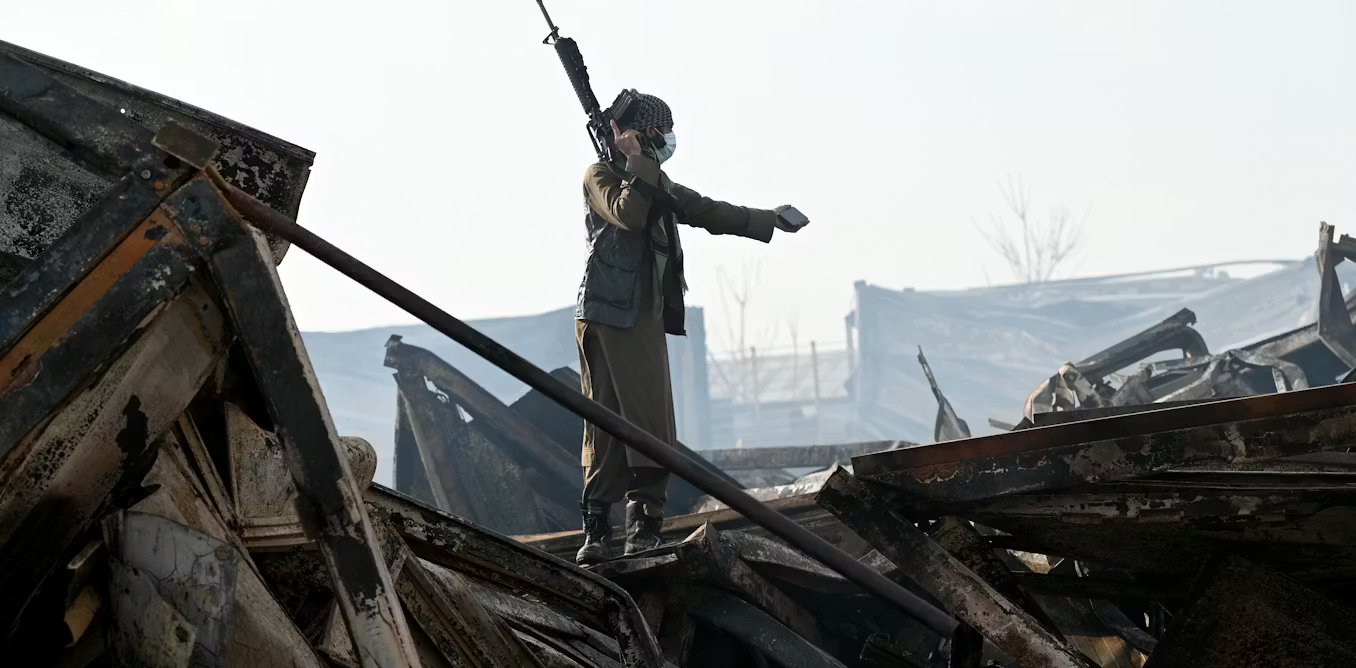
A weekslong war between Pakistan and Afghanistan was paused on March 18, 2026, to mark the Muslim holiday of Eid al-Fitr. But that does not mean the conflict is over.
Neither side showed any indication that the planned five-day cessation of operations would be anything other than temporary, and they warned that any violation would be met with reciprocal strikes.
Already the conflict has seen hundreds killed, with a blast at a drug rehabilitation center in Kabul on March 16, 2026, killing more than 400 people, according to Afghanistan’s Taliban government.
The conflict has been largely kept off the front pages by the war in Iran. But as an expert on Pakistan’s foreign policy and security, I believe the fighting has the potential to further destabilize the region.
Why are Pakistan and Afghanistan fighting now?
The current conflict between Pakistan and Afghanistan is not a sudden rupture of relations between the two countries, which share a 1,640-mile (2,640 km) border called the Durand Line.
Rather, the flare-up is a result of an intensification of long-simmering, historical security concerns along the Durand Line. The immediate trigger lies in Pakistan’s growing concern over cross-border militant activity, particularly from groups such as the Tehreek-e-Taliban Pakistan, which Islamabad believes operate from sanctuaries inside Afghanistan.
After the Taliban’s return to power in Kabul in 2021, Pakistan had anticipated a more cooperative security environment, based on earlier experiences in the 1990s.
However, that did not materialize. Instead, there was a perceptible rise in militant attacks within Pakistan, accompanied by Kabul’s reluctance or inability to decisively act against Tehreek-e-Taliban Pakistan.
Complicating this landscape further is the evolving character of the threat environment for Pakistan. In 2025, Pakistan was involved in a short war with historical rival India – the most intense fighting between the two countries for nearly 30 years.
The use of suspected Indian-made drones by the Afghan Taliban in recent attacks inside Pakistani territory adds an additional regional element to the fighting – Islamabad will be wary of any Indian interference in Afghanistan.
In response, Pakistan has reportedly undertaken countermeasures, including airstrikes targeting drone infrastructure linked to militant networks inside Afghanistan.
All this points to a widening battlespace, where new technologies make it easier to escalate in indirect and deniable ways.
This is not merely a bilateral border crisis but a layered security contest shaped by cross-border militancy, emerging technologies and competing threat narratives.
The convergence of Pakistan’s growing willingness to respond with physical force, the Afghan Taliban’s assertion of sovereignty and the absence of a mutually agreed framework for border management continues to drive episodic escalation rooted in structural mistrust.
What is the broader history of Pakistan-Afghanistan relations?
Historically, Pakistan-Afghanistan relations have often oscillated between uneasy cooperation and strategic suspicion toward each other – all shaped by unresolved territorial, ideological and geopolitical dynamics.
At the heart of it lies a dispute over the Durand Line, which Afghanistan has never formally recognized as an international border. This has resulted in a sustained and persistent tension in their bilateral relations since Pakistan’s independence in 1947.
During the Cold War, these tensions were overlaid by competing alignments. Pakistan was embedded in the U.S.-led security framework, while Afghanistan maintained closer ties with the Soviet Union at various points.
However, the Soviet invasion of Afghanistan in 1979 marked a critical turning point. Pakistan became a front-line state supporting the Afghan jihad against invading Soviet forces.
This entrenched cross-border militant networks and blurred the boundary between state policy and nonstate actors, resulting in dynamics that continue to shape the region.
The post-2001 period was marked by fraught relationships between Pakistan and successive U.S.-backed Afghan governments, particularly over allegations of Pakistan’s alleged proxy support for Islamist groups in Afghanistan.
Many thought the Afghan Taliban’s return to power in 2021 would resolve this tension. But instead, it reconfigured it.
While ideological affinities continue to exist between the two nations, they have not translated into any sort of strategic alignment – especially on questions of militancy and border control.

What are the implications of the conflict for the region?
The implications of Pakistan-Afghanistan tensions are significant and extend well beyond bilateral frictions. They intersect with broader questions of regional stability, militancy and great power competition.
I believe there are four direct implications:
-
First, the persistence of ungoverned or contested spaces along the Pakistan-Afghan border risks creating an enabling environment for transnational militant groups. This has real implications not only for Pakistan’s internal security but also for regional actors concerned about spillover effects.
-
Second, instability along the Pakistan-Afghanistan border complicates regional connectivity and economic integration initiatives, including projects linked to broader Central and South Asia. A volatile western frontier constrains Pakistan’s ability to act as a regional stabilizer and a safe conduit for regional trade and energy corridors.
-
Third, for outside interested parties like the U.S., the situation underscores the limits of disengagement from Afghanistan. While Washington’s military withdrawal marked the end of direct involvement, the persistence of militancy and the risk of regional destabilization ensure that Afghanistan remains strategically relevant not only for the U.S. but for other major powers as well.
-
Finally, I see these tensions as highlighting a broader pattern: The post-2021 Afghanistan remains internally consolidated but externally contested. Its relationships with neighbors, particularly Pakistan, will be central in determining whether the region moves toward managed stability or recurring cycles of escalation.