Welcome to Edition 8.34 of the Rocket Report! The most important significant news this week, I believe, is the decision by Canada to make a serious investment in launch infrastructure at a spaceport in Nova Scotia. Tensions have risen between the United States and Canada of late (for reasons which are baffling to this author, who has always had an affinity for the nation to our north), and as a result Canada is seeking launch independence. This is an important start, but it will require a sustained, long-term commitment to really develop a flourishing launch industry.
As always, we welcome reader submissions, and if you don’t want to miss an issue, please subscribe using the box below (the form will not appear on AMP-enabled versions of the site). Each report will include information on small-, medium-, and heavy-lift rockets as well as a quick look ahead at the next three launches on the calendar.

Canada makes major commitment to space launch. The country’s leading minister of national defense, David J. McGuinty, announced on Monday a $200 million investment in “core infrastructure” for a spaceport in Nova Scotia. The investment is a 10‑year, $200 million agreement to lease a dedicated space‑launch pad that will serve as the central foundation for a multi-user spaceport near Canso, Nova Scotia. The facility is operated by Maritime Launch Services.
Why do this now? … McGuinty cited “a more complex and unpredictable security environment.” He added, “In the decades ahead, our security, our prosperity, and our sovereignty will increasingly extend beyond our atmosphere.” One way of looking at this is that, for decades, Canada has relied on others, including the United States, to get its payloads into orbit. The country probably now views its southern neighbor has a less reliable partner. Canada also said it had awarded $8.3 million in funding, each, to native rocket companies NordSpace, Canada Rocket Company, and Reaction Dynamics—companies it hopes will utilize the Nova Scotia spaceport.
Rocket Lab strikes big deal for “Haste” missions. Rocket Lab announced Wednesday it has signed a $190 million contract for a block buy of 20 hypersonic test flights with its Haste launch vehicle for the US Department of Defense. Haste is a modified version of the Electron rocket that is used to fly suborbital missions and demonstrate hypersonic flight. The first of these 20 new missions is expected to take place within months of contract signing. This is Rocket Lab’s largest-ever launch contract in terms of total number of flights.
The nation’s hypersonic provider … Rocket Lab has been flying Haste missions for the US government from its launch site at Wallops Flight Facility since 2023. “Our advanced technology, responsive launch schedules, and mass production of our Haste hypersonic rockets are enabling faster progress across a range of hypersonic experiments by our government and industry partners,” Rocket Lab founder Peter Beck said. This contract signals that demand remains strong for the company’s small-lift Electron vehicle.
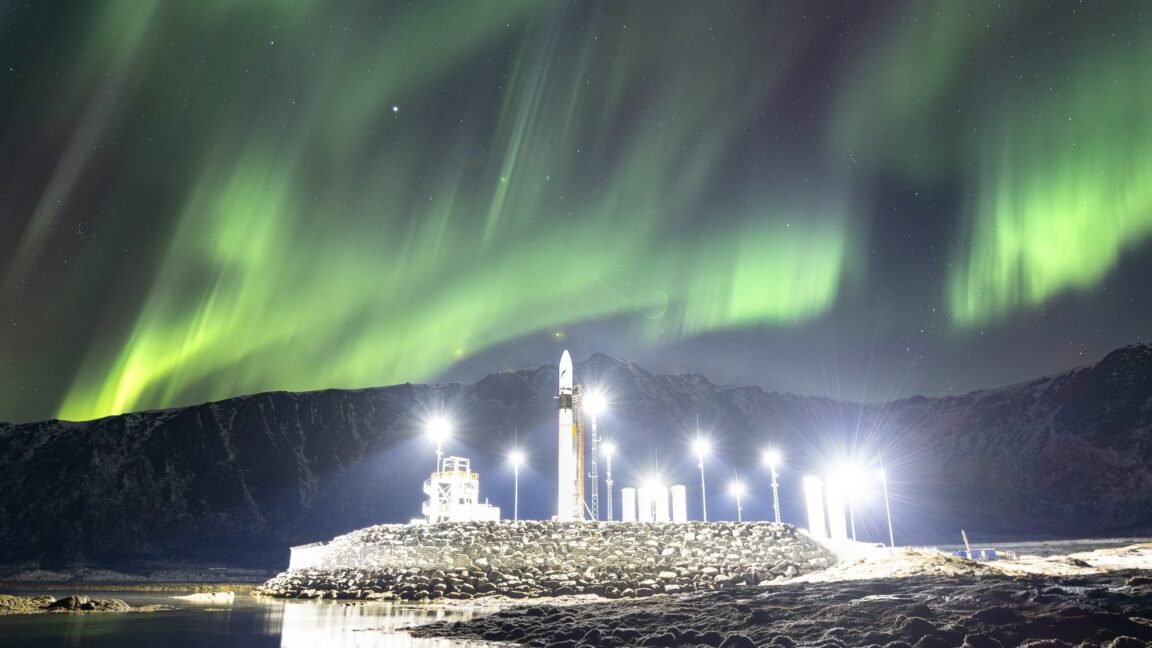
Isar targeting Monday for next Spectrum launch. Germany-based launch company Isar Aerospace said Wednesday it is now targeting Monday, March 23, for the second test flight of its Spectrum rocket. The company moved off a March 19 launch date “due to unfavorable weather conditions in the launch area,” the company said on social media. The launch will be webcast here.
If at first you don’t succeed … Nicknamed “Onward and Upward,” this will be the second flight of Spectrum. The vehicle failed 18 seconds into its initial test flight a year ago, on March 30. This second flight will carry five cubesats and one non-separable experiment with the goal of reaching orbit. Isar is aiming to become Europe’s first new space launch company to successfully reach orbit.
Where is Goddard’s historic rocket, Nell? Robert Goddard’s first liquid-fueled rocket, which lifted off from a snowy field on March 16, 1926, has been written about extensively. Earlier solid-fueled rockets existed, but liquid-fueled rockets promised the sustainability and control needed to send spacecraft and humans into Earth orbit and beyond. Photos from that day exist through the efforts of Goddard’s wife, as does a monument stand from where the rocket, nicknamed “Nell,” left the ground (today, located on a golf course).
Putting the pieces together … Over the decades, replicas of Nell have been built, even ones capable of flight. But a century later, a question about the rocket remains. Where is it now? Ars reports that Goddard did not try to reassemble the rocket, which landed in pieces in the New England snow. Rather he reused elements of the rocket in subsequent vehicles. Today fragments of the vehicle remain in a museum in New Mexico as well as what is probably Nell’s nozzle in The National Air and Space Museum.
HyImpulse to launch from Scotland. Germany’s HyImpulse Technologies announced a launch service agreement to begin flying from SaxaVord Spaceport, in the Shetland Islands, Payload reports. The suborbital flight, which is expected to lift off in the third quarter of this year, is the latest in a broader, European-wide push for sovereign launch capabilities much closer to home than French Guiana, which requires many of Europe’s launchers today—including Arianespace and Avio—to cross an ocean before passing the Kármán line.
SR75 to come alive … SaxaVord, located above the northern tip of the Scottish mainland, is working to complete three launch pads to host European launchers. The spaceport also has installed a tracking and telemetry system, mission control center, and integration hangar and has received a license from the UK Civil Aviation Authority for up to 30 launches per year. The expected launch of SR75 this year aims to build on the successful launch of HyImpulse’s hybrid suborbital system from Australia’s Koonibba Test Range in 2024, which validated its single-stage, 75kN engine for the first time.
Innospace pinpoints launch failure. Innospace says a gas leak led to a combustion chamber rupture that caused the first flight of the Hanbit-Nano rocket to fail, Aviation Week reports. The South Korean launch company says it aims to return to the pad in the third quarter of this year. Performance of the rocket, which took off on December 22 from the Brazilian Alcantara Space Center, was nominal for the first 33 seconds when the system suffered a combustion gas leak at the forward section of the first-stage hybrid rocket combustion chamber assembly. That caused the chamber to rupture and the Hanbit-Nano to break apart, Innospace said.
Seeing that it doesn’t happen again … “The leakage was caused by insufficient compression and uneven sealing performance resulting from plastic deformation of sealing components during the reassembly process following the replacement of the forward chamber plug during launch preparation activities in Brazil,” the company said. Innospace is making component upgrades and quality oversight improvements to pave the way for a return to flight in the third quarter, it adds. It also plans to perform additional tests. The precise launch schedule will depend on technical progress and flight approval from the Korean AeroSpace Agency.
French launch company acquires component manufacturer. French launch startup Sirius Space Services has acquired the high-precision metal-component manufacturer AMM-42, part of the company’s vertical integration efforts to bring key manufacturing capabilities in-house, European Spaceflight reports. This is Sirius’ second such purchase in less than a year, following its acquisition of SERM in June 2025. That acquisition specialized in advanced metal manufacturing and is bolstering its parent company’s additive manufacturing capacity, particularly for combustion chambers and turbopumps.
Getting Sirius about launch … Sirius Space Services is developing a range of three rockets that all use a modular booster system. Sirius 1 will be a two-stage, single-stick rocket capable of delivering 175 kilograms to low-Earth orbit. Sirius 13 will feature two strap-on boosters, while Sirius 15 will use four, with payload capacities of 600 and 1,000 kilograms, respectively. The company is currently preparing for a suborbital flight of its Sirius 1B demonstrator in early 2027.

Thanks to Falcon 9, Starlink hits a milestone. SpaceX on Monday night crossed the threshold of having more than 10,000 Starlink satellites in low-Earth orbit simultaneously for the first time, Spaceflight Now reports. The milestone comes less than seven years after SpaceX launched its first batch of satellites in May 2019 on the Falcon 9 rocket.
A lot of launches since Goddard … Coincidently, the Monday night launch also coincided with the 100th anniversary of Robert Goddard’s launch of the first liquid-propelled rocket. The Falcon 9 rocket flew on a southerly trajectory upon leaving Space Launch Complex 4 East. This was the 17th orbital launch from Vandenberg Space Force Base in California so far this year. SpaceX’s Monday night launch of a Falcon 9 rocket was the 615th flight of this kerosene-fueled rocket.

Artemis II rocket to roll back out to the pad. Engineers are targeting 8 pm EDT on Thursday, March 19, to start rolling the Artemis II SLS (Space Launch System) rocket and Orion spacecraft to Launch Pad 39B at the agency’s Kennedy Space Center in Florida, the US space agency said. NASA’s crawler-transporter 2 will carry the 11-million-pound stack, including the mobile launcher, at about 1 mph along the four-mile route from Kennedy’s Vehicle Assembly Building to the launch pad. The journey can take up to 12 hours.
Astronauts enter quarantine again … Meanwhile, the Artemis II crew entered quarantine at 5 pm CDT Wednesday in Houston to ensure they stay healthy leading up to launch. NASA astronauts Reid Wiseman, Victor Glover, and Christina Koch, along with CSA (Canadian Space Agency) astronaut Jeremy Hansen will limit their exposure to others for the next week in Houston before flying to Kennedy approximately five days before launch. Both activities are key milestones on the way to a launch as early as Wednesday, April 1.
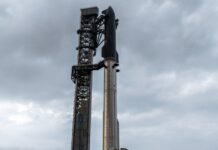
Booster 19 completes initial test campaign. The Super Heavy first stage that will be used for the 12th Starship flight test, Booster 19, completed an initial test campaign on the newly commissioned Pad 2 at Starbase, Texas, NASASpaceflight.com reports. Culminating in a short static firing of the rocket, the series of tests was a first for Pad 2, the new Block 3/V3 Super Heavy Booster, and for the upgraded Raptor 3 outside of single engine testing.
New and improved (?) rocket and pad … As the inaugural vehicle to undergo operations on this pad, Booster 19’s campaign served as both a booster qualification test and a commissioning milestone for the expanded launch infrastructure. Pad 2 features significant upgrades over Pad 1, most notably dual booster quick disconnects: one dedicated to liquid methane and another to liquid oxygen. This separation enables independent tank pressurization and more efficient loading, reducing risks associated with mixed propellants. After the static firing, SpaceX said the rocket performed well. Flight 12 is likely to occur no earlier than the second half of April.
Next three launches
March 20: Electron | Eight Days a Week | Māhia Peninsula, New Zealand | 16:10 UTC
March 20: Falcon 9 | Starlink 17-15 | Vandenberg Space Force Base, Calif. | 21:48 UTC
March 22: Soyuz 2.1a | Progress MS-33 | Baikonur Cosmodrome, Kazakhstan | 11:59 UTC