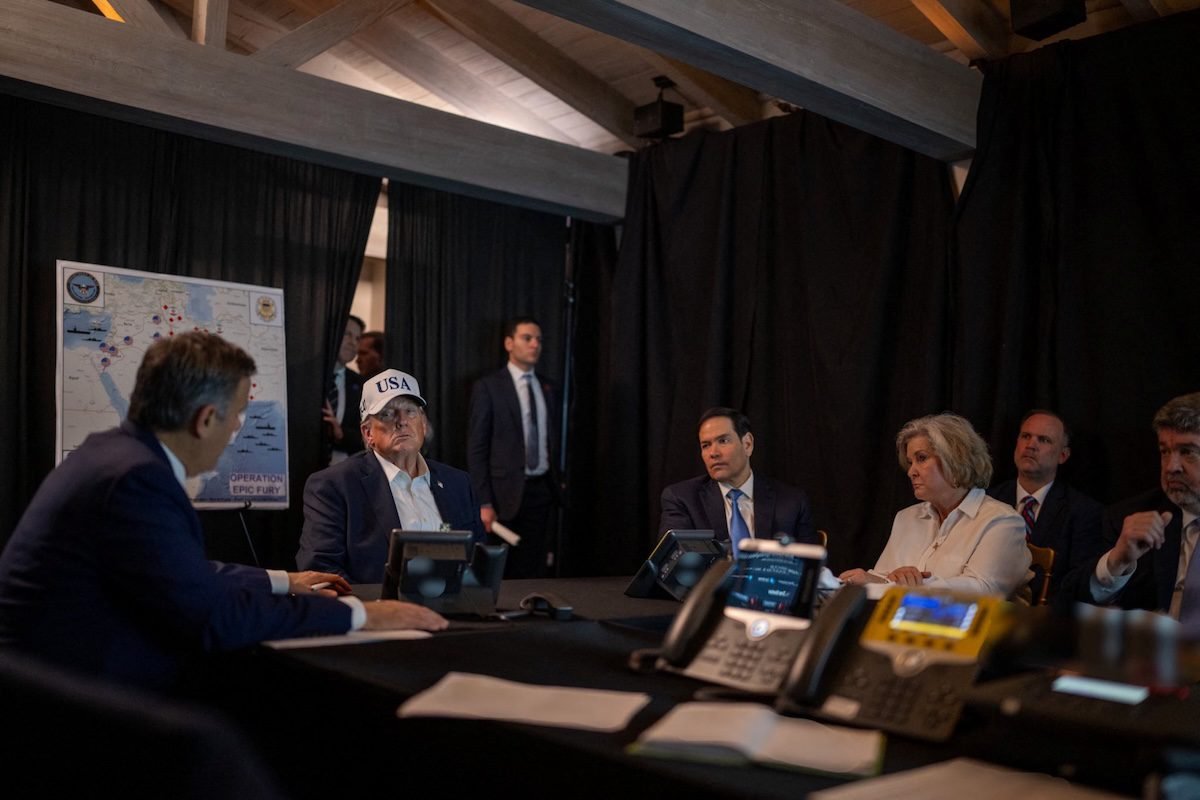
US Senator Jon Ossoff on Wednesday cornered Director of National Intelligence Tulsi Gabbard over President Donald Trump’s false claims that he launched a war with Iran because it was an “imminent” threat to US national security.
During a Senate Select Intelligence Committee hearing, Ossoff (D-Ga.) questioned Gabbard about how any purported threat from Iran could possibly be deemed “imminent” given past administration statements about the state of its nuclear weapons program.
Ossoff began by noting that Gabbard’s opening statement given to the committee ahead of the meeting claimed that “Iran’s nuclear enrichment program was obliterated” as a result of airstrikes launched last year by the US.
“So the assessment of the intelligence community is that Iran’s nuclear enrichment program was obliterated by last summer’s airstrikes?” he asked.
“Yes,” replied Gabbard, who prior to joining the Trump administration had a long history of advocating against launching a regime change war against Iran.
“The opening statement you submitted to the community last night also stated, ‘There has been no effort since then to try to rebuild their enrichment capability,’ correct?” Ossoff continued.
“That’s right,” Gabbard replied.
“The White House stated on March 4 of this year that this war … was a ‘military campaign to eliminate the imminent nuclear threat posed by the Iranian regime,’” Ossoff said. “That’s a statement from the White House: ‘The imminent nuclear threat posed by the Iranian regime.’ Was it the assessment of the intelligence community that there was an imminent nuclear threat posed by the Iranian regime?”
Gabbard briefly paused and then responded that “the intelligence community assessed that Iran maintained the intention to rebuild and to continue to grow their nuclear enrichment capabilities.”
At this point, Ossoff interjected.
“Was it the assessment of the intelligence community that there was an ‘imminent nuclear threat’ posted by the Iranian regime, yes or no?” he pressed.
“Senator, the only person who can determine what is or is not an imminent threat is the president,” Gabbard said.
“False,” Ossoff shot back. “This is the worldwide threats hearing where you present to Congress national intelligence…. You’ve stated today that the intelligence community’s assessment is that Iran’s nuclear enrichment program was ‘obliterated,’ and that there ‘had been no efforts since then to try to enrich their capability.’”
Ossoff then asked Gabbard if the intelligence community believed Iran posed an “imminent nuclear threat” despite the purported “obliteration” of its nuclear program.
“It is not the intelligence community’s responsibility to determine what is and is not an imminent threat,” Gabbard said.
“It is precisely your responsibility to determine what constitutes a threat to the United States,” Ossoff countered. “This is the worldwide threats hearing.”
War to spike US grocery costs
Meanwhile, it’s become apparent since the beginning of the attacks he greenlighted that Trump’s war against Iran has already been raising gas prices for US drivers, and could soon raise the cost of food both in the US and all over the world.
NBC News reported on Tuesday that the price of diesel fuel has now soared above $5 per gallon for the first time since December 2022. If the price of diesel remains high, the report explained, it will raise the price of all goods delivered by trucks throughout the US, including food.
Paul Dietrich, chief investment strategist at Wedbush Securities, told NBC News that diesel prices will become a “direct hit on consumer prices” if they remain elevated, as “groceries get more expensive, delivery costs rise, and household budgets are tightened.”
“Diesel is what moves the real economy,” explained Dietrich. “It hauls the food, the packages, the building supplies, and the inventory sitting on store shelves.”

The cost of diesel isn’t the only factor that could spike food prices, as the Iran war has also put a strain on fertilizer that farmers need to grow crops.
Al Jazeera reported on Wednesday that there is growing concern that the rising price of fertilizer caused by the closure of the Strait of Hormuz could lead to a global food crisis.
As Al Jazeera explained, almost half of the global supply of urea, the most commonly used fertilizer, is shipped from Middle Eastern nations through the Strait of Hormuz.
With the strait closed by Iran in response to US and Israeli attacks, Al Jazeera wrote, “urea export prices from the Middle East have surged by about 40%, rising from just less than $500 to a little more than $700 per metric ton as of last Friday.”
Al Jazeera also cited an estimate from data and analytics firm Kpler projecting that up to one-third of the global fertilizer trade could be disrupted if the strait remains closed for a prolonged period.
Carl Skau, deputy executive director and chief operating officer of the World Food Program, warned on Tuesday that the Iran war could push millions of people into extreme hunger should it persist.
“If this conflict continues, it will send shockwaves across the globe, and families who already cannot afford their next meal will be hit the hardest,” said Skau. “Without an adequately funded humanitarian response, it could spell catastrophe for millions already on the edge.”
WFP said the disruption in fertilizer markets offers “the most recent proof that conflict is the number one driver of hunger.”
“Conflict forces people from their homes, destroys infrastructure, fuels inflation, and wipes out jobs,” said the agency. “All of this makes it nearly impossible for people to find or afford enough food to survive. And children are always hit hardest: A child living in a country ravaged by conflict is more than twice as likely to be malnourished and out of school than their peers in peaceful settings.”
Warnings about the war’s impact on the price of food come as the US economy is showing signs of accelerating inflation.
As reported by CNBC on Wednesday, wholesale prices in February surged by 0.7%, more than double economists’ consensus estimate of 0.3%.
On a year-over-year basis, wholesale prices rose by 3.4% in February—the highest increase in a year.
Spikes in wholesale prices, which reflect the amount that firms pay for inputs for their products, typically also lead to increased consumer prices, as companies pass on their cost increases to customers.
“The report suggests that pipeline inflation pressures remain persistent, particularly on the services side, complicating the Fed’s path as it weighs how long to keep interest rates elevated,” CNBC noted.
Originally published by Common Dreams, this is republished under Creative Commons license.