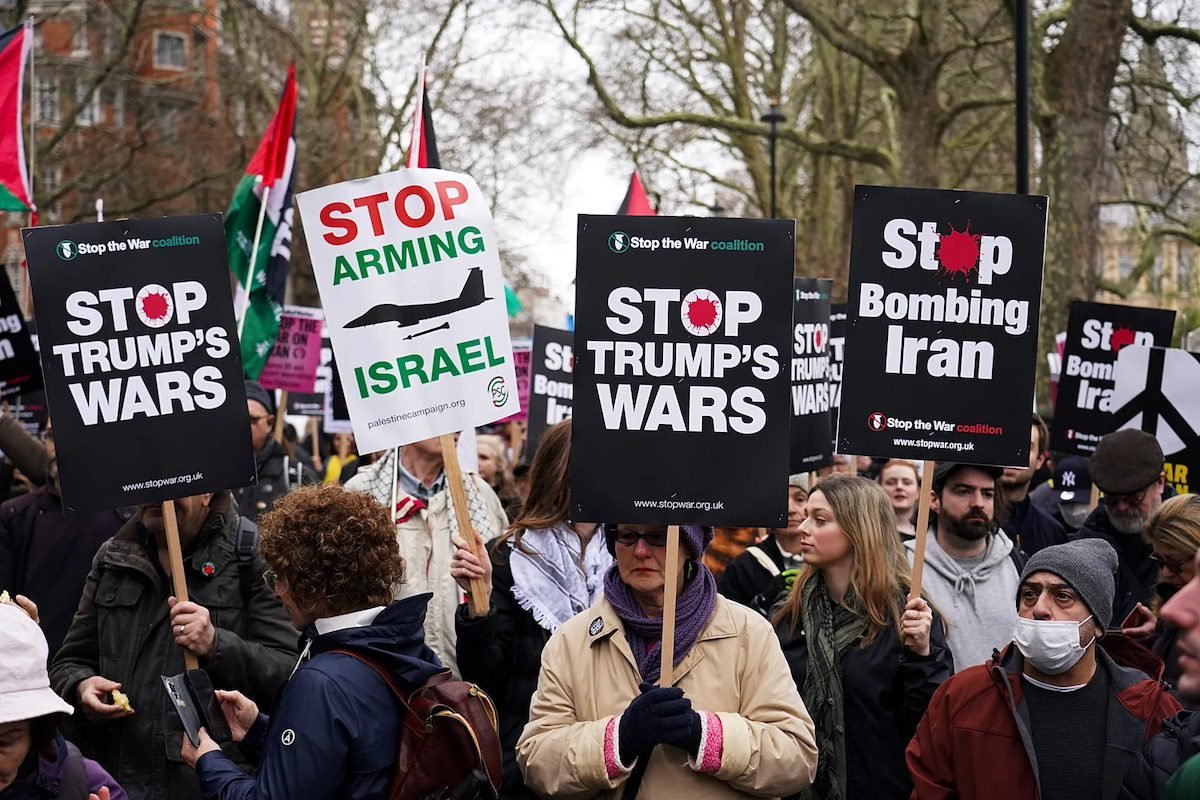
Watching European capitals scramble to calibrate their response to the US-Israeli military campaign against Iran, one is reminded of a recurring scene in a very bad play — one that has run, with minor variations, since Suez. Europe blusters. Europe convenes. Europe issues a communique. And then Europe does nothing.
The pattern is so familiar by now that it barely warrants analysis. And yet the current crisis deserves closer scrutiny, not because Europe has surprised observers, but because the depth of its strategic irrelevance has been so thoroughly exposed — and so thoroughly obscured by the fog of its own rhetoric.
Let us be clear about what has happened. Washington, in close coordination with Jerusalem, undertook a major military operation against Iranian nuclear and military infrastructure.
Whatever one thinks of the strategic wisdom of that decision — and there is much to think — the US made a choice of historic consequence in the Middle East, affecting energy markets, regional stability, international law and the security of American allies in Europe, without any meaningful consultation with those allies.
NATO, that much-celebrated “cornerstone of the liberal international order,” was informed rather than consulted. The distinction matters enormously. The European response was, predictably, a symphony of discord dressed up as harmony.
France, ever anxious to perform its role as the continent’s strategic conscience, condemned the operation in carefully calibrated language designed to offend no one — least of all Washington, upon whose security umbrella Paris still quietly depends.
Germany, still psychologically tethered to the ghost of its post-war pacifism, expressed “grave concern” while its defense minister simultaneously reaffirmed the inviolability of the transatlantic bond.
The smaller NATO members, those eastern European states for whom American hard power is existential currency, refused to criticize Washington at all, terrified of any signal that might weaken US commitment to their own security.
This is what European strategic unity looks like in practice: a cacophony of national interests dressed in the language of shared values. The deeper problem, which European leaders seem constitutionally incapable of confronting, is structural.
Europe has, for decades, enjoyed the luxury of moral posturing precisely because it has outsourced the hard business of security to Washington. It has been able to criticize American unilateralism in Iraq, in Libya, in Syria, because it bore none of the cost and assumed none of the responsibility.
The Iran operation follows this same logic to its inevitable conclusion. When the US acts, Europe reacts. Europe does not shape, does not deter, does not decide. It reacts — and then, within a news cycle or two, accommodates.
What we are witnessing is not a transatlantic rift. A rift implies two parties pulling in opposite directions with roughly equivalent force. What we have is more like a rope being pulled by one very large party, while the other end is held by a committee that cannot agree on which direction to face.
The strategic autonomy project — that earnest Macronist vision of a Europe capable of independent geopolitical action — lies exposed once again as aspiration masquerading as policy.
When Iranian proxies begin targeting Gulf shipping lanes and oil prices spike, it will be American carrier groups, not French frigates, that matter. Europe knows this. Its angry statements cost nothing precisely because everyone understands they will change nothing.
None of this is an endorsement of the US-Israeli operation. A realist analysis of its probable consequences — Iranian radicalization, regional destabilization and the acceleration of nuclear proliferation logic among states watching from Riyadh to Ankara — gives serious cause for concern.
The question of whether military force can resolve what is fundamentally a political problem in the Islamic Republic has not been answered to anyone’s satisfaction, and the historical record of “successful” strikes on adversary nuclear programs is, to put it charitably, thin.
But that debate belongs to Washington and Jerusalem, not Brussels. And that, in the end, is the point. Europe’s tragedy is not that it disagrees with American policy in the Middle East. It often does, and sometimes with good reason. Europe’s tragedy is that its disagreement is strategically weightless — a grievance without leverage, a principle without power.
Until Europe is willing to pay for genuine strategic autonomy — in defense budgets, in political risk, in the willingness to act independently when American interests diverge from European ones — its commentary on American military decisions will remain what it has always been: the sound of a spectator insisting, from the stands, that the game is being played wrong.
The field, as ever, belongs to those who showed up.