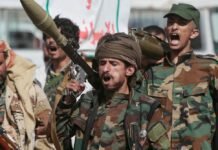
[DAMASCUS] Artillery shells fell on Syrian territory near the town of Serghaya, west of Damascus, early Tuesday, with the Syrian Arab Army confirming in an official statement that the shells were fired from Lebanese territory.
A military source told The Media Line that Hezbollah fighters from Lebanon fired the shells at Syrian army positions near the border. The source added that the Syrian army has observed Hezbollah reinforcements arriving in the Syrian-Lebanese border area and is closely monitoring the situation.
The source, who spoke on condition of anonymity, added that the Syrian leadership is in contact with the Lebanese army to consider possible responses to the attack, emphasizing that the Syrian army will not tolerate any violation of the country’s territorial sovereignty.
Syrian President Ahmed Al-Sharaa held phone calls in recent hours with several prominent Lebanese political figures, including Kataeb Party leader MP Samy Gemayel. The conversations lasted more than an hour.
During the call with Gemayel, Al-Sharaa reassured him that reports claiming the Syrian army intends to enter Lebanon are “completely false,” and said the deployment of Syrian forces along the border is solely intended to safeguard Syria’s security and prevent the conflict from spilling into its territory.
Following the conversation, Gemayel said the exchange reflected “a desire to open a new chapter in Lebanese-Syrian relations” after decades of tension under the previous regime. He emphasized the importance of reassuring Lebanese citizens about the situation along the northern and eastern borders.
The call was part of a series of contacts Al-Sharaa has held in recent days with Lebanese leaders and international officials amid the regional escalation that began in late February between Iran on one side and Israeli and US forces on the other. The conflict has spread into Lebanon and Syria, prompting Damascus to stress its support for efforts by Lebanon and Iraq to disarm Hezbollah and prevent the fighting from widening, while reducing the risk of it spreading further into Syrian and other Arab territories.
Lebanese reactions to the Syrian accusations were mixed. The government, led by President Nawaf Salam, conveyed through diplomatic channels its commitment to maintaining calm and stressed that Lebanon is not a party to the escalation, a position reflected in statements by Lebanese officials issued the same day.
Meanwhile, Lebanese parties opposed to Hezbollah voiced concern about the incident’s potential impact on domestic stability. Some called for the Lebanese army to play a direct role in monitoring the border to prevent armed activity outside state authority, while others warned that further escalation could lead to confrontations extending beyond the two countries’ land borders.
Against this backdrop, relations between Syria’s new leadership and Hezbollah differ markedly from those under the previous government, which had regarded the group as an ally during earlier stages of the conflict, particularly throughout the long Syrian war. The former Assad administration supported Hezbollah in numerous combat operations inside Syria and facilitated the group’s movements.
By contrast, the current Syrian leadership has publicly backed Lebanon’s efforts to disarm Hezbollah and establish full state authority over its territory, describing the position as part of a new policy aimed at addressing military entanglements that have strained relations between Damascus and Beirut for decades.
The developments come amid broader regional tensions over Iranian influence and the role of Tehran-backed militias. The struggle for influence in Lebanon and Syria is widely seen as part of the wider confrontation between Iran and its allies on one side and regional and international powers on the other.
In Beirut and Damascus, the accusations directed at Hezbollah are viewed in that context, as part of efforts to rebalance relations among neighboring Arab states and limit the influence of nonstate armed groups.
Damascus’ accusation that Hezbollah fired shells near Serghaya, after a prolonged period of war and border tension, marks a new escalation. The development signals a shift in the Syrian government’s stance toward nonstate armed groups operating along the border and reflects the new leadership’s effort to assert sovereignty and prevent incidents that could be used to further inflame regional conflicts at a time of complex, overlapping tensions.
Ultimately, the developments highlight the sensitivity of the Lebanese-Syrian border and the extent to which regional dynamics influence relations between the two countries, particularly regarding the role of nonstate armed groups. The incident also illustrates how a single border event can affect political and strategic alignments in an increasingly tense region.