You may be hearing a lot lately about critical minerals and rare earth elements. These natural materials are essential to industry and modern technology – everything from cellphones to fighter jets.
They include lithium and cobalt used in batteries, neodymium for magnets in motors and hard drives, and rare earths that are essential in defense systems, lasers and medical imaging. Critical minerals are also indispensable for renewable energy systems, energy storage and digital infrastructure. Without them, modern society – and any realistic path to a world with net-zero emissions – would not be possible.
Critical minerals get their name because they’re also highly vulnerable to supply chain disruptions from global events, trade tensions or economic instability. And, today, one country dominates many critical mineral supply chains: China.
With that in mind, many governments are looking for alternative sources of critical minerals, and several companies are eyeing the ocean floor as a potential new frontier for mining them.
As a marine geologist, I know the potential for seafloor minerals is vast. But that doesn’t mean those minerals are easy to harvest. They come in several forms, from potato-size rocks scattered on the seafloor to seafloor crusts at hydrothermal vents and underwater brine pools. And they are often found in sensitive locations that are home to fragile marine life, raising questions about damage to some of the least explored and least understood parts of our planet.
Polymetallic nodules on the seafloor
When you picture seafloor mining, polymetallic or manganese nodules are probably what come to mind.
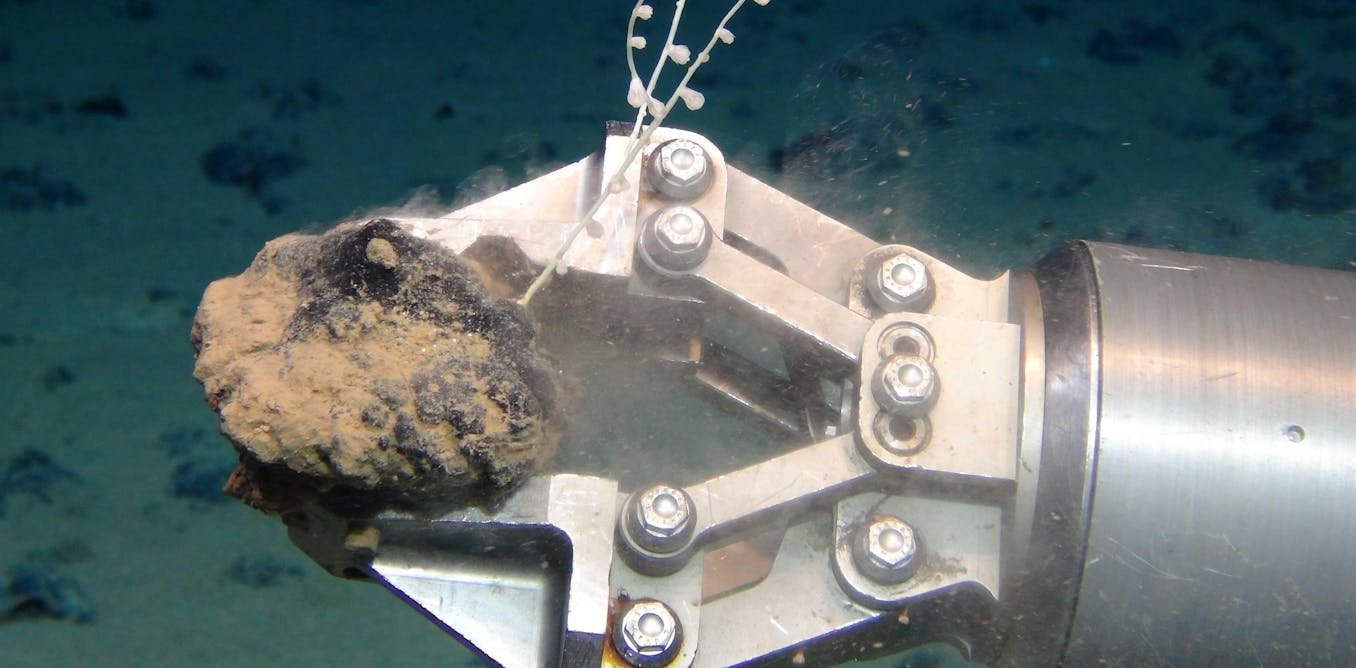
Rock-like nodules are about the size of potatoes and are found scattered on vast deep-water plains, typically 3,000 to 6,000 meters deep, in several regions, including a large area of the Pacific Ocean southeast of Hawaii.
They primarily consist of manganese and iron, though they can contain significant amounts of other metals, including valuable nickel, cobalt, copper and small amounts of rare earth elements and platinum.

Nodules form from metals that get into the ocean through erosion or from seafloor hydrothermal vents in volcanically active areas. The metal ions attach to a nucleus, such as a rock or shell fragment. Over time, layers form around that core. The growth is very slow – only a few millimeters in a million years – so larger nodules can be several million years old.
More than 17 exploration licenses exist, primarily in the Pacific’s Clarion-Clipperton Zone. Tests there have involved suctioning nodules from the seafloor to ships above. But, as of early 2026, full-scale, commercial mining has not yet begun.

Seafloor massive sulfides at hydrothermal vents
Another source of critical minerals is seafloor massive sulfides, which form near hydrothermal vents along oceanic ridges. Volcanic activity reacts with seawater, fueling bursts of marine life at these vents, and also forming rocks rich in copper, gold, zinc, lead, barium and silver.
These hot springs form where water rises through the oceanic crust at high temperatures, up to about 750 degrees Fahrenheit (400 degrees Celsius). The metals contained in these solutions precipitate on contact with the cold, oxygen-rich seawater, forming the ventlike structures known as “black smokers” because they look like factory chimneys.

The technology for mining these deposits is currently being built. The first deep-sea tests were performed by Japanese miners in their coastal waters.
Cobalt-rich crusts at seamounts
Ferromanganese crusts are another source. They form on the slopes and summits of underwater mountains known as seamounts and contain manganese, iron and a wide array of trace metals such as cobalt, copper, nickel and platinum.
Over millions of years, metals in the surrounding seawater form coatings of iron and manganese oxides, with thicknesses ranging from a few millimeters to a few decimeters, depending on the age of the seamounts.

Crust mining is technically much more difficult than nodule mining. Nodules sit on soft sediment. Crusts, in contrast, are attached to substrate rock. For successful crust mining, it would be essential to recover the crusts without collecting too much substrate, which would dilute the ore quality.
However, little is known about the marine life found on seamounts, particularly those in the most likely regions for crust exploration and mining.
Underwater brine pools
Another possible ocean source of lithium and potentially rare earth elements may lie in unusual underwater lakes called hypersaline brine pools. These salty pools are found on the seafloor in several parts of the world, but they are especially common in the Gulf of Mexico.
Brine is already the source of much of the lithium used today. Companies extract it from salty water produced during oil and geothermal operations.
Lithium becomes concentrated in brines over millions of years. As water moves through deep rocks, minerals dissolve along the way and elements like lithium can accumulate.
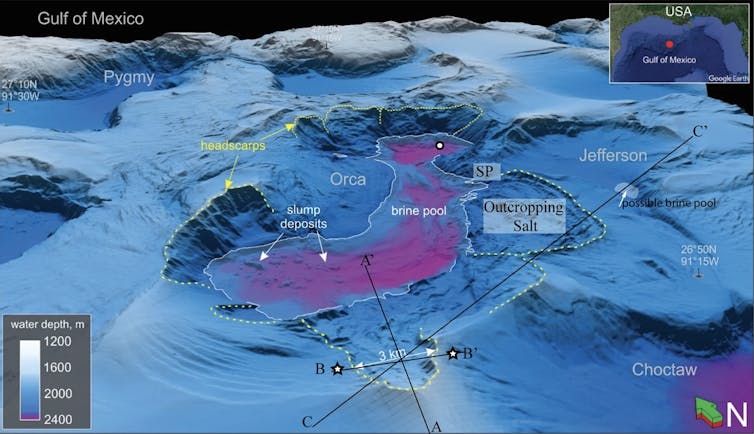
Extracting lithium from deep-sea brines, if it is confirmed to be there, could be more straightforward than traditional seabed mining. Technologies already exist to separate lithium from salty water.
In the Gulf, this approach could potentially use existing offshore oil and gas infrastructure, reducing the need for new construction. The brine could be pumped up, processed to remove lithium, and then returned to the subsurface.
Deep-sea mud
In the Central Pacific Ocean and off Japan, deep-sea mud enriched with rare earth elements and yttrium has been recognized as another new resource.
These deposits form from the very slow accumulation of fish debris, composed of biogenic calcium phosphate, in the deepest parts of the ocean. In 2026, a Japanese research vessel successfully drilled and retrieved deep-sea sediment containing rare earth minerals from the seabed near the island of Minamitorishima, and the Japanese government announced a deep-sea mud extraction trial would begin in 2027.
The drawbacks for marine life
While these regions likely hold vast resources, scientists know very little about the ecological conditions at the boundary between deep-sea water and seafloor sediments, especially about the microbial communities that live there.
Microorganisms are the most widespread and fundamental forms of life on Earth. They play central roles in ecosystems, nutrient cycles, and the long-term stability of the planet. The potential impacts of mechanically removing nodules from the seafloor – through cutting, scraping or lifting – on these microscopic ecosystems remain largely unknown.
In the Pacific Ocean, an experimental mining test carried out in 1978 was revisited more than two decades later. Even after 26 years, tracks left by mining vehicles were still visible on the seafloor. The disturbed areas had fewer bottom-dwelling organisms and less diversity compared to nearby undisturbed regions. Notably, no detailed assessment of microbial communities was conducted, leaving a significant gap in understanding.

Complicating the issue further, many prospective deep-sea mining areas lie in international waters, beyond the jurisdiction of individual nations.
The International Seabed Authority is responsible for regulating mineral activities in the deep ocean, but there is no global consensus on the rules, safeguards or acceptable risks associated with seabed mining. Some countries, including the United States, are discussing creating their own licenses to mine in international areas, while about 40 others are calling for a mining moratorium until the risks are better understood.
Critical minerals are the invisible foundation of modern life. As interest in deep-sea mining grows, these scientific uncertainties and governance challenges will be central to the debate.