“I shielded the baby with my body.” That is how Magen David Adom paramedic Elad Pas describes the moment an ambulance birth on a highway in southern Israel coincided with a missile alert.
The newborn had just begun crying when the warning arrived on the team’s phones. A missile had been launched toward the region.
Moments earlier, Pas and his team had been transporting a 23-year-old woman whose contractions were getting closer together. The hospital was still some distance away. It became obvious the baby would not wait that long.
“There was a very high probability the birth would happen immediately,” Pas recalled. The delivery took place inside the ambulance.
“We were notified that there was a woman with contractions that were becoming urgent,” Pas told The Media Line. “We understood there was a very high probability that the birth was about to happen.” By the time the team reached her, another ambulance had already arrived and begun assisting the patient. It immediately became clear that there was no time to reach the hospital before the baby arrived.
“We saw that she was really at the beginning of delivery,” Pas said. “So we delivered the baby right there, in the ambulance.” The newborn emerged safely and began crying as the team quickly cleaned and checked him while stabilizing the mother.
Only seconds later, the situation shifted dramatically.
“Immediately after the baby came out, after we cleaned him a little and made sure everything was okay, the sirens started,” Pas said. A missile alert had just been issued for southern Israel. Within moments, the medical team received the warning on their phones that a missile had been launched from Iran and was heading their way.
Emergency crews in Israel operate under clear safety procedures during rocket and missile alerts, but the presence of both a newborn and a mother who had just given birth created a particularly complicated situation inside the ambulance.
“In general, there are instructions for what to do when there are sirens,” Pas explained. “If you are in the ambulance, if you are on the way to a call, or if you are treating someone at the scene. But here the situation was more complex.” Moving the patient outside the vehicle was simply not possible, given her condition immediately after the birth.
“She had just given birth,” he said. “It wasn’t possible to take her out.” At the same time, the newborn was entirely dependent on the people around him. “The baby is helpless. Completely dependent on you. Those are his first breaths in the world.”
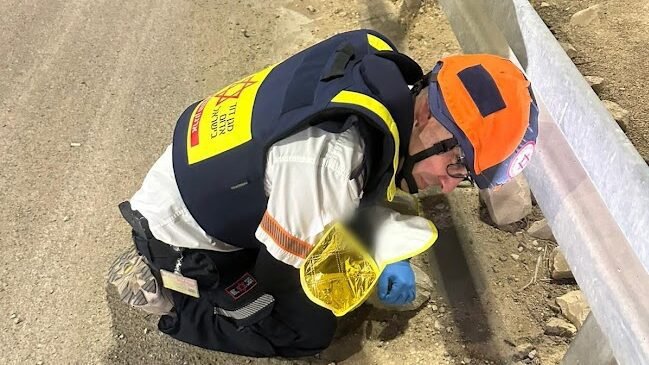
The team pulled the ambulance over to what they judged to be the safest available position. Helmets and protective vests were put on quickly as they secured the mother and the person traveling with her. Pas then lifted the newborn and shielded him with his body while the alert continued.
“I held the baby and covered him,” Pas said. “You instinctively protect him.”
The moment lasted only minutes, but for Pas, it carried a powerful contrast; a moment that normally represents joy and celebration was unfolding under the threat of incoming missiles.
“Birth is something very joyful,” he said. “Life is coming into the world.” Much of his work typically involves the opposite: arriving at scenes where people are critically ill or injured and fighting for their lives. “A lot of our work is dealing with people in very difficult situations,” he said. “When there is a birth, it’s something optimistic. It makes you smile.”
This time, however, the joy of the moment was mixed with the reality of war.
“Suddenly it was very mixed,” Pas said. “On one hand, a baby had just been born, something very happy. On the other hand, we are in a reality of war, and we are being bombarded.”
For Pas, the responsibility in that moment was clear: protect the newborn until the danger passed. The siren soon ended, and the immediate threat cleared, allowing the ambulance to continue its drive to the hospital.
“It goes into the collection of moments you never forget,” he said, reflecting on the incident. Paramedics often find themselves at the extremes of human experience, witnessing moments of tragedy, survival, and sometimes new life.
“Our work deals with extreme situations,” Pas said. “People in very serious condition who need help.” In this case, the danger did not come from illness or injury but from the war unfolding around them.
“It was something external,” he said. “Missiles falling.” In that moment, there was no treatment to perform and no medical procedure required. “There was nothing to treat,” Pas said. “Only to make sure the baby would not be hurt.”
The newborn’s first moments in the world took place not in a hospital delivery room but inside an ambulance stopped on the side of the road, in the arms of a paramedic shielding him from the possibility of incoming fire.