An international law-enforcement operation has dismantled key parts of a sprawling drug trafficking and money-laundering network operating across Europe, Asia and Australia, after investigators unlocked crucial data from two mobile phones seized in Sweden.
Small local case reveals global criminal ecosystem
The investigation, led by the Swedish Police Authority and known as Operation Candy, began in November 2023 when officers confiscated two mobile phones from a suspected drug trafficker in a small Swedish town.
Forensic analysis of the devices revealed encrypted communications and international contacts that quickly transformed what appeared to be a local case into a major global investigation. Specialists at Europol helped examine the data, uncovering several interconnected criminal networks involved in large-scale synthetic drug trafficking and complex money-laundering operations.
Investigators discovered that the networks were not structured as a single organisation but functioned as a decentralised system linked through facilitators and a web of companies used to conceal ownership, logistics and financial flows.
Evidence showed activities stretching across multiple countries. In Sweden, suspects managed domestic drug distribution and laundering operations, while other members ran online drug markets supplying customers in the Nordic region.
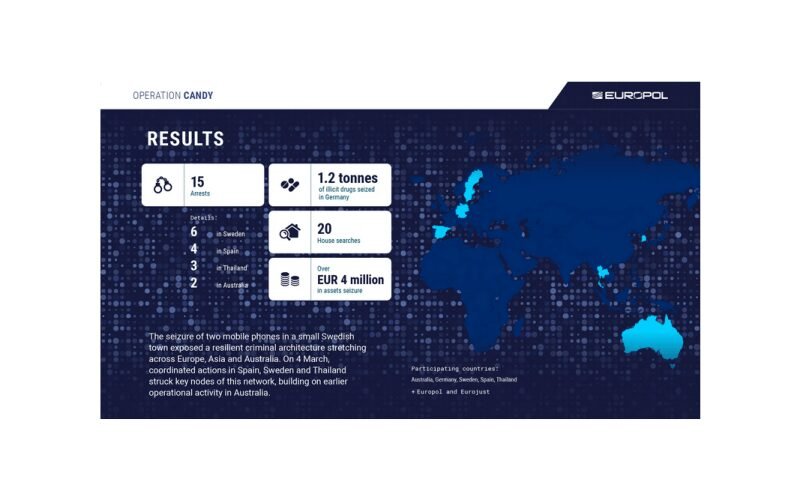
In Germany, authorities intercepted 1.2 tonnes of illicit drugs destined for Australia, hidden inside shipping containers. The shipment triggered a parallel investigation by the Australian Federal Police and partners in Australia, where two suspects were later charged after the consignment was tracked to warehouses in Victoria.
On 4 March, coordinated raids in Spain, Sweden and Thailand targeted key figures linked to the network. Around 20 searches were carried out, leading to 13 arrests and the seizure of criminal assets worth about €4 million. Combined with earlier arrests in Australia, the operation has resulted in 15 suspects detained.
Judicial coordination for the cross-border investigation was supported by Eurojust, while authorities from Germany, Spain, Thailand and Australia also participated.
Officials said the case highlights how modern organised crime increasingly operates through flexible international networks embedded within legitimate business structures, allowing criminals to move drugs and launder profits across multiple jurisdictions.