In his 1961 novel The Winter of Our Discontent, John Steinbeck wrote of loss, “It’s so much darker when a light goes out than it would have been if it had never shone.”
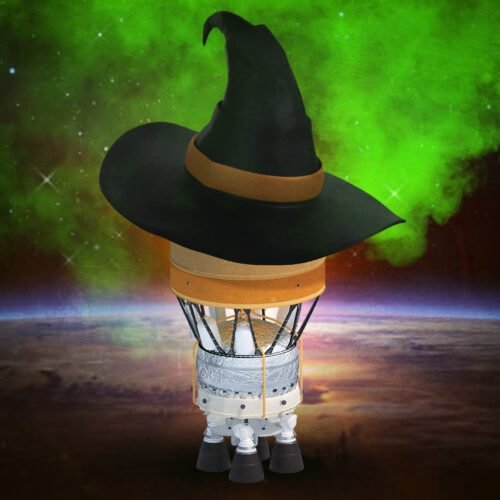
The death of NASA’s Exploration Upper Stage today represents the inverse of that sentiment. The world of spaceflight is so much brighter now that its light has gone out.
The rocket’s death came via a seemingly pedestrian notice posted on a government procurement website: “NASA/MSFC intends to issue a sole source contract to acquire next-generation upper stages for use in Space Launch System (SLS) Artemis IV and Artemis V from United Launch Alliance (ULA).”
If the Exploration Upper Stage was anything, it was a survivor—a testament to the power of pork, and the value of political support from key southern senators in Alabama, Mississippi, Texas, and Florida.
Why it came into existence
Contracted to Boeing more than a decade ago, the Exploration Upper Stage upgrade was intended to allow the SLS rocket to launch not just the Orion spacecraft to the Moon, but large payloads alongside it. That the development of capable rockets by SpaceX, Blue Origin, and United Launch Alliance to deliver large cargo to the Moon rendered it obsolete mattered, for a long time, not at all.
So why have the Exploration Upper Stage at all?
The short answer is, mostly, pork (excess spending). But let’s unpack it a little further. When Congress and NASA created the SLS rocket in 2011, they always intended the first launch or two to use an “interim” upper stage, essentially a modified version of the Delta IV rocket’s upper stage. But that rocket faced retirement (it was too expensive in the face of emerging competition), so NASA needed a more permanent upper stage.
Now, you might think NASA would ask industry for solutions to this problem. After all, United Launch Alliance was developing a more powerful upper stage for its Vulcan rocket, the Centaur V, that used the same propellant as the core stage of the SLS rocket. And Blue Origin was also developing a powerful upper stage engine, the BE-3U, powered by hydrogen. These options were cheaper, available, and … summarily ignored.
10 years, billions of dollars, and not much to show for it
Congress, smelling jobs, wanted NASA to develop a brand new upper stage. So in 2016, lawmakers allocated $85 million for preliminary work on the upper stage, and have since awarded more than $3.5 billion.
For the development of a rocket’s second stage.
With engines (RL-10s) that have been flying in space for six decades.
And after all of this, a decade later, the upper stage remains years from being ready to fly.
In some ways, the Exploration Upper Stage was the perfect vehicle for pork. It not only spread largesse among Boeing and Aerojet Rocketdyne (for the engines), but it also necessitated a massive new launch tower in Florida. That was good for the Exploration Ground Systems program at Kennedy Space Center.
The original cost estimates of these projects are always instructive to look back on. Boeing’s initial contract to build the Exploration Upper Stage started at $962 million, and NASA planned to launch the rocket on the second flight of the SLS in 2021. Oops. As for the launch tower, the initial estimate for its cost was $383 million, but as of late, it was heading north of $2 billion. So we are talking billions and billions and billions of dollars for a relatively straightforward upper stage, using off-the-shelf engines and a large launch tower.
It didn’t have to be this way. Over the years, from time to time, a company like Blue Origin would show up and say, ‘Hey, NASA, we could provide you with a more powerful and low-cost alternative.’ And the space agency would just laugh and send them away with a pat on the head.
Sanity prevails
It was all staggeringly and stupidly expensive. And I just want to underscore this point: The Exploration Upper Stage did not, in any way, get NASA closer to landing the Artemis III mission on the Moon. Taxpayers were spending billions of dollars to hinder, rather than help, the United States beat China back to the Moon.
Finally, sanity has prevailed. Mere weeks into the job, NASA Administrator Jared Isaacman looked at NASA’s convoluted plans for exploring the Moon and asked some simple questions. Like, why are we building a space station around the Moon when we, our allies, and our competitors are all much more interested in having a presence on the surface? And then, why are we spending billions of dollars on an upper stage that only exists to support that space station?
After he got the usual nonsensical answers, Isaacman made some decisions and, in a short time, rounded up political support to get Artemis moving. The expensive upper stage and its boondoggle launch tower? Gone. That space station that will be thousands of kilometers from the Moon? It’s not necessary. Instead, the space agency is putting its resources into returning to the surface of the Moon with the best available technology.
NASA should have selected the Centaur V upper stage a decade ago. The next best time was today. To his credit, Isaacman decided that vehicles to get us on the Moon are better than vehicles to enrich contractors.