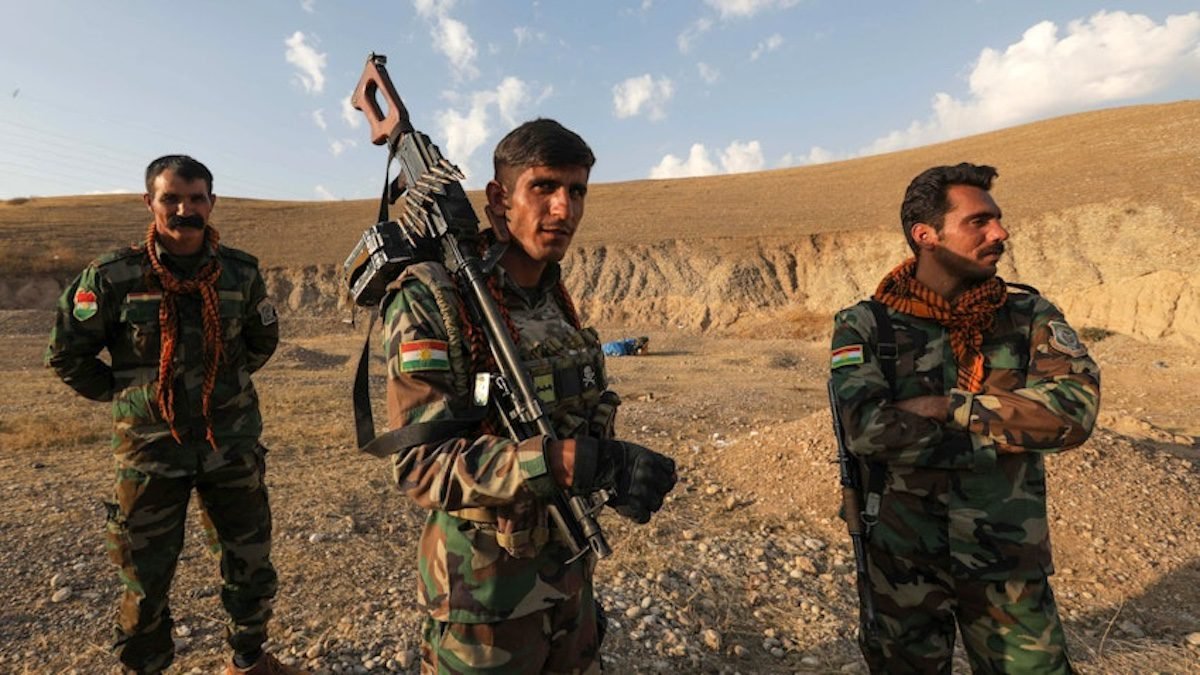

CNN has reported that the US Central Intelligence Agency (CIA) is working to arm Kurdish forces to spark an uprising in Iran, which would allegedly be facilitated by neighboring Iraqi Kurdistan.
According to one anonymous CNN source, “the idea would be for Kurdish armed forces to take on the Iranian security forces and pin them down to make it easier for unarmed Iranians in the major cities to turn out without getting massacred again as they were during unrest in January.”
The Iran conflict will expand significantly, however, if Trump plays this Kurdish card. Turkey has a long history of intervening in Iraq and Syria to fight armed Kurdish groups it considers linked to the PKK — which finally laid down its arms last year after decades of guerrilla warfare against the Turkish state — and which Turkey and the US designate as a terrorist organization.
Any significant gains Iranian Kurds might achieve, aided in no small part by US and Israeli air support, could trigger a large-scale Turkish intervention modeled on its earlier campaigns in Iraq and Syria.
The Syrian Kurds lost US backing after the fall of Bashar Assad and submitted to new Syrian leader Ahmed al-Sharaa’s authority earlier this year, following a Turkish-backed offensive that swiftly dismantled the autonomous region they had carved out since 2011.
This precedent should not inspire optimism among the Iranian Kurds or their Iraqi counterparts ahead of US President Donald Trump’s envisaged Kurdish-led uprising in Iran — one that could effectively constitute an invasion if the Iraqi Kurdish forces become directly involved.
Even so, they might still try their luck, calculating that history will not repeat itself and that the US will not abandon them again. But Trump may be cynically plotting to do precisely that, provoking a Turkish intervention that could catalyze a chain reaction of other interventions.
For instance, Azerbaijan — a close Turkish ally — regards northern Iran, where ethnic Azeris outnumber the entire population of Azerbaijan itself, as “South Azerbaijan” and could move to exploit any opening created by a Turkish anti-Kurdish campaign.

Saudi Arabia, the Gulf’s self-styled leading power, might then lead some of its smaller neighbors into battle against their shared Iranian rival — with or without the UAE, which could attacks unilaterally due to its own bilateral tensions with Tehran.
Saudi Arabia and Pakistan have close ties, and Islamabad might join the conflict as well — either by conducting its own strikes against Iran or launching a limited ground operation against Baloch separatists on similar counterterrorism grounds to those Turkey would cite against the Kurds.
This potential chain reaction of interventions could begin with Trump playing the Kurdish card, provoking Turkey to be the first to join the war against Iran — even if Ankara and the others act independently of Israel while coordinating only with the US.
If this unfolds, Iran’s balkanization would be a fait accompli, with the only question being its post-war form. Some minority-majority peripheral regions might receive Bosnian-like autonomy, functioning as de facto independent statelets, while others might formally separate as breakaway states.
Other scenarios include annexation by Iran’s neighbors or occupation on peacekeeping or counterterrorism grounds, possibly including no-fly zones. Playing the Kurdish card could therefore prove fatal for Iranian statehood.







 is working to arm Kurdish forces to spark an uprising in Iran, which would allegedly be)