The Moon has received a lot of attention in recent months, particularly the surface of Earth’s cold and dusty companion.
This has largely been driven by a decision from SpaceX founder Elon Musk to pivot, at least in the near term, from Mars to lunar surface activities and the potential for using material there to build large satellites. But there has been a notable shift from NASA, too, which has started talking a lot more about building up elements of a base on the surface rather than an orbiting space station known as the Gateway.
In short, the world’s most successful space company and the largest space agency have both increased their lunar ambitions, suggesting a greater frequency of missions to the Moon in the coming years.
For companies that have long-term business plans focused around the surface of the Moon, these are very positive developments. And two of these lunar startups, Astrolab and Interlune, announced Tuesday morning they are forming a partnership amid this favorable environment.
Astrolab is one of three firms vying to build rovers for NASA’s scientific activities on the surface of the Moon, as well as to provide transportation for its astronauts. But the company has been working with commercial customers as well, and one of the most important long-term ones could be a Helium-3 mining company called Interlune.
“Ultimately, we want to build a fleet of electric harvesters that will go to the Moon and excavate, extract, and separate Helium-3 from the lunar regolith,” said Interlune chief executive Rob Meyerson. “The FLEX Rover is a great platform to go do that.”
Starting smaller with FLIP
This is not the first time the two companies have worked together. Last August, Interlune announced that it would fly a multispectral camera on a smaller prototype rover being built by Astrolab. This camera will be used to estimate helium-3 quantities and concentration in Moon dirt, or regolith.
This FLIP rover, about the size of a go-kart, is due to launch later this year on a lunar lander built by Astrobotic. It will fly atop the Griffin lander, taking the place of NASA’s VIPER rover, which has been moved to another spacecraft.
The mission will therefore be a learning exercise for both Astrolab, in testing out its software and other features of a small lunar rover, as well as Interlune, which will seek to ground truth data about the concentration of Helium-3 that has previously been estimated from samples returned to Earth during the Apollo program.
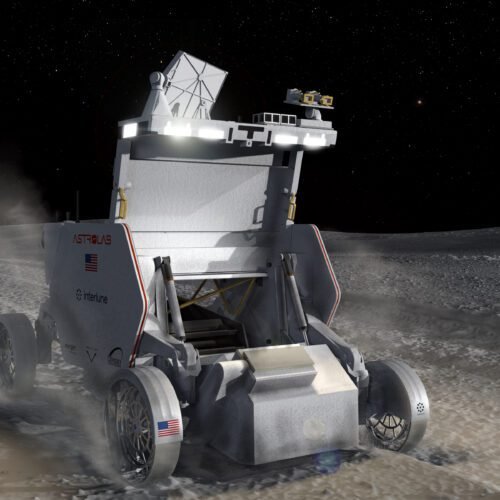
In addition to FLIP, Astrolab is developing a larger rover, FLEX, that is about the size of a minivan. This vehicle has a horseshoe-shaped chassis that can accommodate about 3 cubic meters of payload. This allows for a broad array of activities, from carrying multiple scientific instruments across the Moon and providing a long-distance rover for two astronauts, to moving large equipment or, in the case of Interlune, serving as a mobile harvester.
“Our thesis is to make the most versatile platform possible so we can serve a wide array of customers and achieve NASA’s goal of being one customer among many,” said Jaret Matthews, Astrolab founder and chief executive, in an interview. “So we have essentially a modular approach that allows us to either pick up cargo or implements or payloads. And so in this case, the excavating equipment that Interlune is developing would basically go under the belly of the rover.”
Precursor activities underway
The companies did not say when they are scheduled to deploy an initial harvester, but both are working toward that goal. It is likely that a FLEX rover will be one of the payloads on the first SpaceX Starship mission to the lunar surface—probably, but not certainly, the lunar demo mission without crew—planned to fly to the Moon in 2027 or 2028. Interlune has been working with Vermeer, an industrial equipment manufacturer, to build a harvester to excavate and separate Helium-3 from the lunar surface.
Helium-3 does not occur naturally on Earth, and it exists in only very limited quantities from nuclear weapons tests, nuclear reactors, and radioactive decay. It has several applications, but the most near-term use is in cryogenics, Meyerson believes. The company has already announced contracts for the sale of thousands of liters for very low-temperature refrigeration. But first, it must demonstrate the ability to mine and refine the material, which exists in small quantities in lunar soil, and get it back to Earth. This is a difficult challenge, of course, but having partners to move across the Moon and get to and from there helps a lot.
Astrolab and Interlune plan to conduct prototype testing of a mobile harvester in Houston, where there is a new commercial facility known as the Texas A&M University Space Institute. This institute is currently under construction at NASA’s Johnson Space Center as the space agency seeks to broaden support for commercial space activities.