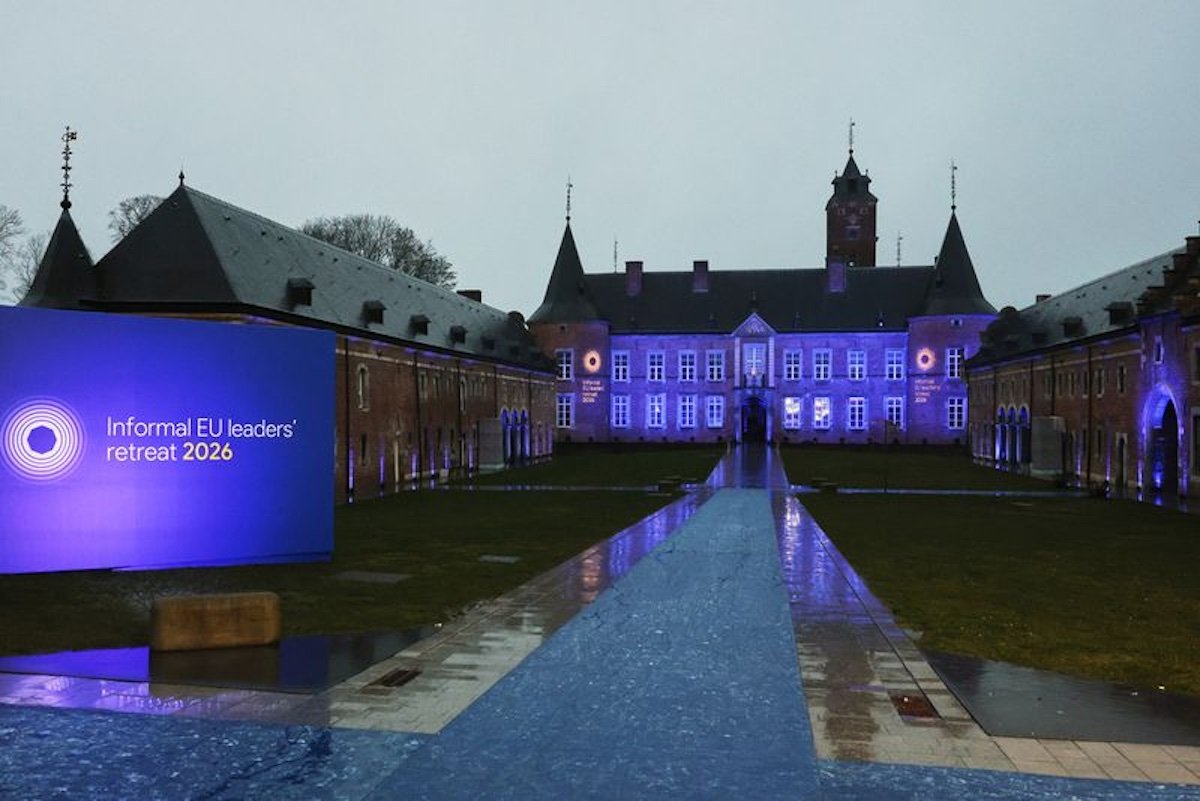
EU elite retreated to a Belgian castle on February 12 to formalize what other powers had long priced in: Europe is losing. Not a policy debate or a trade dispute, but the century itself.
The get-together was billed as a consequential competitiveness summit. The outcome—pledging to address in 2027 an economic crisis now in its third decade—reads as a declaration of surrender.
Nonetheless, Europe’s decline did not begin there. It is rooted in operational choices that long predate the gathering: energy priced at uncompetitive levels, a regulatory system that rewards output over restraint, a focus on protecting declining economic sectors and a sovereignty architecture that fragments decision-making while competitors consolidate it.
The more immediate question is whether the EU is chasing events while ignoring entrenched problems. The dominant focus is Ukraine, which has often functioned as a unifying rallying point, yet the leaders are consumed by the war and have little political energy left to confront Europe’s economic morass.
Brexit, the pandemic, China’s industrial supremacy, Trump’s return, Gaza, Venezuela, Iran and persistent immigration pressures have each overtaken the agenda in turn. The result: decline is acknowledged but never urgent enough to address.
The pattern is, therefore, structural: delay acknowledgement of the core problems, commission analysis, promise action at the next summit and repeat until Europe’s factories are gone. Meanwhile, Beijing builds battery plants in the time Brussels drafts a framework for discussing battery policy.
Chinese automakers produce EVs at half the European cost, so Europe spends 2024 tariffing them, only to remove the tariffs in 2026, while at the same time, backtracking on the long-planned 2035 ban on combustion engines, thereby creating further confusion amongst producers and consumers. The chemical industry relocates to America, where energy trades at prices Europe forfeited when it chose to cut Russian gas for reasons of moral outrage rather than industrial logic.
Indeed, energy is where the surrender shows clearest. Industrial gas in the EU costs five times what American manufacturers pay. Electricity costs more than twice as much in the US, China and India. European Commission chief Ursula von der Leyen stood up and said: “We did not come to a conclusion. I want to be very clear on this one. But to the next European Council, I will bring different options.”
Antonio Costa invoked decisive commitments and timelines going nowhere. Translation: we failed, we will fail again, but we will do so with better slides and outstanding new slogans.
In this context, two debates dominate. The first is whether to force the purchase of European products to compensate for firms that cannot compete: “Buy European.” The second is deregulation: even Berlaymont, the building that houses the European Commission’s headquarters, is beginning to concede that the “Brussels Effect” no longer disciplines anyone but itself.
The experts who built careers on the wishful thinking that Europe could regulate the world still invoke it like tiffosi, while production has moved to jurisdictions that approve factories in months, price energy at competitive rates and treat regulation as a tool for expansion rather than a substitute for competitiveness. Compliance is now a structural cost, not a competitive advantage.
In fact, the share of EU firms citing regulation as a major obstacle rose 42% in four years. Between 2019 and 2024, the EU adopted 13,000 legislative acts—seven a day—while the US Congress passed 3,500. Europe legislates at scale, it just does not build at scale: a single factory waits years for approval.
The reason is operational. Every actor in the system has incentives to legislate and none to restrain. The Commission expands its remit with each new regulation. Parliamentary rapporteurs build careers by closing files.
Council rotating presidencies need deliverables within six months. The result is a regulatory machine that no one is paid to switch off, as economist and former European parliamentarian Luis Garicano has argued.
Meanwhile, European industry is dying in specifics. Pharmaceuticals, semiconductors and renewable energy equipment—sectors Europe invented or dominated—are now assembly lines for components made in Asia, selling brands whose value is legacy, not capability.
The Eurozone runs a current account surplus that topped 500 billion euros (US$579.6 billion) in 2024, larger than China’s $430 billion. This looks like strength, yet it is the opposite. Europe collects rents on intellectual property accumulated when it still made things, while ceding production to competitors who will soon own the IP as well.
Over two years, 83% of key competitiveness indicators stagnated or deteriorated. The response was to accelerate work on the single market and keep “enhanced cooperation” in reserve if unanimity fails.
This concedes that 27 countries cannot agree on anything, so nine will proceed with whatever nine can tolerate. This is what a two-speed Europe means: a minority inches forward while the rest sink faster, with the bar set high enough to ensure this happens.
The retreat sidestepped a central contradiction: it promotes Ukrainian reconstruction as a pathway to membership while postponing the institutional, fiscal and governance implications, as if enlargement were a slogan rather than a treaty-bound process. Yet, accession before the 2030s is implausible, as enlargement requires unanimous approval at every stage, with bountiful roadblocks along the way
Fixing any of this would require redesigning a social model built when Europe dominated global manufacturing and could afford generous welfare, early retirement and six-week vacations—all funded by export dominance that ended 20 years ago.
The model survives on deficit spending, a decade of negative interest rates and the belief that productivity will return if Europe regulates itself into competitiveness.
It will not. The green agenda alone—emissions trading, carbon border adjustments and sustainable mandates—imposes costs that industry cannot pass to consumers who buy cheaper alternatives from countries that do not share European climate religion: US climate policy is being rolled back; China builds coal plants to power manufacturing and sells Europe the solar panels.
The decision to let nine states proceed with enhanced cooperation abandons the pretense that Europe can reverse any of this. Every major reform—capital markets union, defense integration and industrial champions—dies in committee because it would require states to surrender sovereignty and voters to accept pain that leaders will not inflict.
And for a solution, the summit handed the diagnosis to Mario Draghi and Enrico Letta, the clearest signal yet that tragedy is approaching. Both governed Italy with authority; neither fixed a single structural dysfunction.
Now they draft reports on what distresses the Union, as if the problems were analytical. Letta wants to move from 27 to one. Fine. Would he have surrendered his own authority as prime minister to make it happen? The question answers itself.
Reports pile up: Draghi on competitiveness, Letta on the single market, a dozen others on energy, defense and demographics. What Europe needs is a leader willing to tell voters that the life they have known is over, that the welfare state cannot be funded at current tax rates, that protecting dying industries only delays the funeral, that the choice is lower living standards now or devastating adjustment later.
They speak of values and solidarity as if these were economic policies, as if moral superiority compensated for collapsing productivity.
The Castle pre-summit was preceded by a pre-meeting convened by Germany, Italy and Belgium, which 19 states attended. Spain objected that this violated Union principles, a rich complaint coming from a government that has repeatedly joined selective gatherings.
Italian officials confirmed Pedro Sanchez raised no objection in private with Giorgia Meloni; yet the Spanish prime minister chose virtue outside the room while 19 coordinated inside it.
So, Europe faces an industrial crisis, and Madrid litigates seating protocol. The episode is less an aberration than a pattern. National leaders routinely privilege domestic positioning over collective outcomes, calibrating every intervention against electoral risk at home.
This is the measure of the EU elite: political survival first, public interest second, industrial subsistence somewhere after. A leader who privileges national optics will not ask voters to bear costs; they schedule the next summit instead.
Hence, the agreement to begin substantive discussions in 2027 seems to be the final countdown. By then, Chinese automakers will be entrenched in EU markets. American tariffs will have pulled more European capital west.
The defense spending deferred for two decades will crowd out funds for industry. The crisis will be deeper, and the room to act will be narrower. Leaders know this, setting the timetable for 2027, even 2028, perhaps because it falls beyond their own mandates.
The continent retains universities, research capacity and industrial infrastructure. What it lacks is politicians capable of deploying those resources. The EU was not built to compete with continental-scale economies run by governments that treat industrial policy as existential.
China redirects capital, rewrites regulations and reorganizes entire sectors in months. The US, for all its dysfunction, can still pass trillion-dollar bills and restructure when the cost of waiting exceeds the cost of acting.
Competitors are not waiting for Europe to decide if it wants to compete. Europe chose the social model over competitiveness, consensus over speed, process over power. At the Belgian castle, the crisis was acknowledged and postponed, leaving a narrower question than before: will Europe confront what it chose to bury while there is still time to exhume it?