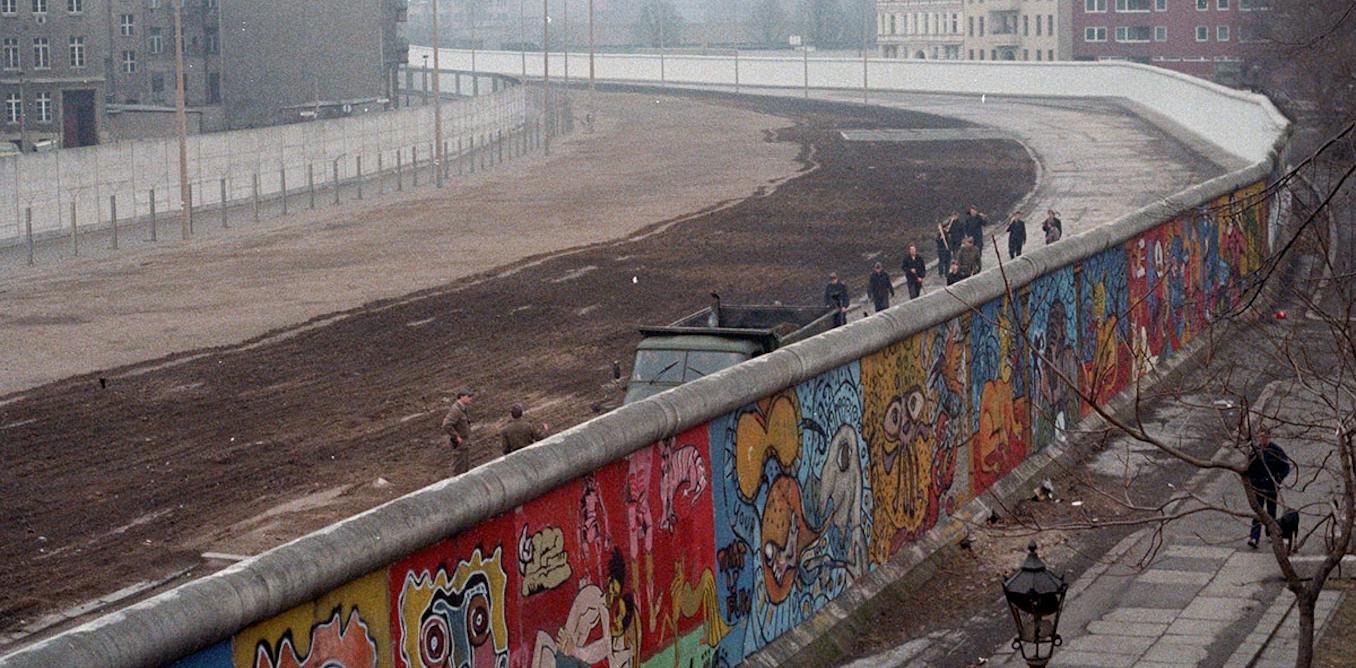
However, there are geographical divides in the AfD’s support. Polling indicates that over 35% of voters in east Germany support the AfD compared with 20% in the west. My research offers insights into why, 36 years after Germany was reunified, there are differences in voting behaviour between both sides of the country.
In 2019, two video artists, advised by me and other researchers and historians, interviewed 26 people about their lives in a divided and reunified Germany. These people were all born in 1975 and grew up in different areas of the country: east or west Berlin, Baden-Württemberg in the south-west or Brandenburg in the north-east.
My analysis of the interviews found that west Germans consistently stated their lives had not changed as a result of reunification. Torsten*, an interviewee from Baden-Württemberg, said: “For me, everything was fine before and everything is still fine.”
On the other hand, all of the east German interviewees experienced the transition from the planned-economy socialism of the German Democratic Republic to the social market economy of the Federal Republic of Germany as a profound change.
As 14-year-olds at the time of reunification, their entire lives were turned upside down. Nathalie, who grew up in east Berlin, where she still lives, said: “That’s when the chaos began, I’d say. My nice, orderly world just wasn’t so orderly anymore. I felt like I’d lost my footing.”

Reunification did present opportunities for east Germans, including greater freedom in choosing a career and new chances to travel. When asked what changes the fall of the Berlin Wall had brought about, Matthias from Brandenburg explained: “For me, that was the biggest opportunity of my life. I don’t know where I’d be now if that turning point hadn’t happened the way it did.”
But people like Matthias also had to witness businesses from former East Germany struggle to withstand new economic competition. The closure of unprofitable firms and the massive job cuts in companies that were sold, primarily to west German investors, meant they saw their parents and grandparents lose their jobs and towns and neighbourhoods left desolate.
Some of the interviewees spoke of a feeling of “devaluation” and of being treated as second-class citizens. Matthias recalled travelling to West Germany on a student exchange programme and hearing the parents of host students ask whether teenagers from the east knew how to eat with a knife and fork.
The majority of the west German interviewees knew little about the German Democratic Republic era and the challenges associated with the fall of the Berlin Wall. And many were unaware that inequalities between the two sides of the country persist.
These include the fact that less wealth is passed down through the generations in eastern Germany and that a higher share of households in western Germany own their homes than in the east. West Germans also occupy a large share of top positions in east German companies.
As a result, the west German interviewees did not understand the dissatisfaction felt by many in the east. Elke, from Baden-Württemberg, said in reference to east German complaints: “Man, you’ve been here for so long now. Why are you complaining? You’ve built such a great life for yourself here, and you’ve been given so many opportunities.”
For east Germans, on the other hand, the effects of inequality are part of everyday life. The people interviewed as part of the project had come to terms with the fact they are not listened to and that no understanding is shown towards them.
Bridging the divide
This feeling of not being heard or understood could be a leading factor in why many people in eastern Germany are voting for the AfD. The party is promising radical change and, in eastern regions, promotes nostalgia for the German Democratic Republic era.
According to a national survey released after the Saxony-Anhalt regional election in September, where the AfD secured victory with 43.8% of the vote, many east Germans see economic disparities and a lack of recognition for their achievements as an obstacle to national unity.
That is why it is important for east and west Germans to talk to one another, helping them come to terms with the past and shape the present together. This is the aim of outreach projects I run with my colleagues.
In one of these projects, Connecting Generations, we present video installations based in part on a selection of our interviews with the Germans born in 1975. We display the video installations in public spaces such as museums, memorial sites, libraries and adult education centres throughout Germany.
The aim is to provide Germans with spaces for encounter and dialogue. West Germans learn about the history of division and the period of change, and can familiarise themselves with the perspectives of people from the east.
Another project, Generations in Dialogue, focused on schools. We presented a video installation partly based on the same interviews and invited eyewitnesses into school classes to talk about their experiences.
After all, greater knowledge and understanding of all perspectives are needed to bridge the political divide between east and west Germany.
*The names of the interviewees have been changed to protect their anonymity.
Source: Iwpost.com





 is roughly twice as high in east Germany than in the west.)