 cde.news desk · 5 min read
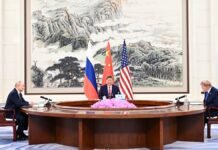
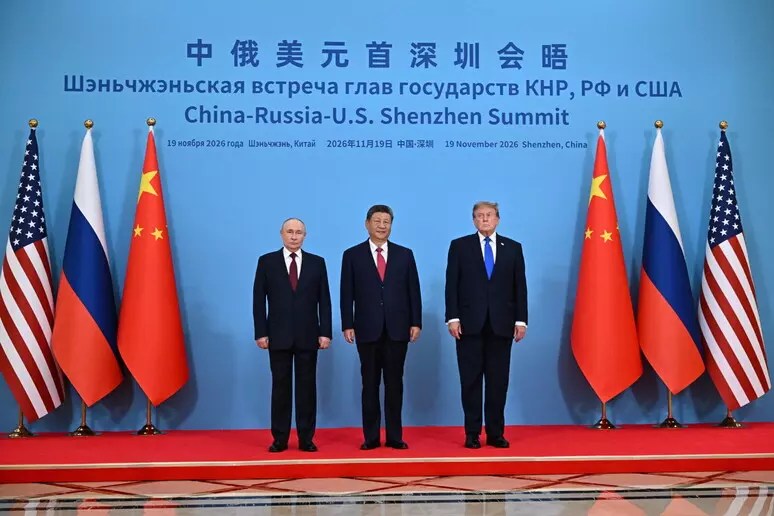
China, Russia and the United States issued a joint statement on Thursday after their first trilateral meeting, saying Chinese President Xi Jinping, Russian President Vladimir Putin and U.S. President Donald Trump are committed to upholding strategic stability and international security.
The statement said the leaders discussed energy security and plan to increase the production and supply of refined petroleum products. It also addressed the immunity enjoyed by state officials. “They agreed that the International Criminal Court and other similar institutions must not abuse their jurisdiction,” it read. On nuclear issues, the three leaders agreed that “nuclear war cannot be won and must never be fought,” and that dialogue was ongoing on preventing nuclear proliferation.
Xi said the meeting was the first of its kind in history and was of “groundbreaking significance.” He added that the three countries should work together to address global challenges and “set an example” for the rest of the world.
Trump echoed Xi, saying the meeting was “really making history” and that the three leaders have a “special responsibility” to maintain productive dialogue. “No peace was ever forged by declining opportunities for engagement,” he said.
Putin also said the three share a responsibility to preserve international peace, and that Russia, China and the United States can strengthen global stability if they co-operate constructively. He stressed that the three countries were among the victorious powers in World War II and said they share a “joint responsibility” for “maintaining international peace and security.”
The Russian president proposed discussing global and regional economic, food and energy security, as well as the resolution of regional conflicts, including the war in Ukraine. He said he had already discussed Ukraine in his bilateral meetings with Xi and Trump.
Putin’s opening remarks suggested that Russia sees the meeting as a kind of “Yalta 2.0.” The original Yalta conference brought together the leaders of the United States, Britain and the Soviet Union in the Crimean city in 1945 to discuss the post-war reorganisation of Europe.
Ukraine and trade on the sidelines
Earlier on Thursday, Trump said he wanted the war in Ukraine brought to an end as he met Xi. He said the two leaders would “help with respect to the war with Russia and Ukraine,” and he put the toll at about 25,000 deaths a month, mostly soldiers. The comments marked a shift, as White House officials had said days earlier that they did not expect him to raise Ukraine at the summit.
Before the Xi talks, Trump held an unscheduled pull-aside meeting with Putin in a separate room at the APEC conference center. He was joined by Treasury Secretary Scott Bessent and Chief of Staff Stephen Miller. Reporters were ushered out 58 seconds after Trump entered, and he left after 42 minutes.
The Kremlin said Ukraine was the main topic, according to Russian state news agency TASS, which added that Putin left in an “excellent mood.” Trump later said the encounter “set the stage” for the trilateral talks. The Wall Street Journal has reported that Putin first proposed a three-way meeting last month as a way to end the war on terms favorable to Moscow.
With Xi, Trump focused on trade. He said a U.S.-China Board of Trade, agreed at the leaders’ mid-May Beijing summit, has “brought greater balance” to a relationship he called “very lopsided” under past administrations. Officials describe the board’s work as identifying about $30 billion in goods on each side that could be traded without crossing national security lines and could qualify for tariff cuts. Its first official meeting took place last Friday.
Xi said ties are “stable and improving” and spoke of a new “constructive China-US relationship of strategic stability” based on respect, fairness and reciprocity. Trump called Xi a friend and said the two feel strongly that oil should keep flowing through the Strait of Hormuz.
The talks come as both sides try to keep a trade truce on track before it expires in January. The truce was extended earlier this month. After the leaders met in Washington in September, the two sides floated a $60 billion package of reciprocal tariff cuts, including about $17 billion in U.S. farm goods. That package has not been finalized.
Tensions have also risen after Washington announced new curbs on China’s access to advanced AI chips, including from Nvidia. Beijing criticized the rules and warned of countermeasures.
Ukrainian and European leaders fear Trump could strike a deal with Putin without Kyiv at the table. Ukrainian Foreign Minister Andrii Sybiha said Kyiv expects the U.S. and China to use their influence to press Moscow, and warned against any return to great-power “spheres of influence.”
Other issues hung over the talks. Republican lawmakers urged Trump to press Xi to free two Americans they say are wrongfully detained, Youlin Chen and Min Zin. Taiwan, which Trump said in May he was holding back an arms sale for as a “negotiating chip,” said it is in “close contact” with Washington. Trump also visited the Philippines on Wednesday, where he pledged deeper defense cooperation, including more than $5 billion in approved arms sales.
The trilateral meeting was originally scheduled for 2:30 p.m. local time. Pool reporters said the delegations were having lunch just after 3 p.m., and the schedule shifted amid confusion over the bilateral and trilateral sessions.
Source: Iwpost.com