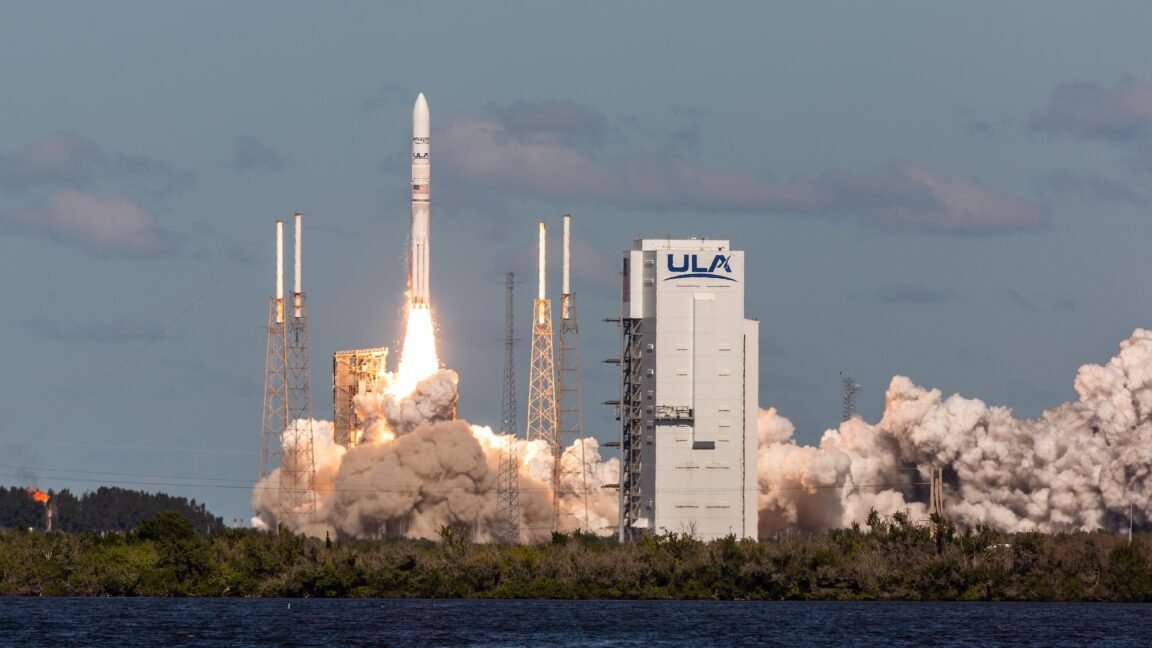
“ULA has completed an initial integrated review of flight data from the Leo 1 launch anomaly that occurred last Sunday,” the company said in a statement. “While work remains to determine cause, preliminary indications are that the low booster thrust was the result of inadequate fuel supply from the vehicle to the BE-4 engines, not from the performance of the engines.”
The new information released by ULA confirms reporting from Ars Technica on Tuesday that the rocket’s failure was not due to the performance of the vehicle’s main engines, which are provided by Blue Origin.
This represents an important revelation from ULA and will provide some major relief to different parts of the US aerospace community, particularly Blue Origin and NASA.
Big for Blue
That’s because the BE-4 engine is also the bedrock of Blue Origin’s New Glenn rocket. This powerful rocket uses a similar but slightly more powerful version of the BE-4 engine. New Glenn experienced its own catastrophic failure in May during a ground test, a failure that was later attributed to a main oxygen valve on one of the BE-4 engines.
After this anomaly, Blue Origin retrofitted the main oxygen valve, including for Vulcan missions. Now it’s clear that this retrofit was not implicated in the Vulcan accident. With the preliminary Vulcan investigation having largely exonerated the BE-4 engine, Blue Origin can press ahead with its return-to-flight mission with New Glenn, which could occur as soon as January.
“Following the Vulcan anomaly, Blue Origin immediately worked alongside ULA to review flight data and support the investigation,” Blue Origin said in a statement Wednesday. “Together, we identified that the low booster thrust was the result of inadequate fuel supply from the vehicle to the BE-4 engines, not from the performance of the engines. ULA is a valued partner, and we look forward to Vulcan’s return to flight.”
Amid a worsening US launch crunch, New Glenn offers the most tangible option for near-term relief for satellite operators, including Amazon Leo, which lost dozens of satellites on Sunday. The heavy-lift rocket has many commercial and government customers lined up for launch. NASA in particular is counting on the rocket to launch a number of lunar missions in the next two years, as well as play a significant role in landing humans on the Moon later this decade.
Also a relief to NASA will be confirmation that Vulcan’s upper stage, the Centaur V, did not contribute to the failure. NASA recently contracted with ULA to use the Centaur V as its new upper stage for the Space Launch System rocket, enabling future missions to the Moon.
More unwelcome woes for ULA
For ULA, however, the latest update only brings more challenges.
Vulcan represents the company’s great hope to remain relevant in a US launch industry increasingly dominated by SpaceX and newer entrants such as Blue Origin. With Vulcan on the sidelines, other companies, such as Relativity Space, Rocket Lab, and Stoke Space, could also elbow out the once all-powerful launch firm.
Although Sunday’s Vulcan flight, its fifth overall, was the first outright mission failure for the rocket, two previous launches also experienced problems. Those issues involved the nozzle of the solid rocket boosters. ULA has now spent three years trying to move the rocket out of its teething phase and into regular operations. A successful launch on Sunday could have set up at least a monthly launch cadence next year.
Now, the cash-strapped company must also contend with a new issue involving propellant management and complicated plumbing that feeds liquid oxygen and methane to the BE-4 engines. It will certainly be offline for several months.
Source: Iwpost.com