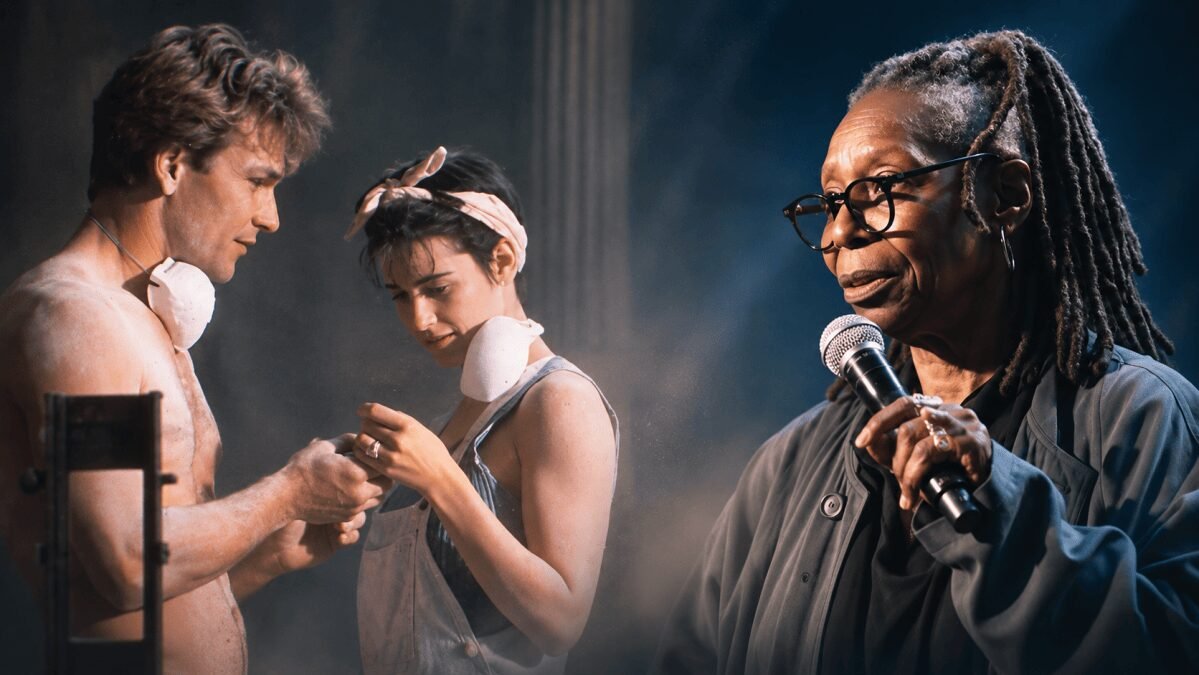
Patrick Swayze reportedly threatened to walk away from one of Hollywood’s most beloved movies unless Whoopi Goldberg was given a chance to star alongside him, an extraordinary move that helped change the course of her career.
More than 36 years after the release of the 1990 blockbuster Ghost, Goldberg’s account of the late actor’s behind-the-scenes intervention reveals how close audiences came to missing her Oscar-winning performance.
The supernatural romance, starring Swayze and Demi Moore, became a massive box-office success and one of the decade’s most unforgettable films. But Goldberg, who played the outspoken psychic Oda Mae Brown, almost never made it into the cast.
According to Goldberg, Hollywood executives were initially reluctant to hire her. Swayze, however, believed she was exactly what the movie needed and reportedly delivered an ultimatum.
“If you’re not going to hire her, I am not going to be in this film,” Swayze allegedly told the filmmakers, according to Goldberg’s recollection.
The stunning demand ultimately led to an unexpected meeting that would help secure Goldberg one of the most important roles of her career.
In Dave Karger’s 2024 book 50 Oscar Nights, Goldberg recalled receiving a surprising phone call from her agent, Ron Meyer, informing her that Swayze wanted her involved in the project.
Meyer explained that the leading man was unwilling to proceed without her and asked whether she could meet with Swayze and director Jerry Zucker.
The pair subsequently flew out to meet Goldberg, who recalled forming an immediate connection with the actor despite their unfamiliarity with each other.
Within minutes, the two were talking like longtime friends.
After approximately 40 minutes, Swayze made a personal appeal.
“Please do this with me,” Goldberg recalled him saying.
She agreed, unaware that the decision would lead to an Academy Award.
Released in July 1990, Ghost follows Sam Wheat, a banker murdered during a robbery who remains on Earth as a spirit determined to protect his girlfriend, Molly Jensen, played by Moore.
Goldberg’s character, Oda Mae Brown, initially poses as a psychic before discovering she can actually communicate with Sam. Her hilarious reactions and unexpected emotional depth provided some of the movie’s most memorable moments.
The film became the highest-grossing movie worldwide of 1990, earning more than $500 million at the global box office.
It also received five Academy Award nominations, including Best Picture, and won two Oscars at the 1991 ceremony.
Goldberg took home Best Supporting Actress, while Bruce Joel Rubin won Best Original Screenplay.
Her performance also earned her a Golden Globe and a BAFTA, cementing her status as one of Hollywood’s most versatile stars.
Years later, Goldberg admitted she never imagined the film would become such a cultural phenomenon.
“I said yes, not really knowing what it was going to be,” she recalled in an earlier interview. “It wasn’t until we all saw the film that we realized what we had.”
But the bond forged during that first meeting with Swayze extended far beyond the movie set.
When Swayze died on September 14, 2009, at age 57 following a battle with pancreatic cancer, Goldberg was among the Hollywood stars who publicly mourned his passing.
During an emotional tribute on The View the following day, she praised his remarkable determination to continue working despite his illness.
“He worked, he did his show, he just was a cat that never gave up,” Goldberg said. “I would like to be able to be that. I would like to have that bravery.”
She also remembered his refusal to allow his diagnosis to define his remaining years, describing a man who continued pursuing his passions even while confronting a devastating illness.
For Goldberg, Swayze’s legacy included something deeply personal: his willingness to stand up for her when Hollywood decision-makers were unconvinced.
What began as an unlikely casting battle ultimately helped produce one of the most celebrated performances of the 1990s.
And without Swayze’s insistence, one of Hollywood’s most memorable Oscar victories might never have happened.
Source: Iwpost.com