Eisenkot’s allies seek control of the Knesset and move to reverse Netanyahu-era legislation, but disagreements over Arab party support and military conscription complicate efforts to form a government
Israel’s newly elected parliament opened Tuesday with a challenge to Knesset Speaker Amir Ohana and a legislative push to establish a state inquiry into the October 7, 2023, Hamas-led attacks, as Gadi Eisenkot’s allies sought to exercise their parliamentary majority before forming a government.
Eisenkot’s Yashar party submitted a petition backed by 67 lawmakers demanding a vote to replace Ohana, a member of Prime Minister Benjamin Netanyahu’s Likud party. Ohana subsequently announced that the vote would take place November 17, with former Religious Affairs Minister Matan Kahana, a Yashar lawmaker, nominated as his successor.
The confrontation highlighted an unusual political situation following Israel’s October 27 election. Netanyahu remains prime minister at the head of a caretaker government, although his political bloc holds only 53 seats in the 120-member Knesset. Eisenkot’s four-party alliance controls 48 seats, while two Arab-led parties hold another 19.
President Isaac Herzog tasked Eisenkot with forming a government on Sunday after factions representing 67 lawmakers recommended him, compared with 46 who backed Netanyahu. Eisenkot has 28 days to assemble a coalition, with a possible 14-day extension, but the parties that endorsed him have not agreed to govern together.
Meanwhile, Yashar and allied factions filed bills to establish a state commission of inquiry into the October 7 attacks, impose term limits on prime ministers, and repeal elements of Netanyahu’s judicial overhaul.
The proposed repeals target changes affecting the attorney general’s authority, judicial appointments, and the circumstances under which a prime minister can be declared incapacitated. Other measures address legislation governing the courts, broadcasting, and police.
Eisenkot’s allies also agreed on candidates to lead several influential parliamentary committees. They backed Yashar’s Roy Folkman to chair the Arrangements Committee, Yisrael Beitenu leader Avigdor Liberman for the Foreign Affairs and Defense Committee, and B’Yachad lawmaker Liran Avisar Ben-Horin for the Finance Committee. The appointments remain subject to parliamentary approval.
Control of the speaker’s chair would give Eisenkot’s allies greater influence over the legislative agenda, even without a governing coalition.
Joint List lawmaker Ahmad Tibi told Israel’s public broadcaster Kan that his faction would support Kahana.
“We want to be part of the change,” he said.
We want to be part of the change
Finance Minister Bezalel Smotrich urged Kahana to reject the position if his election depended on votes from Arab-led parties. National Security Minister Itamar Ben Gvir separately repeated an unsupported claim that the October election had been stolen.
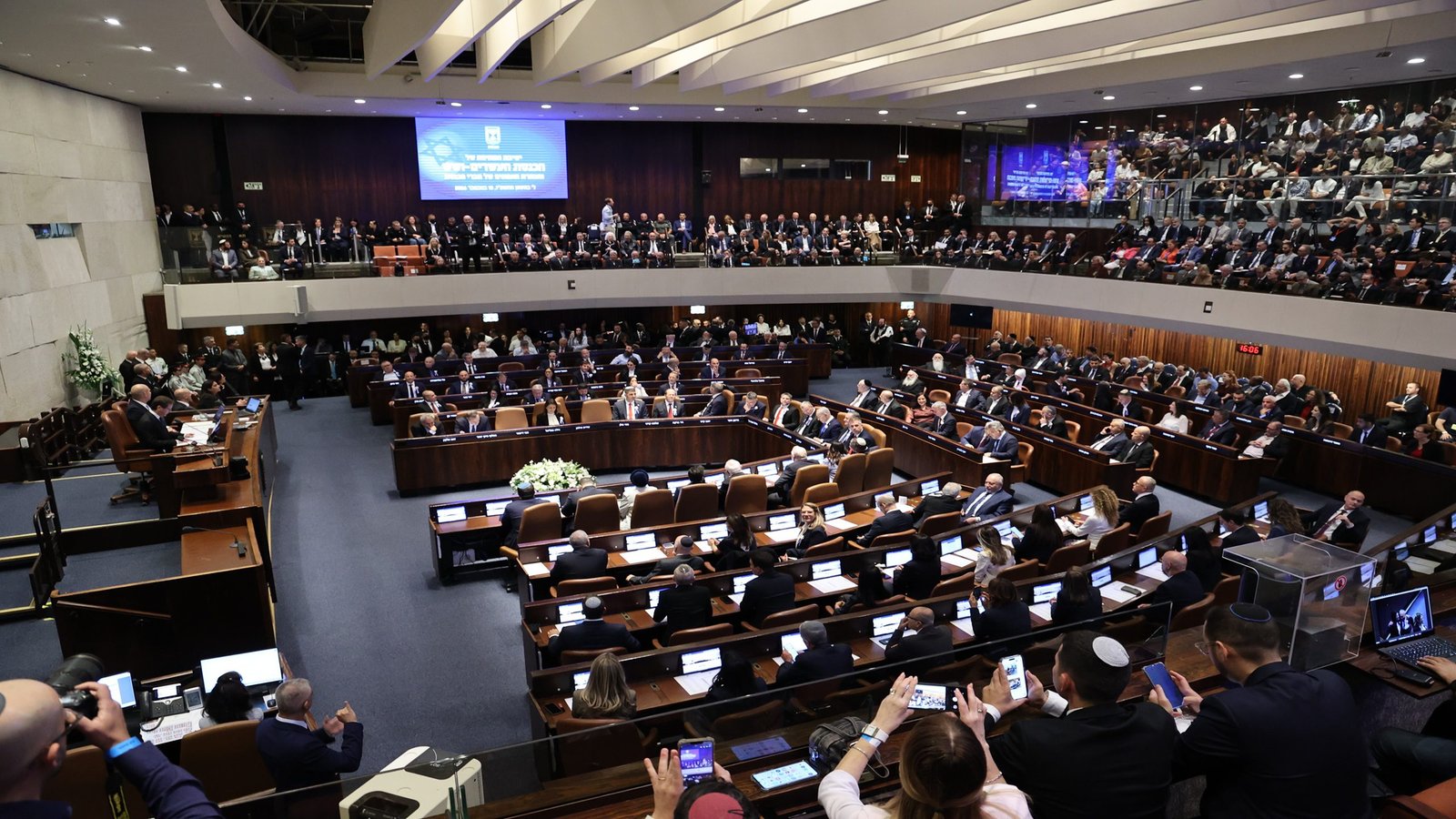
The political divisions were evident during Tuesday’s inauguration, which began with children waving Israeli flags outside the Knesset as Ohana welcomed Herzog.
During the swearing-in ceremony, Joint List leader Yousef Jabareen responded to the parliamentary oath with the prescribed words, “I commit.” Ben Gvir interrupted, asking, “Who’s he committing to, Hamas?”
Who’s he committing to, Hamas?
Ohana called Ben Gvir to order and warned that further interruptions would result in removal from the chamber.
The atmosphere shifted when newly elected Likud lawmaker Elisha Medan, a military reservist who lost both legs fighting in Gaza, rose on prosthetic legs to take the oath. Lawmakers across the political spectrum applauded him.
At the ceremony’s conclusion, Joint List lawmakers left the chamber before the singing of “Hatikvah,” Israel’s national anthem. Ra’am Chairman Mansour Abbas and fellow Ra’am lawmaker Yoav Segalovitz remained, although other members of their faction were also absent, prompting protests from right-wing lawmakers.
The new Knesset must also fill the vacant state comptroller position after the Supreme Court invalidated the previous parliament’s June election for the government watchdog post. Several lawmakers had recorded their ballots, violating the secrecy requirement.
Michael Rabello, Netanyahu’s former personal lawyer, won that vote but withdrew his candidacy on November 4 after the court ordered a new election. The position has remained vacant since July.
Despite their ability to act together on parliamentary appointments and legislation, the parties opposed to Netanyahu remain divided over the composition of a future government.
At Yashar’s faction meeting, Eisenkot said he would seek a broad national emergency government while maintaining his commitment to “service for all,” including military, national, or civilian service.
Former Prime Minister Naftali Bennett, who leads B’Yachad, said he was working to help Eisenkot establish a Zionist government quickly. He pointed to the burden on military reservists as one reason for changing the government.
Liberman ruled out supporting a minority government dependent on Arab-led parties. Instead, he proposed bringing in the ultra-Orthodox Shas and United Torah Judaism parties, whose combined 13 seats would give Eisenkot’s 48-seat alliance the minimum 61 needed for a parliamentary majority.
That approach faces substantial obstacles. Shas, which holds six seats, said it remained committed to Netanyahu, while United Torah Judaism, with seven seats, has indicated a willingness to explore alternatives.
United Torah Judaism lawmaker Yitshak Goldknop told Channel 12 that preliminary contacts had taken place with Eisenkot’s camp. The party has demanded protections for religious seminaries and exemptions from military service for ultra-Orthodox men, potentially putting it at odds with Eisenkot’s commitment to broader national service.
Meanwhile, Ra’am leader Abbas said his party wanted to participate in the next coalition or government. The Joint List has also indicated its willingness to support efforts to replace Netanyahu, although that does not necessarily mean joining the government.
With no agreed coalition in place, Eisenkot must reconcile competing demands over military service, Arab political participation, and the next government’s composition. If he fails to secure a majority, Netanyahu could receive another opportunity to form a government, potentially prolonging the political uncertainty that followed the election.
Source: Iwpost.com