It followed the unveiling of Task Force Iron Gate – the Trump administration’s latest plan to isolate the Iranian economy in a bid to coerce the government in Tehran to bend to Washington’s will. At the same time, Trump has suggested that a return to open war with Iran is “highly unlikely.”
From my perspective as an expert on Iran’s relations with the wider world, I believe that the U.S. war in Iran – now into its ninth month – is increasingly resembling an earlier episode of Iranian-Western conflict. In the early 1950s, the British imposed a two-year blockade and embargo against Iran after Iran’s then-prime minister, Mohammad Mossadegh, nationalized the country’s U.K.-controlled oil industry.
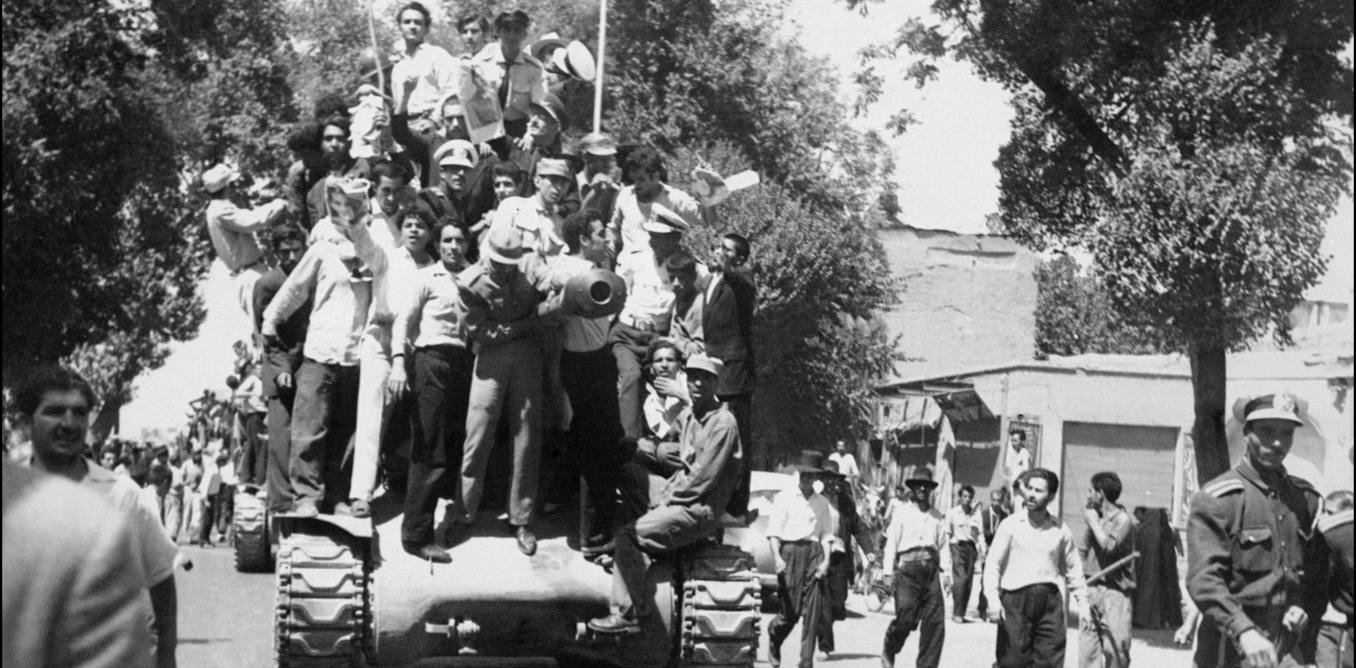
These efforts culminated in a 1953 British- and American-backed plot to stir up protest in Iran and eventually overthrow Mossadegh.
Seventy-three years later, many of those themes – oil, economic coercion, political intervention – ring true again. Trump’s stated and shifting justifications for the war include imminent threat preemption and nuclear nonproliferation. Yet his main motivations seem to be choosing Iran’s leader and controlling its oil.
Having failed to achieve this through direct military force, Trump’s main means for achieving the objectives are now a naval blockade and economic isolation – much like the British some seven decades earlier.
But there the analogy may end. Unlike during the Mossadegh era, Iran has shown it can fight back against foreign intervention and coercive economic actions through asymmetric warfare and economic disruption.
From oil nationalization …
In March 1951, one month before becoming prime minister and while serving as a parliamentary representative, Mossadegh persuaded the Iranian parliament to pass legislation that nationalized the Anglo-Iranian Oil Company. While popular with many Iranians, who perceived it as a long overdue measure to reclaim the nation’s independence and control its wealth, the move was considered by the British a breach of contract and a theft of its largest overseas asset.
The U.K. filed complaints with the newly created United Nations Security Council. But in July of that year, negotiations stalled and tensions escalated between Mossadegh – now the prime minister – and the British.

Economic coercion began with the British obstructing Iran’s oil sales by informing Iranian tankers that their receipts – issued when cargo is loaded on board – would not be accepted on the international market. In August, the U.K. stepped up the campaign by imposing a naval blockade against Iran.
In the process, they intercepted oil tankers off the Persian coast and prevented Iran from exporting petroleum to other countries. The British also prohibited the export of key commodities to Iran – such as sugar and steel – and froze Iranian bank accounts and assets in the U.K.
That same month, the U.K. evacuated its British technicians and closed Anglo-Iranian Oil Company refineries and other installations in the city of Abadan.
Mossadegh and his government assumed they could replace the technicians with those from other countries while training Iranians to fill the void. However, through legal threats and agreements, the British convinced other international oil companies in the United States and Europe, except Italy, to refrain from sending personnel.
… to Operation Ajax
Due to the British blockade and embargo, Iran’s petroleum production declined by about 96% and its oil income to almost zero between 1950 and 1952. At the same time, foreign oil companies like British Petroleum and Saudi Aramco doubled their production to offset the economic impact to the U.K. and the world of reduced or nonexistent production and exports from Iran.
Amid the economic crisis, Mossadegh’s inability to alleviate poverty, among other issues, caused his political coalition to fracture and fueled the British and American propaganda campaign against him ahead of his overthrow in Operation Ajax on Aug. 19, 1953.
A year later, the Shah of Iran, Mohammad Reza Pahlavi, consolidated power and signed an oil agreement with the British. In it, Iran’s share of the profits increased slightly, while an overwhelming majority of between 75% and 79% continued to be claimed by British and American companies. In exchange, the British lifted the blockade and enabled Iran to resume exporting oil on the international market.
The difference of deterrence
The U.K.’s campaign to pressure Iran and oust its leader contains parallels with the current conflict. Now, just as then, a Western power is hoping to bring Iranian leadership to its knees – and encourage widespread anti-government protests – through coercive economic actions.
But contrary to the 1950s, Tehran today is better placed to deter its foreign adversary.
While Washington has drastically degraded Iran’s conventional military capabilities, including its air force and navy, Tehran has effectively employed drones, missiles and proxies to repeatedly strike U.S. assets in the region. Back in the 1950s, Iran had no network of sympathetic regional militias like it has today, and it lacked the sufficient technology to hit back at a conventionally superior military.
Iran can also counter economic measures. Since the war began in February 2026, Tehran and its partners have continuously targeted the tanker traffic and civilian and energy infrastructure of the Arab Gulf states.
Consequently, it has caused Gulf kingdoms to rethink remaining under the U.S. security umbrella and diversify defense partnerships to include other powers inside and outside the region.

Iran has also asserted control, to different degrees, over the critical choke points of the Strait of Hormuz and the Bab al-Mandab Strait in cooperation with the Houthis in Yemen.
By attacking the Arab Gulf states and disrupting commercial vessels in the region, Iran has driven up the price of oil and other commodities and exerted economic and political pressure on the United States and other countries.
And while the U.S. sanctions and other measures have exacerbated the formidable economic challenges facing Iran that predated the war – record currency devaluation, runaway inflation and contracted growth – the regime in Tehran has seemingly weathered the serious social unrest that transpired right before the conflict, during which thousands of protesters and other citizens took to the streets and were killed by the security forces.
Unlike Mossadegh, the current leaders of Iran have had decades to build up a resilience to outside pressure. And while it took two years of economic pressure to push Mossadegh from power, years of sanctions have to date failed to bring Iran’s Islamic Republic to its knees. There is no guarantee that increasing the pressure now will change that.
Source: Iwpost.com