<
article id=”post-952768″>
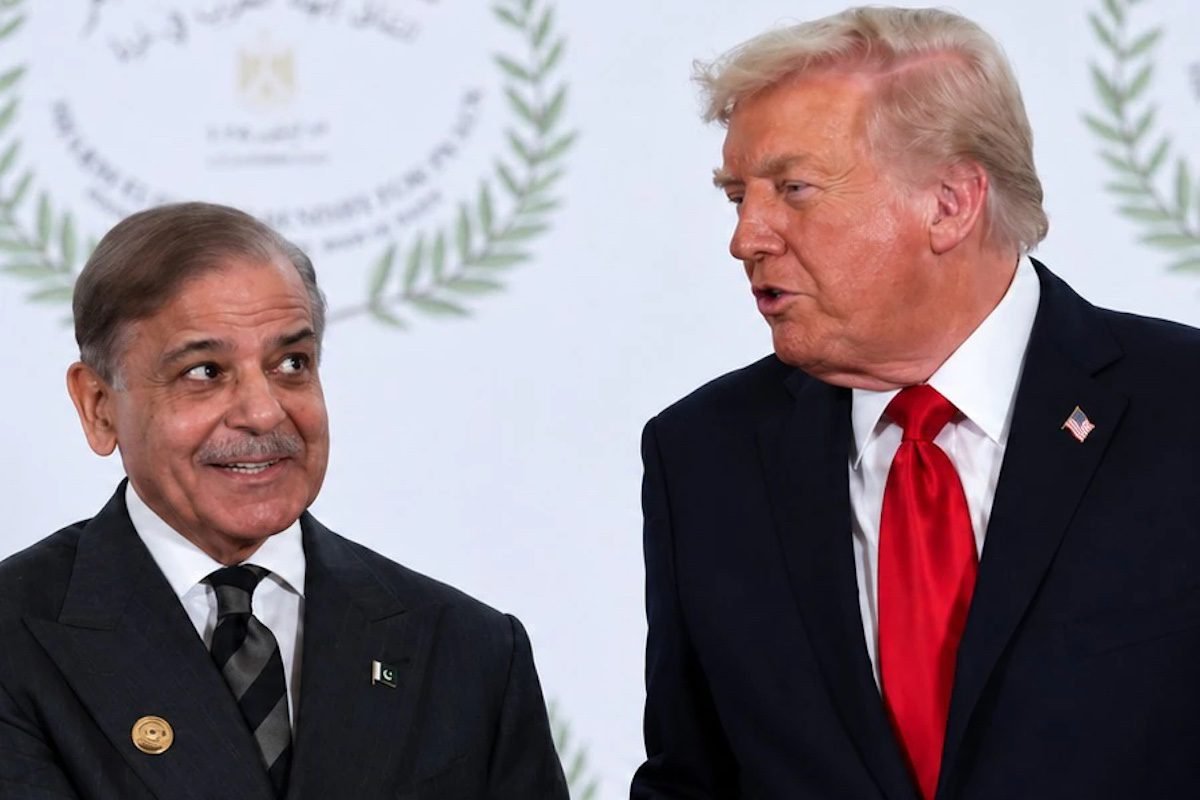
Pakistani Prime Minister Shehbaz Sharif left no stone unturned in praising Trump. From the Global Peace Summit on Iran to discussions on Gaza and other pressing international conflicts and issues, Sharif repeatedly lauded Trump, seemingly hoping to secure his goodwill.
Islamabad has also hired lobbying firms in the United States and spent substantial sums to cultivate political influence in Washington. These efforts reflected a broader strategy of using personal diplomacy and transactional engagements to secure favor and advance interests within the Trump administration.
Millions for influence, little in return
In a lobbying blitz, Islamabad committed nearly US$5 million to contracts with six major Washington firms. They included a $200,000-per-month engagement with Seiden Law, which subcontracted Javelin Advisors — a firm co-founded by former Trump Organization executive George Sorial and Trump’s ex-bodyguard and Oval Office operations director Keith Schiller.
A parallel deal with Orchid Advisors, which subcontracted powerhouse firm Squire Patton Boggs, also targeted the administration’s inner circle. Though these initial contracts have wrapped up, Sharif’s government doubled down on May 1, 2026, locking the Pakistani Embassy into a new multi-year $1.2 million deal with Ervin Graves Strategy Group LLC — led by former Republican Congressman Tom Graves — to promote Islamabad’s strategic narratives at the Pentagon and on Capitol Hill.
For a country that depends on International Monetary Fund (IMF) bailout packages, remains heavily dependent on external loans and faces recurring economic crises, spending millions on lobbying in Washington raises hard questions about the government’s priorities and willingness to divert scarce national resources to secure foreign favor.
The cryptocurrency arrangements involving members of the Trump family were particularly noteworthy, highlighted by a January 2026 Ministry of Finance MoU with SC Financial Technologies, an affiliate of the Trump family’s World Liberty Financial, to integrate a dollar-linked stablecoin for cross-border payments and remittances.
The Sharif government’s mineral diplomacy has been equally calculated. On September 8, 2025, the military’s Frontier Works Organization (FWO) signed a landmark $500 million critical-minerals investment framework with Missouri-based U.S. Strategic Metals (USSM), following a high-profile Oval Office meeting where Pakistani leaders presented raw mineral samples directly to Trump.
The transactional charm offensive has also extended to defense deals. In September 2026, Pakistani army chief Field Marshall Asim Munir finalized a procurement order and joint-technology MoU with Powerus, an American autonomous systems company that is set to merge with a publicly traded entity backed by Donald Trump Jr. and Eric Trump via a 9.9% stake held by American Ventures.
For all this, Pakistan has received certain symbolic returns. Trump has repeatedly praised Munir, calling him his “favorite field marshal” during major addresses, including at the October 2025 Sharm el-Sheikh Peace Summit in Egypt.
Beyond such flattery, however, Pakistan has secured very little of substance, neither financial rescue packages nor significant economic or strategic investment. Trump’s recognition did help Munir at home, bolstering the narrative that Pakistan’s international standing had improved and that its leadership enjoyed unprecedented access to the White House.
It also deflected attention from the continued imprisonment of popular former Prime Minister Imran Khan and growing criticism of the military establishment.
The government has aggressively played up these moments to justify and validate the constitutional centralization of power under Munir, who was elevated to field marshal in May 2025 and appointed the country’s first chief of defense forces under the 27th Amendment later that year.
In reality, though, Pakistan’s newfound prominence is largely symbolic, yielding little corresponding economic or strategic benefits.
US-India strategic resilience
India’s strategic partnership with the US, by contrast, has shown considerable institutional resilience. Even when bilateral relations were strained under Trump, particularly when he lent some support to Pakistan’s narrative surrounding Operation Sindoor, the broader strategic relationship between New Delhi and Washington has continued to progress.
Defense cooperation, technological collaboration and economic and industrial engagement have all remained on course. Both countries signed a new 10-year framework for defense cooperation in October 2025, while technological collaboration advanced through initiatives such as TRUST, covering artificial intelligence, semiconductors and other critical technologies.
American companies have also stepped up their investments in India, committing over $67.5 billion into the country’s technology, semiconductor and cloud infrastructure. Google has deployed $15 billion to build its largest gigawatt-scale AI data center hub outside the United States.
Amazon Web Services (AWS) has pledged $35 billion to scale its cloud infrastructure. Micron Technology has operationalized a $2.75 billion semiconductor assembly and test facility in Gujarat, Prime Minister Narendra Modi’s home state.
The India-US strategic partnership has developed strong institutional foundations and bipartisan support in Washington. Despite political differences and occasional tensions at the highest levels, the relationship has largely continued on its established positive and upward trajectory. Arguably, the partnership has built sufficient institutional momentum to outlast changes in political leadership on both sides.
American lawmakers have repeatedly assured their Indian counterparts that Washington’s engagement with Pakistan has been transactional, driven by specific American interests in West Asia and the wider region’s security context, while its partnership with India is a long-term strategic commitment.
US Secretary of State Marco Rubio made the point during his diplomatic visit to New Delhi in October 2026. While addressing Indian anxieties regarding Washington’s outreach to Islamabad, Rubio openly categorized the US–Pakistan relationship as operating at a purely “tactical level,” comparing it to India’s own transactional ties with Iran.
Washington engages Islamabad out of geopolitical necessity, he said, citing Pakistan’s geography, its role in counterterrorism and its status as a nuclear-armed state. Those interactions, Rubio averred, will “never come at the expense of our relationship… with India.”
Sergio Gor, the US ambassador to India, delivered a further rebuff to Islamabad during an August 2026 visit to Srinagar, where he explicitly referred to the region as an integral part of India.
Together, the remarks by Rubio and Gor bore out analyst assessments that Washington views New Delhi as a defining strategic partner for the 21st century, while confining its ties with Islamabad to narrow, security-driven matters.
Congressional shift
Washington’s political landscape shifted significantly since last week’s midterms. Trump has lost control of Congress and enters his final stretch in office as a weakened lame duck.
His administration’s dealings with Pakistan, including the cryptocurrency arrangements and business interests involving his family members, could now draw greater congressional scrutiny and possible investigations. This could leave Pakistan in a difficult position, particularly if the financial and political arrangements it used to court Trump come under examination.
Michael Kugelman, a South Asia analyst, has characterized this changed political reality in Washington as a major structural risk for Islamabad. Kugelman warned that “scrutiny of Trump & his/his family’s business dealings will increase, which may impact his administration’s commercial diplomacy.” Because Islamabad has “banked heavily on doing business with the administration,” a Democrat-controlled Congress could be bad news for Pakistan.
Kugelman also said Pakistan’s underlying vulnerability stems from having “concentrated too much of its diplomatic effort on the White House,” leaving it with little standing or capital left to deploy with the Democrats.
That means Pakistan may soon lose its place in Washington’s political limelight. Although the US may continue to require Pakistan’s services, whether over the Iran conflict or in a broader strategy to bring Pakistan into normalized of relations with Israel, the political dynamics are set to change.
Sharif’s repeated flattery of Trump, including his promotion for the Nobel Peace Prize, is unlikely to pay the same political dividends in an environment where congressional oversight and institutional checks carry more weight and potential consequences.
India-US relations, meanwhile, are likely to gain greater strategic attention. The partnership was already progressing on the strength of its institutions, expanding defense and technological cooperation, and bipartisan support developed over several decades.
With greater congressional oversight and a renewed emphasis on institutional engagement in Washington, it could regain momentum across economic, trade, defense and technological dimensions.
India is better positioned to benefit from the political change coming to Washington, precisely because its relationship rests on a far broader and more durable foundation than the transactional ties Pakistan cultivated and bought with the Trump administration.
Imran Khurshid is associate research fellow at the International Centre for Peace Studies (ICPS), New Delhi.
Source: Iwpost.com