Paraguayan editor Juan Carlos Dos Santos González explains how Ueno Bank transformed everyday banking, why Santiago Peña lost his party’s backing, and the challenges facing his successor
For some Paraguayan retirees, collecting their pensions at Ueno Bank was a Sunday outing. They could withdraw their money, sit down with a newspaper, and enjoy a coffee. In towns with limited banking options, Ueno offered around-the-clock access to its facilities, including staffed services on Sundays.
It was a completely different experience
“It was a completely different experience,” Juan Carlos Dos Santos González, an editor at Paraguay’s La Nación newspaper, told The Media Line. With an ID and 100,000 guaraníes, about $15 at the exchange rate he cited, customers could open an account, apply for a credit card, and begin using the bank’s app.
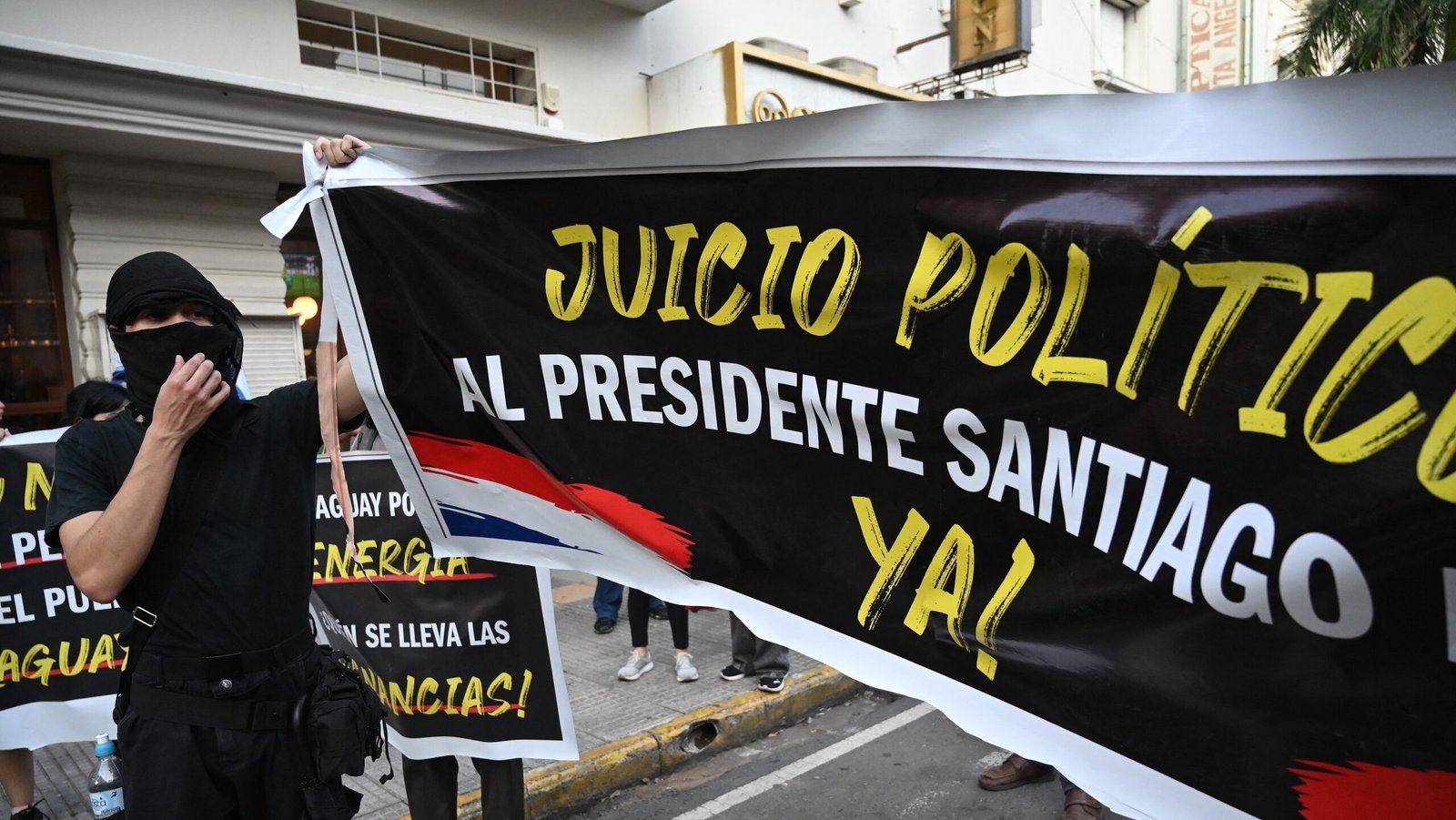
That accessibility helped Ueno attract nearly three million customers. But on November 3, Paraguay’s central bank began proceedings to wind down the lender after finding that its solvency ratio had fallen below half the regulatory minimum. Customers were suddenly unable to access their accounts, protests erupted, and a banking crisis rapidly became a political one.
Three days later, the Senate removed President Santiago Peña, who had held shares in Ueno’s parent company until March 2025. Vice President Pedro Alliana, also a member of the ruling Colorado Party, assumed the presidency that evening. He will serve the remainder of Peña’s term, which ends in August 2028.
Alliana inherited the challenge of restoring depositors’ access to their savings while prosecutors investigate how government agencies and Paraguay’s social security institute came to place hundreds of millions of dollars in the troubled bank.
Ueno had become a familiar presence in Paraguayan life, extending well beyond banking. Its name appeared on major soccer stadiums, including Defensores del Chaco in Asunción. Following the bank’s collapse, soccer authorities began removing its branding.
Dos Santos said Ueno had broken with “the conservative banking system we knew.” Its appeal to ordinary customers helped explain the public outrage when it failed.
The involvement of the Instituto de Previsión Social (IPS), Paraguay’s social security institute, made the crisis particularly serious. Its reserves include mandatory contributions from workers and employers, and approximately $355 million of its funds had been placed in Ueno, according to allegations made by lawmakers.
“Putting those funds at risk was very dangerous,” Dos Santos said.
The bank’s failure also exposed a political struggle within the Colorado Party. Former President Horacio Cartes, the party’s powerful leader and Peña’s onetime political patron, turned against his former protégé as the crisis intensified.
Cartes had helped launch Peña’s political career, appointing him finance minister and supporting his presidential ambitions. But analysts cited by The Associated Press described growing tensions as Peña sought to establish a political base independent of his former mentor. When the bank collapsed, Cartes publicly backed efforts to remove him.
Peña submitted his resignation on November 5 as the Chamber of Deputies considered impeaching him. Lawmakers voted 78–0 to proceed, while a separate congressional session considering his resignation ended without a completed vote after legislators withdrew and deprived it of a quorum.
On November 6, all 44 senators present voted to remove Peña from office.
The decision to pursue impeachment rather than accept his resignation had significant legal consequences. Under Paraguay’s Constitution, democratically elected former presidents are entitled to lifetime seats in the Senate, with speaking rights but no vote, unless they have been impeached and found guilty. The position also carries parliamentary protections.
I think he wanted to resign so he could keep his immunity and avoid the legal situation he’s facing now
“I think he wanted to resign so he could keep his immunity and avoid the legal situation he’s facing now,” Dos Santos said.
Peña maintained that his offer to resign was intended to preserve stability and help depositors recover their money.
During the impeachment proceedings, the Senate rejected Peña’s request for additional time to prepare his defense. His lawyers appeared on his behalf and challenged the evidence presented against him.
For Dos Santos, the speed of events recalled Paraguay’s political upheaval in March 1999, when deadly protests preceded the resignation of President Raúl Cubas. He said the memory of that violence contributed to the urgency surrounding the latest crisis.
This time, demonstrators gathered wearing Paraguayan soccer jerseys and carrying national flags. Dos Santos recalled an incident in which protesters turned away an opposition politician who attempted to join them.
“We’re here for the people who were affected, and we want Santiago Peña removed,” he recalled them telling the politician.
Peña’s removal was followed by criminal proceedings. Police initially detained him at his residence. On November 7, Judge Humberto Otazú ordered him held in pretrial detention at the Presidential Escort Regiment, a military facility in Asunción.
Prosecutors charged Peña with breach of trust and administration for personal gain. They allege that he used his position to influence public institutions to deposit or retain funds at Ueno despite his financial connections to the banking group.
Peña denies wrongdoing and has maintained that the bank’s problems were a regulatory matter.
Otazú also ordered pretrial detention for Carlos Carvallo, a former Ueno executive who subsequently became president of Paraguay’s central bank. Carvallo faces charges including breach of trust, administration for personal gain, and producing false public documents.
The court also ordered restrictions on Peña’s and Carvallo’s assets, including the preventive seizure of funds in their bank accounts.
A separate criminal investigation concerns loans and overdrafts extended to businesses affiliated with Ueno’s owners. Prosecutors charged 27 people in connection with the alleged irregularities. Six former bank executives and directors were ordered held in pretrial detention, while two others were placed under house arrest with electronic monitoring.
As the investigations continue, Alliana has begun consolidating his administration.
A former member of the Chamber of Deputies who also led the Colorado Party, Alliana enters the presidency with considerable experience in party politics.
He has more political backing than Peña had
“He has more political backing than Peña had,” Dos Santos said.
That support may help Alliana navigate the political crisis, although he is not entirely removed from the investigation. He was also named in a complaint concerning the Ueno affair that prosecutors are examining. He has not been charged in connection with the case.
Congress elected Senator Antonio Barrios to succeed Alliana as vice president. The new president also began reshaping his Cabinet, making new appointments to the Interior Ministry, the Public Works Ministry, and his chief of staff’s office.
Other senior officials, including Economy and Finance Minister Óscar Lovera and Foreign Minister Rubén Ramírez Lezcano, remained in their posts.
Despite the abrupt change in leadership, Dos Santos expects continuity in Paraguay’s foreign relations.
Ramírez Lezcano began contacting foreign counterparts on Alliana’s instructions to reassure them that the country would maintain its existing foreign policy.
The foreign minister would “carry on the same work he was doing under Santiago Peña,” Dos Santos said.
Israel was among the countries that quickly established contact with the new administration. On November 7, Israeli Foreign Minister Gideon Sa’ar congratulated Alliana, who reaffirmed his commitment to strengthening relations between the two countries.
The relationship was already familiar to Alliana. In October, while still vice president, he visited Jerusalem alongside Ramírez Lezcano, meeting Sa’ar on October 7 and Prime Minister Benjamin Netanyahu the following day.
Taiwan’s embassy in Paraguay also pledged continued cooperation, including in health, education, trade, and investment.
The United States emphasized institutional stability as the crisis unfolded. The US Embassy in Asunción urged Paraguayan authorities and citizens to maintain peace and respect democratic institutions, a message Dos Santos interpreted as support for allowing the impeachment process to proceed.
Following Alliana’s inauguration, Washington described Paraguay as a strategic partner and expressed its willingness to work with the new government.
Brazilian President Luiz Inácio Lula da Silva also moved quickly to congratulate Alliana, expressing hope that the two leaders would meet in Brasília.
Although their governments differ ideologically, Dos Santos pointed to the shared interests that underpin relations between Paraguay and Brazil.
We have something very important in common, the Itaipú dam
“We have something very important in common, the Itaipú dam,” he said, referring to the enormous hydroelectric facility jointly operated by the neighboring countries.
For Ueno’s customers, diplomatic assurances offer little immediate comfort. Their principal concern remains recovering their money.
Paraguay’s ability to begin repayments relatively quickly reflects lessons learned from earlier banking crises.
Dos Santos traced the development of the country’s financial safeguards to the banking crisis that began in 1995 and the intervention in Banco Alemán in 2002.
In 2003, Paraguay enacted legislation establishing a deposit guarantee fund and procedures for dealing with failing financial institutions.
“We were prepared for a similar situation,” he said.
Following Ueno’s collapse, Congress amended the legislation to accelerate repayments. The changes authorized advances of up to 40 monthly minimum wages, equivalent to approximately 121.7 million guaraníes per depositor, against the existing deposit guarantee of 75 minimum wages, or approximately 228.3 million guaraníes. Outstanding debts to the bank could reduce the amounts paid.
By November 7, Paraguay’s central bank reported that nearly 1.2 million depositors had received repayments totaling approximately $160 million.
Customers with accounts at other financial institutions could receive their repayments through direct transfers. Arrangements were also made to open accounts at other banks for customers who had relied exclusively on Ueno.
That process is particularly important for retirees who previously collected their pensions through Ueno.
The IPS said approximately 32,000 of its 90,000 pensioners had received their benefits through the bank and were being transferred to other financial institutions. Its president, Derlis León, assured beneficiaries that their next monthly payments and annual bonuses would be made as scheduled on November 17.
Recovering the social security institute’s own investments presents a more complicated challenge. Liquidators must determine the value of Ueno’s loans and other assets, establish how much can be recovered, and assess the losses that remain.
For the 32,000 pensioners transferred to other banks, the November 17 payments will be an important test of the government’s response. But while individual depositors are beginning to recover their savings, the fate of approximately $355 million in public retirement funds remains unresolved.
Source: Iwpost.com