The Culture Club frontman visited Re’im ahead of two Tel Aviv concerts, including one dedicated to Nova survivors and bereaved families
At the Nova festival memorial in southern Israel, legendary pop star Boy George recalled the WhatsApp messages from Jewish friends in London. Some no longer felt safe. Others were uncomfortable wearing a Star of David. Standing at the site of the attack he had watched unfold on television, the British singer said he found it strange to be thanked for responding.
I feel odd being thanked for doing what’s just normal
“I feel odd being thanked for doing what’s just normal,” he said.
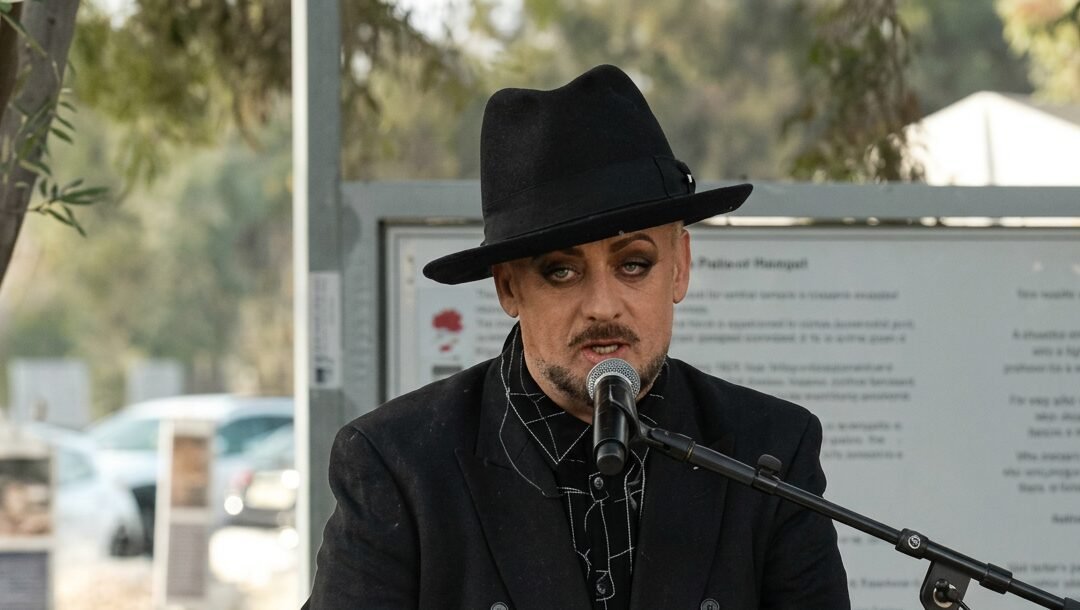
The Culture Club frontman visited the memorial near Kibbutz Re’im on November 3, touring the site with survivors and bereaved families before addressing a press conference moderated by former hostage Omer Shem Tov. The visit brought him to the place whose story inspired “We Will Dance Again,” a song he wrote after visiting the Nova exhibition in London. It also put him alongside the people he had been speaking about from abroad.
Boy George said the October 7, 2023, attack horrified him, but he was also disturbed by people who dismissed accounts of what had happened. “What horrified me more was hearing people that have no connection to what happened telling me it wasn’t true, that it was made up,” he said. Jewish friends with connections to Israel, he added, had quickly confirmed the reality of the attack.
Hamas-led attackers killed more than 360 people at the music festival and abducted dozens into Gaza, according to the background material distributed by the visit’s organizers. The site has since become a memorial bearing the names and photographs of those killed. Nova survivor Jennifer Sibida and Ofer Lior, a bereaved father and one of the memorial’s founders, led Boy George’s private tour.
For a songwriter accustomed to leaving room for interpretation, Boy George said “We Will Dance Again” required unusual directness. He had already written several songs about events in Israel and his reaction to other musicians’ comments. This one, he said, told the story plainly, without the secrecy or subtext he often preferred in his writing.
“As I was doing it, I was thinking, this is never going to get played on the radio,” he said. Commercial prospects were beside the point. “It really wasn’t about ‘what do I need to do to make my career better?’ It was about ‘what do I need to do about what I feel deeply inside.’” He identified the song’s clearest statement as its most important line: “If you’re ever confused, I stand with the Jews.”
Sylvan Adams, president of World Jewish Congress Israel, arranged the visit, and Live Nation Israel coordinated it in cooperation with Israel’s Foreign Ministry. Adams, who has brought international sporting and cultural events to Israel, described the invitation as both an expression of gratitude to Boy George and a welcome gesture for Israelis who feel isolated.
“At the same time, it’s a shot in the arm for us,” Adams told The Media Line. “We as Israelis, we do feel this isolation, and so to have somebody willing to stand up for us, to sing those beautiful words that he wrote, I must say I’ve listened to it a hundred times. It brings a tear to my eye every single time.” Adams said he wanted more artists willing to visit the country and express similar support.
We as Israelis, we do feel this isolation, and so to have somebody willing to stand up for us, to sing those beautiful words … It brings a tear to my eye every single time
Adams also used the gathering to explain his work bringing cultural events to Israel. “I believe sport, music, and culture are the most powerful ways to show the world the real Israel,” he said. As the son of Holocaust survivors, he had grown up hearing “Never Again.” He said October 7 reinforced his belief that those words had to carry a commitment to Jewish self-defense.

Boy George and Sylvan Adams at the Western Wall in Jerusalem, Nov 2, 2026. (Alon Levin)
Boy George traced his response partly to his upbringing in southeast London, where he remembered racism against Black and Asian people and receiving leaflets from the National Front, a neo-fascist party, as a young punk. He said his own experience of being treated as an outsider helped explain his identification with people facing exclusion. “As a gay man and as an outsider, I always feel connected to anyone that’s kind of pushed out.”
That position has brought disagreements with other musicians. Boy George said respect for someone’s work didn’t stop him from challenging their public statements. “If somebody is posting stuff that I disagree with, I will call them out, and I have called them out,” he said. He also acknowledged that some musicians were frightened to speak publicly and said he could accept that when they were honest with him about it.
Boy George said the criticism had even led him to examine a label he had not previously explored: Zionist. “In the end, I just put a thing up saying, ‘I’m a Zionist, get over it,’” he recalled. He said his biggest musical heroes had been supportive. Other relationships had strained, and hostile social media exchanges ended with him blocking people. “But I’m not lonely,” he added.
In the end, I just put a thing up saying, ‘I’m a Zionist, get over it’
Drawing a comparison with his own disagreement with the British government, Boy George said political criticism did not justify attacking an entire people. “I disagree with that government, but I don’t attack the entire race of people based on something that I’ve seen on CNN or on TikTok,” he said. He criticized the pressure to adopt positions because they had become fashionable, saying it often left little willingness to discuss differing views.
For Shem Tov, who was abducted from the festival and held in Gaza for 505 days, Boy George’s presence carried particular weight. Addressing the singer, he spoke about watching him listen to people recount their experiences during the memorial tour. “You could have chosen to stay away, but you chose to come,” Shem Tov said. “And I think that says a lot about who you are.”
The Re’im visit followed a day in Jerusalem, where President Isaac Herzog and first lady Michal Herzog hosted Boy George and Adams alongside released hostage Elkana Bohbot. Herzog presented the singer with a sculpture of red anemones inspired by the Nova memorial installations. Boy George also visited the Western Wall, where he spoke about his parents and prayed for peace, and toured the Museum of Tolerance Jerusalem’s “06:29—From Darkness to Light” exhibition.
Herzog’s welcome included criticism of the treatment of Israelis and Jews in the arts. In remarks released after their meeting, the president said cultural fields that should bring people together had instead become settings for discrimination. He thanked Boy George for his song and his public support, telling him: “You drew inspiration from the resilience and determination of so many Israelis who, faced with tragedy, chose life.”

Boy George with Sylvan Adams at the Western Wall, November 2, 2026. (Marc Israel Sellem)
Two concerts are scheduled at Tel Aviv’s Menora Mivtachim Arena, on November 4 and November 7. The second is dedicated to the Nova community and their families, with DJ Ofer Nissim as a special guest. Organizers said Adams and the Museum of Tolerance Jerusalem donated 1,500 tickets, which were transferred to the Tribe of Nova Community Association for distribution to survivors and bereaved families.
Boy George said “We Will Dance Again” would occupy a prominent place in the performances, even alongside the songs that made him famous. “Karma Chameleon,” he said, had been “pushed out of the way a little bit by this song, particularly here in Israel.” He had already decided which deserved the show’s biggest moment: “It feels like it’s the right song to make the highlight of the show. And that’s what I’m going to do.”
Source: Iwpost.com