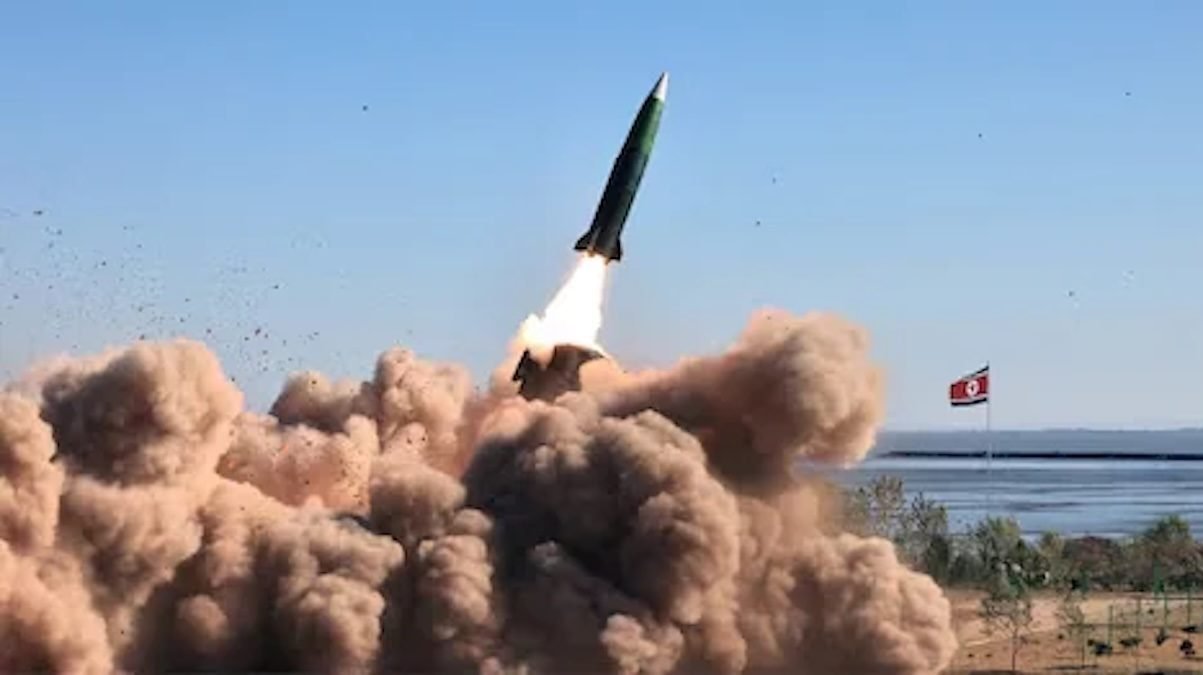
The significance of these developments cannot be measured simply by counting launches. What deserves greater attention is the diversification of North Korea’s weapons technology, particularly its experimentation with hypersonic systems, cluster warheads, artificial intelligence-assisted guidance, sea-based missile platforms and integrated air-defence capabilities.
The emerging pattern suggests that North Korea is attempting to transform its missile arsenal from a collection of individual weapons into an interconnected military system. This development has important implications for the military balance on the Korean Peninsula and the credibility of the US-South Korea security alliance.
Diversification at full speed
A closer examination of North Korea’s missile activities during 2026 reveals a systematic effort to diversify its military technology. Rather than concentrating exclusively on conventional ballistic missiles, Pyongyang is simultaneously experimenting with different delivery systems, warhead configurations and guidance technologies.
The testing program has placed particular emphasis on hypersonic weapons, including the Hwasong-11 Ma series, which reportedly incorporates maneuverable flight technology intended to complicate interception. North Korea has also tested its 600-mm super-large multiple rocket launchers, examining their accuracy, coordinated firing capabilities and operational effectiveness. These systems could provide substantial firepower against military installations and other fixed targets.
Another important development is the reported experimentation with cluster and mine-dispersing warheads for tactical ballistic missiles. Such weapons are designed to distribute destructive effects over wider areas, potentially increasing the vulnerability of South Korean airfields, military facilities and logistical infrastructure. Meanwhile, tests involving cruise missiles launched from the Choe Hyon destroyer indicate Pyongyang’s interest in expanding its maritime strike capabilities and creating additional launch platforms.
Particularly noteworthy are reports of experimentation with AI-assisted targeting, autonomous navigation and anti-jamming technologies. Although the operational maturity of these capabilities remains uncertain, their development suggests an effort to improve missile accuracy and resilience against electronic warfare. North Korea has also conducted combined weapons exercises involving ballistic missiles, cruise missiles, rockets and drones, indicating an interest in coordinating different weapons systems rather than employing them independently.
Taken together, these developments reveal a broader strategic ambition: to build a diversified missile architecture capable of delivering attacks through multiple trajectories, platforms and warhead configurations. This is a significant departure from an approach centred primarily on developing individual ballistic missiles.
Why so much focus on missile tests?
The fundamental explanation lies in the enormous conventional military imbalance between North Korea and the US-South Korea alliance, particularly in the air domain.
South Korea possesses one of Asia’s most technologically advanced air forces. Its inventory includes F-35A fifth-generation stealth fighters, F-15K multirole fighters, modernised KF-16 aircraft and FA-50 light combat aircraft. The F-35A combines low-observable characteristics, advanced sensors and sensor fusion, while the F-15K provides substantial air-to-ground and air-to-air capabilities.
South Korea also operates E-737 airborne early-warning aircraft, aerial refuelling tankers and reconnaissance platforms, enhancing surveillance, operational coordination and sustained air operations. Its indigenous KF-21 program further strengthens its long-term ambition to develop advanced domestic combat-aircraft capabilities.
These capabilities are complemented by American airpower stationed on the peninsula and available through regional deployments. The US Seventh Air Force operates F-16 fighter squadrons at Osan and Kunsan, supported by intelligence, surveillance, reconnaissance and command-and-control assets. The wider American regional arsenal includes F-35s, F-22s, strategic bombers, airborne early-warning aircraft, aerial refuelling tankers and long-range precision-strike capabilities. US naval aviation and aircraft carriers add another dimension to the alliance’s operational reach.
Together, these forces provide substantial advantages in air superiority, intelligence gathering, precision strikes, electronic warfare and integrated military operations. The alliance can also draw upon American capabilities elsewhere in the Indo-Pacific.
North Korea cannot realistically compete with this airpower through conventional aircraft development alone. Its economy, industrial limitations and international sanctions constrain its ability to acquire and sustain comparable advanced aviation capabilities. Its aging air force would face an exceptionally difficult challenge against modern stealth aircraft, sophisticated surveillance systems and precision-guided weapons.
Missiles therefore offer Pyongyang an alternative strategic instrument. They are relatively less expensive than building an equivalent modern air force and can threaten targets without requiring sustained control of the skies. Their mobility, concealment and diverse launch platforms also complicate pre-emptive targeting.
Consequently, missile warfare has become a central pillar of North Korea’s military doctrine. The objective is not necessarily to achieve conventional military superiority but to impose unacceptable costs on a superior adversary, complicate its operational planning and strengthen deterrence. In this context, technological diversification is a strategic necessity rather than simply an exercise in weapons modernisation.
What is North Korea testing right now?
Developments during the final days of October and the first week of November deserve particular attention.
On October 30, North Korea reportedly tested its 600-mm multiple rocket launcher. On October 31, it examined a cluster-bomb warhead designed for tactical ballistic missiles. On November 3, reports described testing of a dispersal warhead for a strategic cruise missile. On November 4, Pyongyang announced the testing of a new air-defence missile system alongside a long-range cruise-missile exercise.
The November 4 developments are especially significant. According to North Korean state media, the air-defence test examined target identification, tracking, guidance and the processing of detection information. Separately, a cruise-missile exercise reportedly involved a simulated airport target.
These developments suggest that North Korea is focusing not only on protecting its military infrastructure against the superior airpower of its adversaries but also on developing offensive capabilities to destroy South Korean airfields with precision-guided weapons within a short period of time.
The broader strategic picture is becoming increasingly clear. Pyongyang appears to be moving beyond the development of individual missiles toward an integrated weapons architecture combining different technologies and delivery platforms.
The possible combination includes hypersonic missiles intended to complicate interception, ballistic missiles carrying cluster warheads, low-flying cruise missiles, AI-assisted targeting, sea-based launch platforms and coordinated rocket and drone operations.
Such diversification could place considerable pressure on South Korea’s air-defence architecture, particularly during simultaneous attacks involving different trajectories and multiple launch platforms. South Korea’s multilayered defense architecture, including Patriot, Cheongung-II and the developing L-SAM system, provides important interception capabilities. However, defending against complex saturation attacks remains a demanding operational challenge.
The central focus of North Korea’s current strategy is no longer simply how many missiles it can launch. Rather, it is whether it can coordinate different weapons systems sufficiently effectively to overwhelm, confuse or delay the alliance’s defensive response. Clearly, Pyongyang is preparing for a major conflict that it believes will occur sooner rather than later.
Path to victory
North Korea’s military modernisation appears increasingly shaped by the recognition that it cannot win a prolonged conventional military campaign against the United States and South Korea. Its strategic calculation therefore rests on creating a situation in which the opening phase of a conflict produces sufficient disruption to prevent the alliance from exercising its full military superiority. This is where hypersonic and supersonic missiles assume a central role in its offensive strategy. Pyongyang appears to be guided by the principle that the best form of defense is offense.
The vulnerability of South Korean airfields, command centrers, surveillance installations and military infrastructure is particularly important in this context. If North Korea could destroy these assets in the first hours of a conflict, South Korea’s air superiority would be rendered ineffective. Pyongyang thus has strong incentives to develop capabilities that threaten the alliance’s ability to operate freely from the outset of hostilities
Missiles, cruise weapons, drones and other asymmetric systems offer different ways of challenging this superiority. Their combined employment could complicate warning, interception and the protection of critical infrastructure.
South Korea and the United States possess extensive intelligence networks, hardened military installations, dispersed operational capabilities, sophisticated missile-defence systems and substantial retaliatory forces. Nevertheless, the effectiveness of these capabilities against a large-scale, technologically diversified North Korean missile offensive has never been tested in an actual war. This uncertainty is reinforcing Pyongyang’s confidence in the possibility of achieving its strategic objectives and encouraging it to expand and further diversify its missile arsenal.
North Korea understands that South Korea is particularly vulnerable to these missiles because of its high population density and the concentration of much of its economic and industrial infrastructure within a relatively small geographical area. Even a limited number of successful strikes against critical infrastructure could produce consequences far beyond their immediate military impact and potentially lead to final victory.
Strategic warning
North Korea’s expanding missile capabilities are changing the strategic calculations on the Korean Peninsula. The traditional assumption that overwhelming US-South Korean conventional superiority would guarantee a decisive military outcome requires more careful re-examination. Technological diversification, nuclear deterrence, mobile launch platforms and growing military cooperation with Russia and China create additional complications.
Russia’s military experience and potential technological assistance, alongside China’s growing broader strategic and industrial relationship with Pyongyang, deserve particular scrutiny. Regional countries that value South Korea’s democracy, economic achievements and contribution to Indo-Pacific stability and prosperity – particularly India – have a responsibility to recognize the implications of this changing security environment and the shifting balance of power on the Korea peninsula.
The US–South Korea alliance remains indispensable, but it needs to be urgently complemented by broader regional military cooperation and stronger mechanisms for crisis prevention. Depending solely on the United States for the security of the Korean Peninsula or the broader Indo-Pacific region could prove costly, as the GCC countries have learned from the US–Iran war.
The time to act is today. Tomorrow may be too late.
Source: Iwpost.com