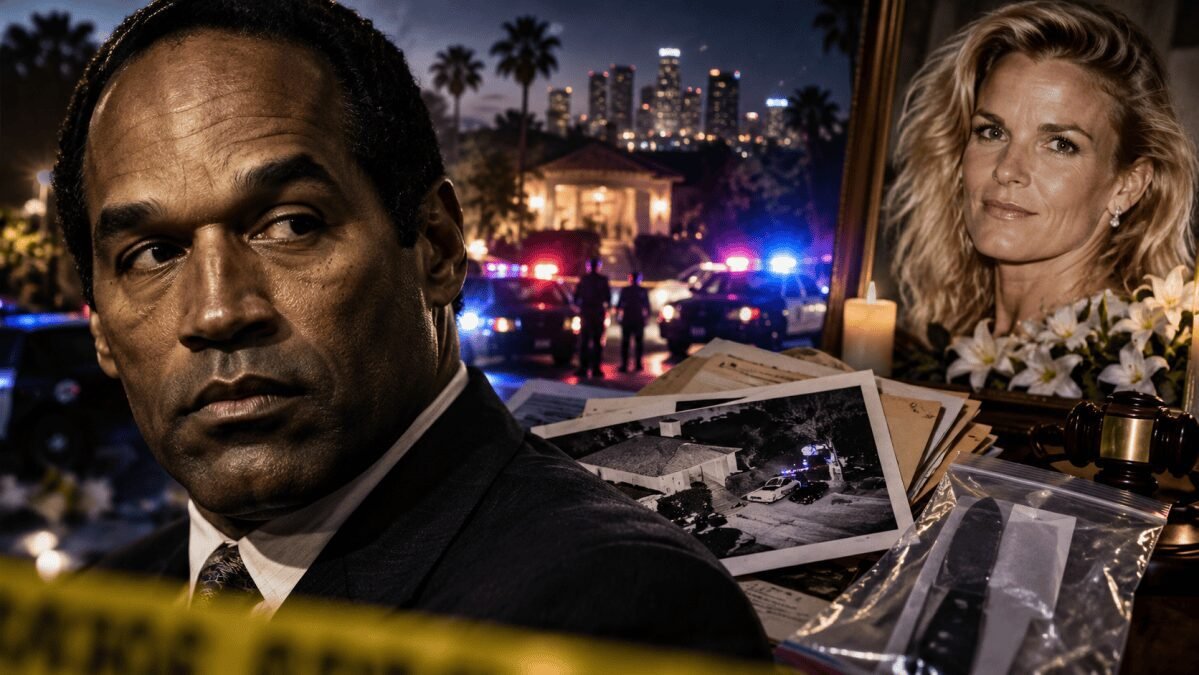
More than three decades after O.J. Simpson was accused of murdering his ex-wife and her friend, explosive revelations from previously sealed court records have reignited one of America’s most notorious murder mysteries — raising the possibility that someone in the former football star’s inner circle knew what happened to the missing murder weapon.
At the center of the stunning developments is Joseph “Joey” Ippolito, a mob-connected drug trafficker and federal informant whose alleged knowledge of the June 12, 1994, killings of Nicole Brown Simpson and Ronald Goldman has emerged in a new investigation by The New York Times.
The revelations include a disturbing account from Ippolito’s own brother, who initially claimed Joey returned home the night of the murders with what appeared to be blood on his hands and a mysterious bag containing a heavy object. The brother later retracted his account, leaving serious questions about its credibility.
According to newly unsealed federal documents, Ippolito provided authorities with information about Simpson’s alleged disposal of the murder weapon, which investigators never recovered. The records, however, do not establish that Ippolito participated in the killings or personally disposed of the knife.
The revelations have revived a question that has haunted the case for 32 years: Could someone have helped conceal crucial evidence?
Ippolito, who had connections to Simpson through his longtime friend Al Cowlings, became a government informant after his arrest in 1995. A December 1996 federal court filing described him as a valuable source who possessed information about Simpson’s alleged domestic violence, drug use, attempted flight from authorities and disposal of the murder weapon.
The filing indicated that his information had been shared with Los Angeles authorities during Simpson’s criminal trial. However, Ippolito was never called to testify, and the prosecution had already presented its case by the time the information surfaced.
Perhaps the most startling allegation came from Joey’s brother, Sam Ippolito, who told The New York Times that Joey left their Los Angeles apartment on the night of the murders to help a friend.
Sam initially claimed his brother returned around midnight with apparently bloodied hands and a heavy bag. He said Joey placed his clothes inside the bag before asking him to throw it away while he showered.
Sam reportedly discarded the bag in a dumpster near a construction site and later recalled overhearing his brother say he had been helping Simpson.
But the account contains a major complication. Sam subsequently denied making the allegations and insisted Joey had nothing to do with the murders. The Times reported that he attempted to retract his statements after the newspaper declined his request for payment.
There is no verified evidence establishing what was inside the bag, whether it contained the murder weapon or whether Joey was present at the crime scene. Joey died in 2006, leaving investigators unable to question him about the latest allegations.
The disclosures have also sparked disagreement among people closely connected to Simpson’s sensational trial.
Former lead prosecutor Marcia Clark told The New York Times that she had never received information about Ippolito and argued that she would have been informed if he had provided credible evidence relevant to the prosecution.
Former federal prosecutor David Kelley, who worked with Ippolito and described his cooperation favorably in the court records, also told the newspaper he did not believe Ippolito participated in the killings.
Meanwhile, Alan Dershowitz, a member of Simpson’s famous defense team, has questioned whether investigators were too focused on a single-suspect theory.
Dershowitz said he had long suspected that more than one person might have been involved and criticized prosecutors for failing to explore alternative explanations. He has called for an independent historical examination of the case, arguing that the public deserves a fuller accounting of what happened.
Adding another intriguing wrinkle is Simpson’s controversial book, If I Did It, in which he described a hypothetical account of the killings involving another person who helped him dispose of evidence. Simpson maintained that the account was fictional, and it does not establish that an accomplice existed.
Nicole Brown Simpson, 35, and Goldman, 25, were found murdered outside her Brentwood home in Los Angeles on June 12, 1994. Their deaths triggered a sensational investigation, the infamous white Ford Bronco police chase and a televised criminal trial that captivated millions of Americans.
Simpson was acquitted of both murders on October 3, 1995. In 1997, a civil jury found him liable for the wrongful deaths and ordered him to pay $33.5 million in damages. He maintained his innocence until his death in April 2024 at age 76.
Now, even with Simpson gone, the case remains officially open.
The Los Angeles Police Department confirmed that investigators remain responsible for pursuing credible new evidence because no one has been criminally convicted of the killings. Detectives have not announced a new suspect, arrest or breakthrough connected to the recently publicized records.
For Nicole Brown Simpson’s and Ronald Goldman’s families, the renewed attention also brings painful memories. Nicole’s sister, Denise Brown, told ABC News that she had heard claims involving Ippolito decades earlier and expressed no interest in revisiting the allegations.
The newly released documents do not overturn Simpson’s acquittal or prove that another person helped commit the murders. But they offer a fresh look at information that never reached the jury and a missing weapon that remains one of the case’s most enduring mysteries.
More than 32 years later, the question of what happened to that knife remains unanswered.