Months after the US and Israel launched Operation Epic Fury against Iran, the Strait of Hormuz remains largely closed. The UK chose not to get directly involved in the conflict. Nonetheless, it has been exposed to the crisis through record-high diesel prices as well as a spike in inflation.
This echoes an earlier crisis in the Middle East, as my recent research illustrates.
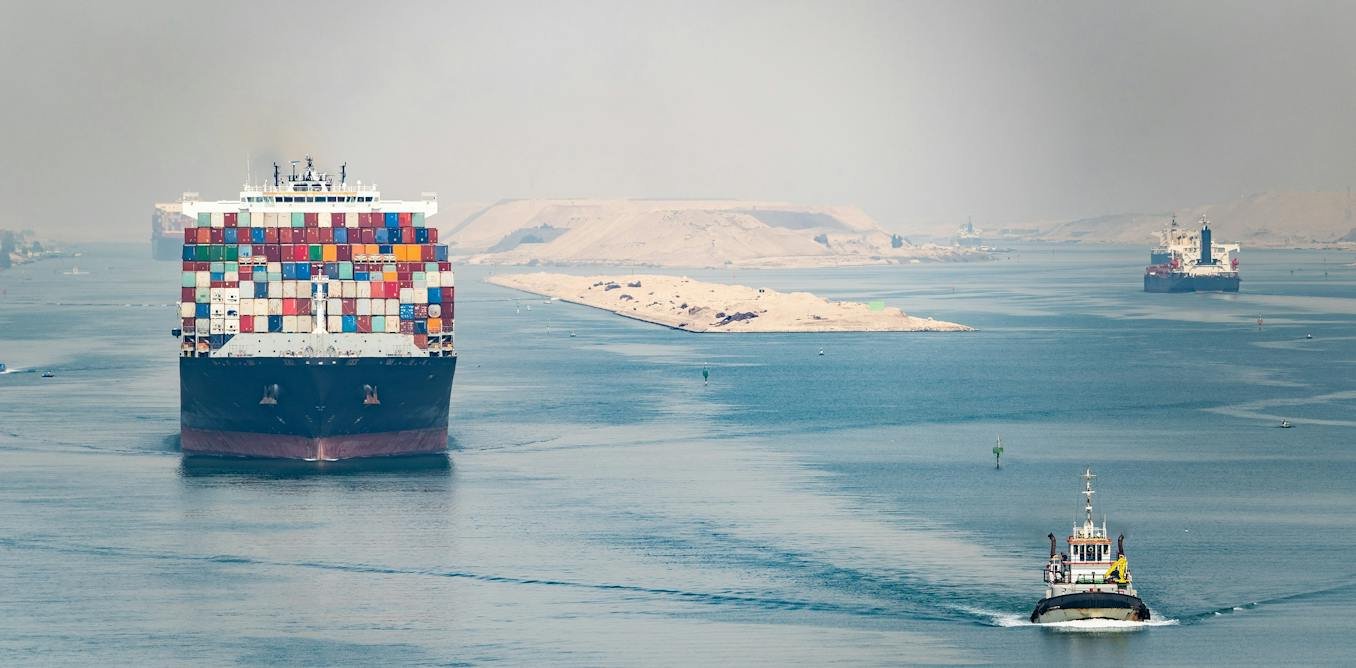
Seventy years ago, the Egyptian government nationalised the Suez canal, sparking the Suez crisis. The canal, which passes through Egypt from the Red Sea to the Mediterranean, was a vital link for ships travelling between Europe and Asia.
After its completion in 1869 by a French-led company, the Egyptian government held a 44% stake in it. However, financial difficulties forced Egypt to sell its shares to the British government in 1875, leaving Britain and France with substantial financial interests in the canal.
Following the Egyptian nationalisation of the canal, France and Britain – together with Israel – invaded Egypt in an attempt to regain control of the vital waterway. But the invasion was a spectacular failure that was condemned by the international community. The crisis came to symbolise Britain’s loss of superpower status.
Today, the US midterm elections are increasing the pressure on the Trump administration over the current conflict. Elections in Israel have also had some bearing on the conflict, with recent reports that Prime Minister Benjamin Netanyahu pushed for renewed strikes ahead of the election. Other reports suggest that the US and Israel have drawn up plans to resume strikes after the elections.
In 1956, US presidential elections were also an important part of the calculus. But back then, Britain and France had assumed that the elections would distract the US from their actions. This was a miscalculation. In communication with UK Prime Minister Anthony Eden the day after the vote, US President Dwight D. Eisenhower was clear that his administration would not tolerate the UK, France and Israel’s continued actions. He demanded a negotiated settlement through the UN.
The parallels between Suez and Hormuz go beyond the closure of two vital waterways. Both crises raise the same question: how far can geopolitical power outrun economic power?
Superpowers in decline
In 1944, the American foreign policy professor William T.R. Fox coined the term “super-power”. He defined it as the consequence of “great wealth, great population, and favourable geographic position”. This is similar to how the historian Phillips O’Brien defines great power today. Fox saw three superpowers at that time: the US, Britain, and the Soviet Union. He later acknowledged that including Britain had been a mistake, primarily because of its relative decline against the US and later the rest of Europe.
Arguably a similar shift is taking place today.
There are arguments over what is the best measure of an economy, but on the basis of purchasing power the shift is striking. China has moved from being a fraction of the size of the US economy in 1990 to being well ahead today.
In the 19th century, Britain was the dominant global power and benefited from what economists call “exorbitant privilege”. This was the ability to easily finance debt at favourable interest rates because sterling played a central role in the international monetary system. London was also the world’s leading financial centre.
But as Britain declined, this privilege gradually shifted towards the US. Its loss became particularly pressing during the Suez crisis as the pound came under intense pressure. Similarly today, there are signs of strain in the financial system that underpins American power.
During the Suez crisis, Britain’s currency weakness and dependence on American financial support constrained its ability to act independently, despite its considerable military power.
The crisis was also part of wider cold war geopolitics. An arms deal signed in 1955 between Egypt and the Soviet Union had upset the regional balance of power and contributed to Israel’s decision to get involved in a preventative war.
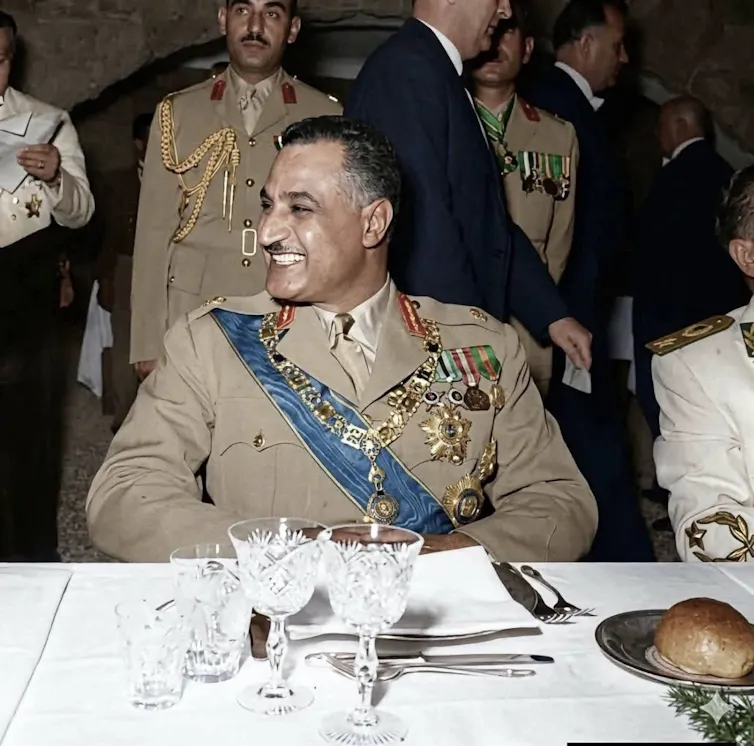
In response to the arms deal, the US withdrew financing for the Aswan Dam, a major infrastructure project on the River Nile. Then, in 1956, Egypt nationalised the Suez canal, sparking the crisis. British leaders sought to portray Egyptian president Gamal Abdel Nasser as a 1930s dictator, intent on regional dominance.
The US intervention in Iran has similar connotations. US secretary of war Pete Hegseth has presented the assassination of the Iranian leadership as necessary to prevent an existential threat from “America’s mortal enemy”.
Geoeconomics, the relationship between economics and geopolitics, also played a central role in the Suez crisis. The canal was a major conduit for Middle Eastern oil and there were fears that the nationalisation of the canal would disrupt UK oil supplies. But ironically, it was the decision to invade Egypt that led to a shortage of oil and fuel rationing in the UK.
The wider cold war was a key factor in the US stance on events. The US did not want to be seen to be condoning imperial actions in Egypt while condemning Russian imperialism in Hungary. Just as the Suez crisis needs to be understood in the context of the cold war, the current conflict should also be seen through the lens of “cold war II” geopolitics. Relations between the US and China have not thawed, while proxy wars bear similarities to the first cold war.
Today, the US is increasingly stretched, most clearly seen in the depletion of its munitions. These were already under pressure (in part because of its support for Ukraine) and have been further reduced by the war with Iran.
The Suez crisis illustrates how political leaders can be slow to appreciate the economic constraints on their geopolitical ambitions. The US today is not Britain in 1956, yet the conflict in Iran has prompted questions about the limits of American power. As its relative economic dominance is challenged, will the US also have to reconsider the extent of its global military commitments?