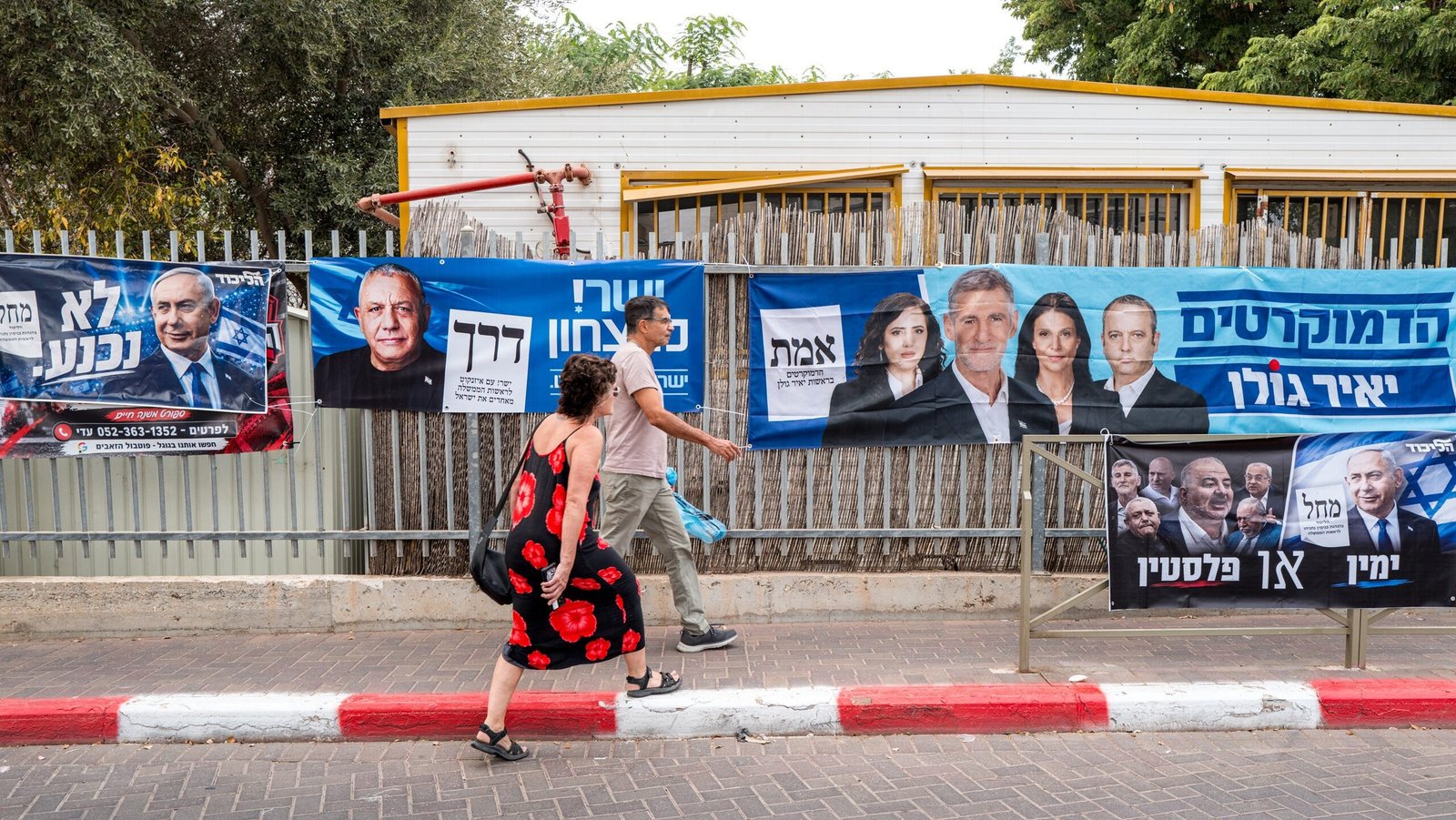
Israel has elected a parliament, but not necessarily a government. With 85.6% of votes counted Wednesday, Prime Minister Benjamin Netanyahu’s right-wing and ultra-Orthodox bloc was projected to win 53 seats, eight short of a majority. A four-party opposition bloc led by Gadi Eisenkot had 48, while two predominantly Arab parties were projected to hold a combined 19. The arithmetic suggests a way to unseat Netanyahu. The politics are another matter.
Keren Setton examines four possible outcomes of Tuesday’s election, beginning with the prime minister’s familiar skill at finding coalition partners where none seem available. Strategic adviser Roni Rimon believes Netanyahu may approach political adversaries, including former Prime Minister Naftali Bennett. Yet Bennett has ruled out joining a Netanyahu government, and crossing that line would require a spectacular reversal.
The opposition’s alternative looks stronger on paper. Its 48 seats, combined with 19 for the Joint List and Ra’am, would give Netanyahu’s opponents 67 lawmakers. Arab turnout reached an estimated 80%, helping deliver what could be their parties’ strongest combined representation. Joint List leader Yousef Jabareen has signaled willingness to help replace Netanyahu, while Ra’am leader Mansour Abbas is open to joining an Eisenkot-led coalition.
But Bennett and Yisrael Beitenu leader Avigdor Liberman oppose depending on Arab parties. Eisenkot has also imposed conditions on potential partners. A minority government backed by Arab lawmakers from outside the coalition remains possible, as Israeli parliamentary precedent shows.
A unity government presents a third option, though opposition leaders reject serving under Netanyahu. His far-right partners, disputes over military conscription, and the prime minister’s corruption trial add further complications. University of Haifa professor Eran Vigoda-Gadot dismisses a Netanyahu-Eisenkot deal outright.
Then comes the fourth possibility: another election, potentially in early 2027. Israel held five between 2019 and 2022. Roughly 600,000 special ballots still awaited counting Wednesday, and official results are due by November 4.
In Setton’s interviews, the competing forecasts expose how much hinges on decisions rather than numbers. President Isaac Herzog has urged party leaders to approach coalition talks with an open mind. Failure would leave Netanyahu governing as caretaker, and Israelis facing yet another trip to the polls.