After two months of discomfort, a man in South Korea went to an eye clinic where doctors pulled 11 living, wriggling worms from his eyes. They apparently made the most of their time on the man’s peepers; at the time of extraction, many of the female worms were pregnant. The man narrowly avoided having them spew their loads of living larvae directly into his eyes.
The man in this case was a 71-year-old crop farmer. He told doctors that for the previous two months he had the sensation of having something stuck in both his eyes, which were also red and blurry. When ophthalmologists took a look, they quickly saw the problem: multiple mobile, whitish roundworms. His eyes were not in good shape either, as one might expect. The blood vessels in the membrane over the eye, the conjunctiva, were enlarged, making his eyes look red. And the cells of his cornea—the transparent, dome-shaped outer layer of the eye—had eroded, potentially after the helminths’ hanky-panky.
According to a case report published in the New England Journal of Medicine, the doctors gave the man a topical treatment to numb his eyes and then began plucking out the worms one by one with fine forceps. They collected 11 adult worms, which ranged in size from 11 to 22 mm.
Examining the worms under a microscope, the doctors identified them as Thelazia callipaeda nematodes, which are widespread across Asia and have also established in parts of Europe. These parasites primarily infest the eyes of cats and dogs but can sometimes make their way into human eyes inadvertently.
The worms’ life cycle depends on flies that feed from the animals’ eyes, slurping up tears and secretions. When they feed from an infested eye, the flies can pick off the worms’ first-stage larvae, which use the insect as both an incubator and an air taxi. Inside the fly, the larvae molt twice, becoming third-stage larvae, which then migrate to the fly’s mouthparts and await the next stop at a suitable watery eyeball. The larvae disembark their flying nannies and take up a permanent peeper residence, where they develop into adults after one more molt. Adult worms then live and mate directly on a victim’s eyes.
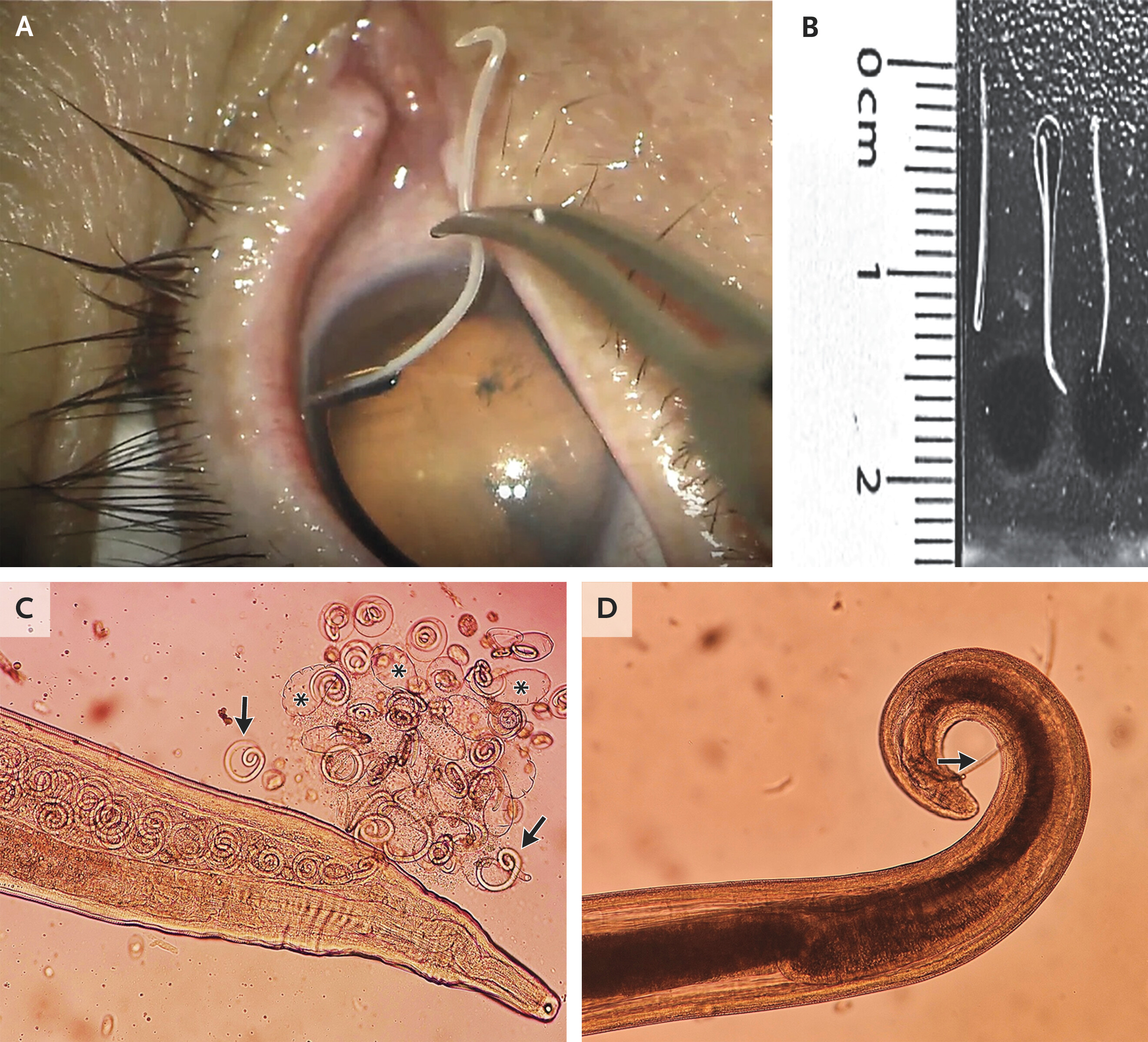
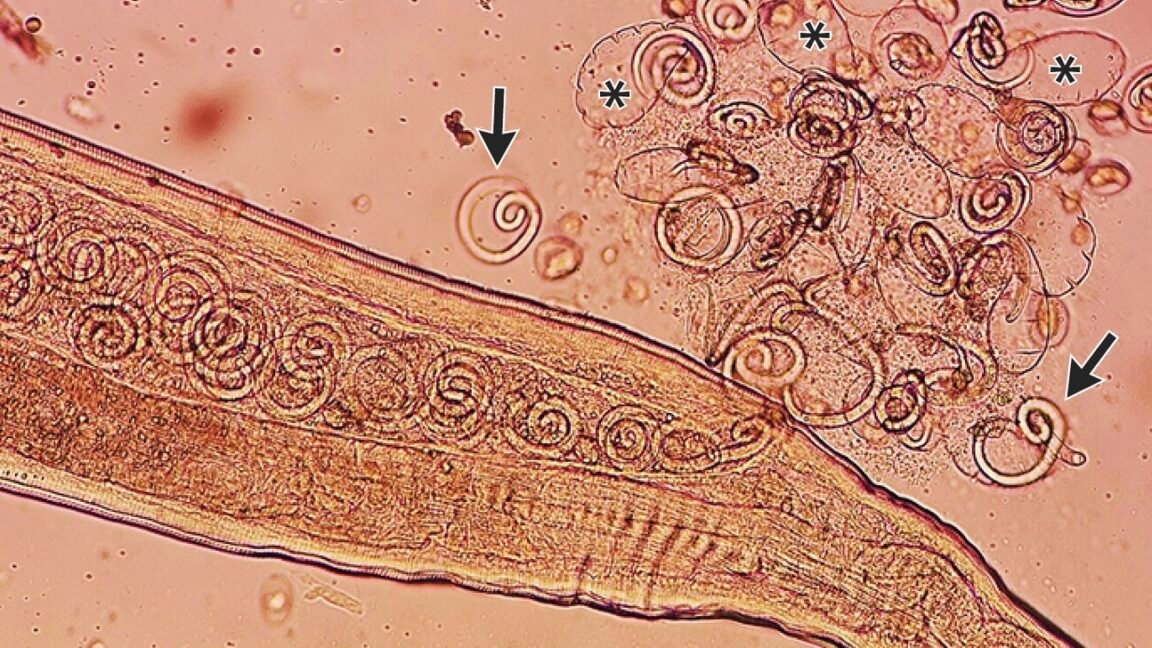
Unlike other worms, female T. callipaeda are ovoviviparous, meaning that embryos develop within eggs inside the female worm’s body. Females release large broods of densely coiled first-stage larvae, which await being lapped up by a thirsty fly.
Some of the female flies pulled from the man’s eyes were plump with embryonated eggs. Doctors noted that coiled larvae began bursting out of some of them after they were pulled from the man’s eyes. The male worms, meanwhile, were identified by their copulatory spicules, needle-like structures used to facilitate mating.
Luckily for the man, having all of the adult worms plucked from his orbs meant the infection was over—no antiparasitic medication required, even if some of the larvae had been left behind. At a follow-up appointment two months later, doctors noted that all his eye symptoms had resolved and there were no more worms.